The late former President Lee Teng-hui famously stated in a 1999 interview with Deutsche Welle that cross-strait relations were a 'special state-to-state relationship'—a concept known as the 'two-state theory.' According to Lin Hsiao-t’ing, a researcher at the Hoover Institution at Stanford University and Director of East Asian Collections at the Hoover Archives, this 'two-state theory' was actually an extension of the idea of the 'Republic of China on Taiwan,' which eventually evolved into the notion of 'mutual non-subordination.'
Lin has uncovered that in 1990, Lee Teng-hui wrote a letter to then-U.S. President George H. W. Bush, in which he explicitly mentioned the 'Republic of China on Taiwan.'
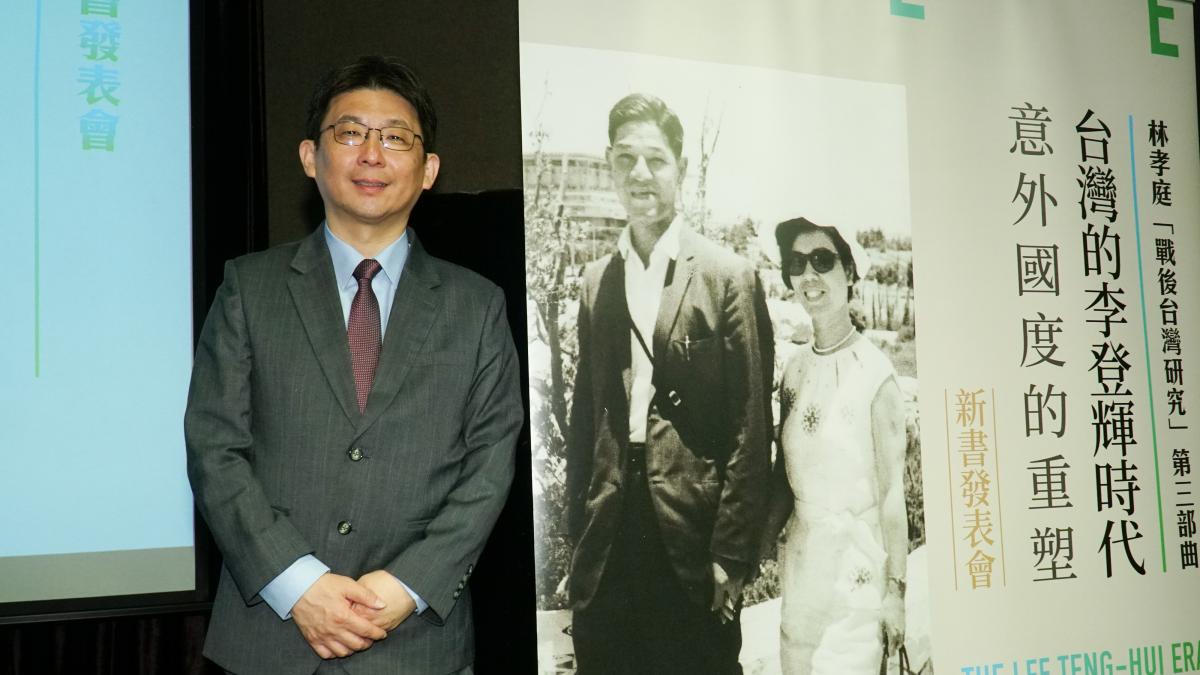
Lin Hsiao-t’ing, a researcher at the Hoover Institution and Director of East Asian Collections, launched his new book, *The Era of Lee Teng-hui in Taiwan: Remaking an Accidental Nation*, at a book launch event on July 22. Attendees included Foreign Minister Joseph Wu, former DPP Chairperson Hsu Hsin-liang, former Taipei County Magistrate You Ching, Director of the National History Museum Chen I-shen, and Chairman of Pegatron Corporation Tung Tzu-hsien.
Born in Taipei in 1971, Lin Hsiao-t’ing graduated from National Taiwan University’s Department of Political Science, earned a master’s degree from National Chengchi University’s Institute of Diplomacy, a D.Phil. from the Faculty of Oriental Studies at the University of Oxford, and was a postdoctoral researcher at UC Berkeley’s Institute of East Asian Studies. He has also been a Kiriyama Distinguished Visiting Scholar at the University of San Francisco’s Center for the Pacific Rim and a Fellow of the Royal Asiatic Society of Great Britain and Ireland. Since 2007, Lin has served as a research fellow at Stanford’s Hoover Institution, and since 2010, he has also served as Director of East Asian Collections at the Hoover Archives. His recent research focuses on postwar Taiwan’s political and diplomatic history, Taiwan-U.S. and cross-strait relations, and Cold War history in East Asia.
From right: Foreign Minister Joseph Wu, former DPP Chairperson Hsu Hsin-liang, former Taipei County Magistrate You Ching, and National History Museum Director Chen I-shen attend the book launch. (Photo by Tsai Chin-chieh)
At the event, Lin delivered a speech introducing the content of his new book.
Lin Hsiao-t’ing stated: 'In the early 1990s, Lee Teng-hui established concepts such as the National Unification Council and the National Unification Guidelines. As a scholar, Lee held firm ideals. After reviewing countless archival documents, I believe Lee genuinely believed that improving cross-strait relations and expanding Taiwan’s international space could proceed simultaneously without contradiction. That’s why Lee even sent envoys to East Germany and West Germany to study seriously how, in 1972 and 1973, the two German states were able to join the United Nations simultaneously, recognize each other, maintain diplomatic relations with other countries, and yet not rule out the possibility of future unification. For Lee, this was something he deeply wanted to understand.'
Lee’s 1999 'two-state theory' was, in fact, an extension of 'ROC on Taiwan,' eventually becoming 'mutual non-subordination.' A document in the George H. W. Bush Presidential Library shows that on September 7, 1990, during the Gulf War, Lee wrote a letter to President Bush expressing good wishes. At the time, Lee’s power was not yet fully consolidated, and struggles between the mainstream and non-mainstream factions within the KMT were ongoing. Yet in that letter, Lee wrote: 'I would like to reassure you Mr. President that the Republic of China on Taiwan will as always continue to work with you.'
Thus, as early as the beginning of 1990, Lee had already mentioned the concept of 'Republic of China on Taiwan'—not for the first time during his 1995 visit to Cornell University. This is our new discovery. We can see how pragmatically Lee handled cross-strait relations. The counterpart to 'Republic of China on Taiwan' is 'People’s Republic of China on the mainland.' In fact, this concept had already taken root in Lee’s mind as early as the late 1980s to early 1990s.
Günter Knabe, former Asia Department Director of Deutsche Welle, interviewed Lee Teng-hui in 1999. (Source: Deutsche Welle Chinese 50th Anniversary Review)
Later, Lee sought to visit Cornell University in the U.S. in 1995. The U.S. State Department, through the American Institute in Taiwan, asked Lee why he insisted on visiting at a time when cross-strait relations were improving, risking damage to those relations. Lee was furious and responded that it was he who first proposed abolishing the 'Temporary Provisions against the Communist Rebellion,' and had prepared to improve cross-strait relations, but the mainland side refused and continued to suppress Taiwan. The key point here is that the U.S. for the first time pressured Taiwan, forcing it to choose between improving cross-strait relations and expanding diplomatic space—suggesting both could not be pursued simultaneously.
Later, President Bill Clinton’s approval of Lee’s visit was actually influenced by personal emotions. At the time, Clinton was in Russia celebrating Victory in Europe Day, and Chinese leader Jiang Zemin treated Clinton with visible disdain. This led Clinton to believe that Lee’s reform achievements in Taiwan were undeniable. Thus, Clinton allowed Lee’s visit not based on grand U.S. strategy, but largely due to domestic politics and personal sentiment.
After Lee’s U.S. visit, cross-strait relations changed. Lee was naturally dissatisfied. He believed the visit had been pre-coordinated through Su Chi-cheng, the Presidential Office Director acting as a secret envoy, and the mainland’s response was, 'You go ahead, but we’ll still criticize you.' According to Taiwan’s Chinese-language records, ultimately, pressure from within the PLA, unhappy with Lee’s visit, caused Jiang Zemin to lose control, leading to missile exercises in the Taiwan Strait.
In October 1997, Chinese President Jiang Zemin visited the U.S. and met with Clinton at the White House. (AP)
According to U.S. National Security Council documents, after the Taiwan Strait missile crisis, the U.S. began reassessing its policy. They concluded that U.S.-Taiwan relations had become unbalanced—just because Taiwan had democratized and the U.S. was the leader of democracies didn’t mean unconditional support for Taiwan. The U.S. needed to return to its own national interests. The U.S. believed Taiwan should be pulled back into the 'One China framework' to maintain peace. The strategic goal was to prevent China’s collapse and ensure pragmatic factions within the Communist Party remained in power. If Lee continued traveling abroad, the pragmatic faction in China might be overwhelmed, leading to domestic instability.
Unfortunately for Taiwan, these assessments eventually became reality. After Clinton’s re-election, he visited China, and the U.S. and China jointly re-embedded Taiwan into the 'One China framework.' The four-year presidential term beginning in 1996 became the most painful period of Lee Teng-hui’s life.
FACT BOX
- Source: PR Times
- Category: News