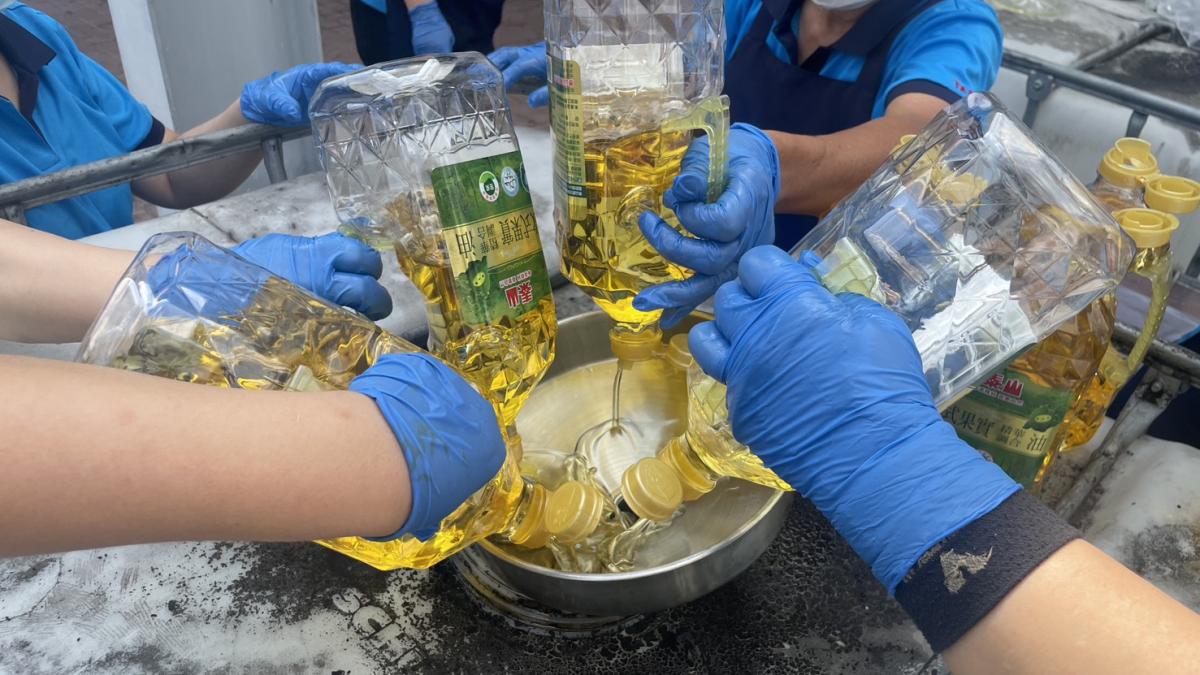
Carcinogenic substance benzopyrene was detected in Chunglien Oil, and the hidden report affected downstream factories across Taiwan. The Department of Health and Welfare's FDA established an investigation team and pointed out that Chunglien relaxed the "heat loss rate" standard for soybeans by 10 times last year, which may be the cause of this food safety storm. Legislator Lin Shu-fen pointed out that the FDA had issued a food safety management report for edible oil factories five years ago, pointing out management deficiencies, but this year, almost all the same problems were found in the Chunglien case. Lin Shu-fen posted on Facebook that the FDA had commissioned the Food Industry Development Research Institute to establish an investigation team to inspect Chunglien's manufacturing and quality management processes; Minister of Health and Welfare Stone Chiong-liang also pointed out that Chunglien relaxed the "heat loss rate" acceptance standard for soybean raw materials from 0.5% to 5% last year, which is equivalent to relaxing it by 10 times, and the oil refining process did not actually follow the originally planned control points for implementation. Lin Shu-fen pointed out that in other words, this problem is not just an abnormality in a certain batch of soybeans, nor is it just a one-time inspection failure, but from raw material acceptance, process control to quality management, systemic risks have appeared in all aspects. "This also makes us have to ask, why didn't the HACCP (Hazard Analysis Critical Control Point), which should play a warning role before shipment, block the problematic oil?" Minister of Health and Welfare Stone Chiong-liang (left) held a press conference on the 21st, pointing out that Chunglien relaxed the soybean heat loss rate standard by 10 times last year. (Data photo, Yan Linyu photo) What is HACCP? FDA's report warned 5 years ago HACCP mainly covers two parts: hazard analysis and critical control points. It is a preventive system that emphasizes the need to first analyze the possible hazards in the food manufacturing process and find critical control points in the process to control them during food manufacturing, so that hazards do not occur in the final product. Lin Shu-fen mentioned that in 2021, the FDA published a paper titled "Overview of Sanitary Management and Food Safety Control Systems in Edible Oil Factories" in the "Food and Drug Research Annual Report," which pointed out the weaknesses in the management of edible oil factories. The article reminded that edible oils have multiple quality indicators and cannot be judged by a single detection item. Subsequent inspections should be based on on-site evidence. In other words, "pre-control is better than final inspection." Lin Shu-fen bluntly said that looking at the Chunglien case, this sentence is particularly heavy, because by the time the downstream detects benzopyrene exceeding the standard, the products are recalled, and the government traces the source, the problematic oil has already entered the downstream systems of Fusu, Fuma, Taishan, and then flows to household oil, business oil, blended oil, food processing, catering, catering, and even school and institutional catering. Lin Shu-fen emphasized that the Chunglien case truly exposed not only the final product testing exceeding the standard, "but the pre-control did not play a role before the problematic oil was shipped," HACCP is not a formal document requirement, but a pre-risk management mechanism for edible oil factories, focusing on finding possible hazards in raw materials, processes, storage, transportation, etc., setting critical control points, and through monitoring and corrective measures, so that risks are identified and handled before entering the market, rather than waiting for post-event testing and recall. Is this the first time a carcinogen appears? Chunglien has had high values since 2021 Lin Shu-fen pointed out that moreover, Chunglien's annual inspection data released on July 6 showed that PAHs (polycyclic aromatic hydrocarbons) are not the first time to appear, from 2021, 2022, 2023 to this year, there have been high values. Among them, on April 25, 2022, 4PAHs reached 8.7ppb, which was close to the monitoring value of 10ppb; on April 22 this year, benzopyrene reached 1.6ppb, which was also close to the limit of 2ppb. Lin Shu-fen said that this represents that the business has long known that the batch of soybean salad oil from Brazil has repeatedly detected PAHs, and it is not an accidental occurrence. In this case, the manufacturer cannot only look at whether a single inspection is over the standard, but should include the high values of previous years in the HACCP hazard analysis, and set truly effective critical control points for raw material acceptance, crude oil testing, refining and deodorization, oil tank pipelines, mixed batch sampling and product release; once the values are repeatedly high, the cause analysis, increased inspection, suspension of release and abnormal correction should be activated. Lin Shu-fen said that the supervision of the competent authorities cannot only look at whether the inspection report is qualified, but should look at the annual trend, batch differences from different production areas, monitoring data from various control points, changes from raw materials to finished products, whether the products have been shipped before the inspection results come out, and whether the downstream inspection is consistent with the upstream samples, otherwise HACCP is just a document review, not a real risk review. Democratic Progressive Party Legislator Lin Shu-fen said that the Chunglien case truly exposed not only the final product testing exceeding the standard, "but the pre-control did not play a role before the problematic oil was shipped." (Data photo, Chen Pin-you photo) Is the edible oil factory really up to standard? Lin Shu-fen: The inspection results were not taken as a warning Lin Shu-fen mentioned that more seriously, the FDA's research in 2021 had already pointed out that the initial compliance rate of HACCP in edible oil factories was less than 60%, common deficiencies included inconsistencies between process diagrams and on-site operations, hazard analysis did not cover all steps, hazard items were only briefly mentioned as "environmental pollutants," monitoring procedures did not match on-site operations, corrective measures were incomplete, and document records were not accurate. Lin Shu-fen bluntly said that these problems can almost all be found in this Chunglien case. "So, Chunglien Oil is not without systems or inspections, but the inspection results were not taken as warnings, and HACCP was not truly implemented in daily processes," the business saw the high values of previous years, did not go back to check the raw materials, processes, and shipment releases; the competent authorities also did not take these data as risk signals for continuous tracking during inspections. Lin Shu-fen pointed out that the FDA and local governments should answer whether the deficiencies found at that time were turned into a common focus for central and local inspections of edible oil factories after the 2021 research was published? After the re-inspection was passed, was it continuously confirmed whether the business implemented process control according to HACCP? Were problems such as inaccurate document records, non-specific hazard analysis, and incomplete corrective measures listed as high-risk indicators for subsequent inspections? Chunglien Oil Plant Area. (Data photo, Central News Agency) Lin Shu-fen pointed out the real problem of the Chunglien case Central and local governments knew about the deficiencies but did not respond Lin Shu-fen said that it takes more than one day to freeze three feet, and the Chunglien case is not a single accidental error in one link, but a systemic risk accumulated over a long period. From the high values of PAHs in previous years, the relaxation of raw material acceptance standards, to the process not being executed according to the originally planned control points, there have been signs of problems, but they were not taken as warnings; food safety is not just a matter of the central government publishing a research report and ending it, nor is it a matter of local governments completing a re-inspection and being at ease. Lin Shu-fen said that the central government knows the common weaknesses of the industry, and local governments grasp the actual situation of local businesses, and subsequent tracking and risk review should be continued, rather than waiting for the event to occur before finding that the business's process management and HACCP documents do not match. Lin Shu-fen emphasized that the real question about the Chunglien case is that the central and local governments have long known that there are common deficiencies in the HACCP of edible oil factories, why can they not ensure that businesses actually implement them in daily processes? Why did they still have to trace the source and find the cause only after the downstream detected benzopyrene exceeding the standard? More Wind Media Exclusive Insider News: · Did the culprit of the carcinogenic oil get caught? Chunglien relaxed the soybean standard by "10 times" Stone Chiong-liang: The oil refining process was not actually controlled · 19 batches of Chunglien oil returned to the shelves! Chiang Wan-an criticized the central government for being in a hurry Jiang Chi-mei also did not understand: What are they doing every day, up and down the shelves · Chunglien carcinogenic oil storm, who is to blame for the central and local governments? The author exposes this sentence of the Ministry of Health and Welfare: Lu Xiuyan smiled
FACT BOX
- Source: PR Times
- Category: 调查