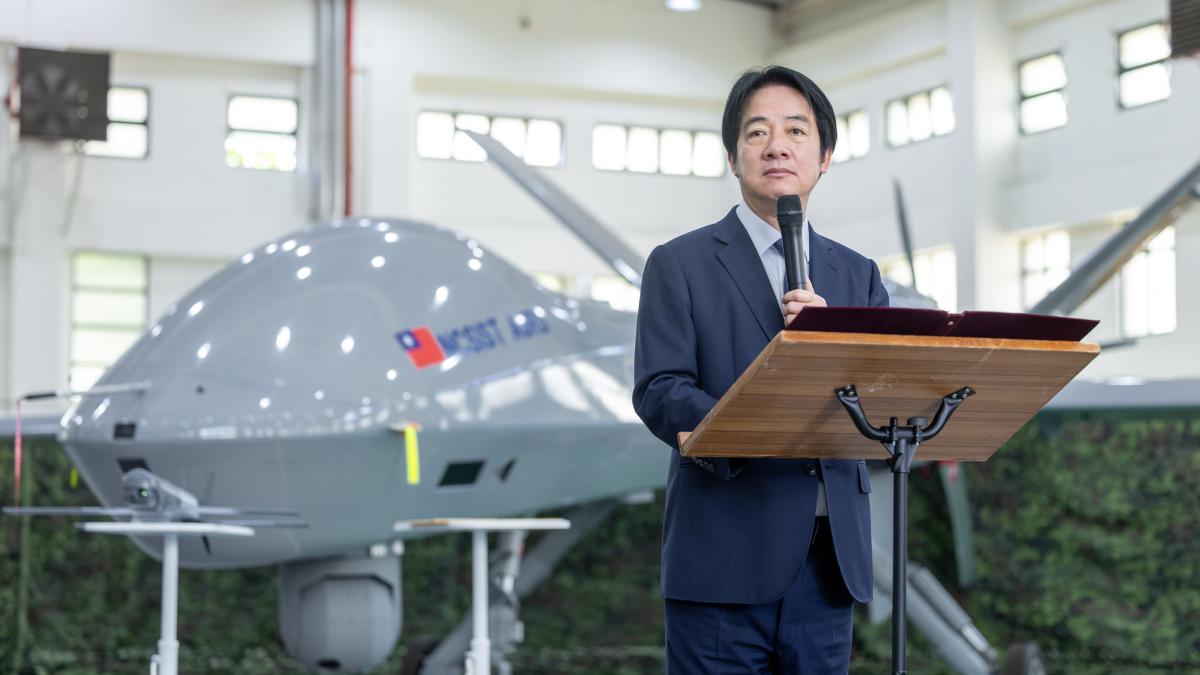
Drones have been extensively used on the battlefield in the Russia-Ukraine war, fundamentally altering modern warfare. Taiwan now aims to develop and produce military drones, with the Kuomintang and Taiwan People's Party proposing regulations on unmanned vehicles and drones, advocating for inclusion in the annual budget. However, the Democratic Progressive Party (DPP) argues that the Constitution stipulates budgets must be proposed by the Executive Yuan and approved by the Legislative Yuan, which cannot increase expenditures—thus, the opposition's drone-related bills may be unconstitutional.
Yet, the more the DPP promotes policies under the banner of a 'national team,' the more stringent oversight is required. Without transparent rules, massive budgets, subsidies, procurement contracts, and licensing systems could transform industrial support into favoritism for specific networks, turning national strategy into political patronage. This is precisely why the opposition parties must rigorously scrutinize drone-related budget proposals.
The debate over Taiwan's military drone development should not merely revolve around 'how many units to buy' or 'how much to budget.' It is a national project concerning defense resilience, industrial upgrading, and democratic oversight. The Russia-Ukraine war has proven that unmanned systems can alter battlefield dynamics—from reconnaissance and communication relay to precision strikes and depleting enemy air defenses and naval assets. Low-cost, high-volume, rapidly iterated systems are challenging the logic of expensive traditional platforms.
For Taiwan to convert this trend into real combat capability, political slogans alone are insufficient, and special budgets must not become opaque procurement black boxes. The key lies in centering development on operational needs, using scientific validation as a benchmark, instituting oversight to prevent corruption, and promoting efficiency through industrial competition.
In recent years, Taiwanese society has grown skeptical of so-called 'national team' policies. Whether in energy, vaccines, pandemic supplies, green energy, or other emerging industries, the public's greatest concern is not government support per se, but whether policy resources are monopolized by a few well-connected individuals. When a new company swiftly secures subsidies, contracts, or policy protection; when market competition is distorted by administrative power; when the government claims public interest while enabling specific firms to reap excessive profits—the term 'national team' becomes tainted.
The military drone industry is especially sensitive, involving national defense, information security, communications, semiconductors, image recognition, and dual-use technologies. If procurement and subsidy systems lack rigor, not only could waste occur, but national security vulnerabilities may arise. For example: Are component sources secure? Can software systems resist external infiltration? Do manufacturers possess mass production and maintenance capabilities? These cannot be judged by presentations, connections, or political correctness—they require professional, technical scrutiny.
Taiwan's first step in drone development should not be determining total budget size, but establishing a clear operational concept. Taiwan faces complex threats: coastal defense, gray-zone harassment, anti-landing, anti-blockade, and critical infrastructure protection. Therefore, drone development should be tiered, not blindly pursuing large-scale or high-cost models. The opposition lawmakers' warning that drone budgets 'must not become the next green cronies' treasury'—though sharply worded—reflects a serious concern: when the government invokes national security to deploy vast resources, the public has the right to demand every dollar be accountable.
Some may argue that strict opposition scrutiny slows drone industry development. This view is unfair. What truly hinders industry is not oversight but opacity; not questioning but corruption; not procedural rigor but misallocation of resources. If the public suspects from the outset that the 'national drone team' is merely a 'green cronies' team,' even excellent companies will be dragged down by political suspicion.
Drones could become a new opportunity for Taiwan's technological and defense autonomy—or the next breeding ground for scandals. The difference lies in whether systems are transparent, oversight is robust, and the ruling party is willing to be scrutinized. The opposition's duty is to guard this gate for the people. If the government is truly confident, it should welcome sunlight and accept review. An industry capable of flying high should not fear the light.
Military procurement fears two things most: mass purchasing before proper validation, and purchasing merely to spend budgets. Drone technology evolves rapidly; using traditional large-weapon procurement models with long-term fixed specifications risks buying outdated products. Taiwan should adopt a 'small-batch, multi-phase, rapid iteration' model. Testing standards must be concrete: range, endurance, wind resistance, electronic warfare resistance, data-link stability, night operations, maintenance time, unit cost, and production speed. These metrics can be partially classified but must not escape oversight entirely.
For the Legislative Yuan, oversight should not focus on technical details, but on whether procurement processes are fair, acceptance criteria exist, bidding is reasonable, and delivery is on schedule. Defense budgets are confidential, but confidentiality does not mean opacity. If the government seeks public support for high unmanned vehicle budgets, it must present a credible governance framework. Special budgets offer strategic flexibility; annual budgets ensure democratic oversight—each has pros and cons. What matters is not the label, but the oversight design.
A 'national team' must not become a 'patronage team.' In a democracy, defense urgency cannot justify bypassing constitutional procedures. On the contrary, the more significant the defense investment, the greater the need for procedural legitimacy. The Executive Yuan proposes budgets under the constitutional system; the Legislative Yuan reviews and supervises. This is the foundation of separation of powers. The legislature can demand information, cut or freeze unreasonable budgets, and legislate policy direction—but if it effectively compels the executive to increase specific expenditures, constitutional disputes may arise.
A more prudent approach is for the Executive Yuan to submit a comprehensive special or annual budget plan, with the Legislative Yuan attaching conditions such as annual reporting, phased budget release, performance indicators, and audit mechanisms—more constructive than simply claiming 'special budgets are black boxes' or 'annual budgets cause delays.' The value of drones lies in being 'cheap, fast, distributed, flexible'—Taiwan's procurement system should reflect these principles: small-scale prototyping, real-world testing, phased mass production, and continuous improvement. Budgets can be large, but not blank; needs can be classified, but not unverifiable; industries can be supported, but not turned into patronage.
Defense autonomy is not a pretty slogan for government spending—it is a serious promise to exchange taxpayer money for national survival. With proper institutional design, the drone industry could become Taiwan's next strategic pillar; with institutional failure, it could become another political slush fund. What Taiwan truly needs is not partisan budget battles, but a defense innovation system that reassures the public and allows companies to succeed based on technology.
Has the DPP government served the people or squandered their hard-earned money? To answer, we need only examine whether past policies have delivered tangible benefits to Taiwanese society.
1. Nuclear Power Plant No. 4 (NPP-4): Construction cost over NT$300 billion, nearly complete, but halted under Chen Shui-bian's administration. Policy reversals prevented commercial operation. This massive investment yielded no return and is widely seen as a key factor in today's power supply pressures.
2. Green Energy Policy: After scrapping NPP-4, the government aggressively promoted green energy to fill the gap. However, controversies arose over land use, environmental damage, and unfair benefit distribution. Specific individuals and firms gained huge profits through preferential policies. DPP-affiliated figures established multiple companies to win green energy contracts, while Taipower bought electricity at prices higher than retail rates—raising conflict-of-interest concerns.
Moreover, due to limited land, solar installations were placed on farmland, reservoirs, and slopes, sparking environmental and landscape concerns. Especially troubling is solar panels on reservoirs—wastewater from panel cleaning may affect water quality and public health. The government must publicly explain and accept societal oversight.
3. COVID-19 Vaccine Controversy: During the pandemic, the government supported domestic vaccine development for self-reliance. However, the Medigen vaccine faced public skepticism over emergency authorization, procurement procedures, and rollout timing. Over-supporting specific firms drove stock prices up, raising suspicions of favoritism. Medigen was not included in the WHO’s Emergency Use Listing (EUL) and remains unrecognized by most countries—making it a lasting social controversy.
4. Egg Procurement Scandal: In 2022, Taiwan faced an egg shortage. The government urgently imported eggs from abroad. However, Chao-Szu Company, with only NT$500,000 capital and no expertise in egg imports, won the Brazil egg contract—sparking public outrage. Later, massive quantities expired and were discarded, causing huge losses. The company’s CEO was eventually convicted in court. Questions remain about whether regulators fulfilled their oversight duties and whether political accountability should be assigned.
5. NT$1.25 Trillion Special Military Budget: The Lai Qing-De administration proposed this budget, raising concerns over lack of detailed disclosure—undermining the Legislative Yuan’s ability to conduct substantive oversight. Some suspect the government may use U.S. pressure to deter legislative scrutiny.
FACT BOX
- Source: PR Times
- Category: News