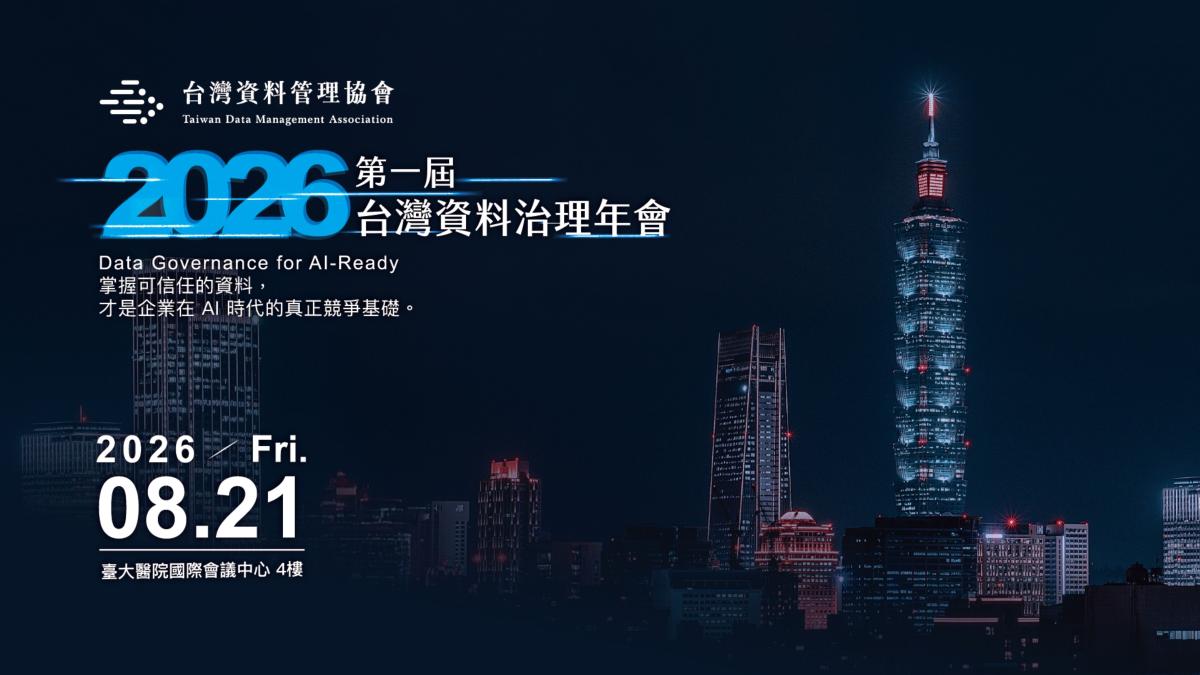
The AI wave is accelerating operational models across enterprises and governments worldwide, making data governance a key foundation for advancing AI applications and establishing digital trust. Organized by the Taiwan Data Management Association (TDAMA) and jointly promoted with Hewlett Packard Enterprise (HPE) and the Open Culture Foundation (OCF), the 'First Taiwan Data Governance Annual Conference' will take place on August 21, 2026. Under the theme 'Data Governance for AI-Ready,' the conference will bring together experts and technology leaders from industry, government, academia, and research for the first time, initiating in-depth dialogues across four dimensions: policy, legal frameworks, industrial practices, and technological development. This will establish a vital cross-sector platform for discussing data governance in Taiwan.
The Key to Scaling AI: Breaking the 50% Project Stagnation Barrier Through Data Governance
According to global authoritative research firm Gartner, as many as 50% of generative AI projects worldwide stall after completing proof-of-concept (PoC), primarily due to insufficient data quality, inadequate risk governance, rising costs, and difficulty in effectively validating business value. This highlights that AI adoption is no longer merely a race of models or algorithms, but a test of an organization’s ability to build robust data foundations and governance capabilities. As enterprises actively adopt generative AI (GenAI), ensuring data quality, minimizing governance risks, and establishing comprehensive data governance mechanisms have become critical for the large-scale deployment of AI.
As AI applications transition from experimental phases to real-world deployment, governments are advancing initiatives such as sovereign AI, the AI New Ten Major Projects, and the 'Artificial Intelligence Basic Act,' shifting AI development from a technological race toward institutional governance. The performance of AI models increasingly depends on high-quality, trustworthy, and governable data. Therefore, establishing a comprehensive data governance framework is becoming the cornerstone supporting AI innovation and industrial applications, making data quality, data sharing mechanisms, and governance systems key issues of shared concern for both governments and enterprises.
Breaking the Siloed Practice Blind Spot: TDAMA Unites Seven Sectors to Build a Cross-Domain Shared Ecosystem
Facing this pivotal battle for industrial competitiveness, Taiwan’s data governance must overcome the limitations of past 'siloed practices.' To this end, the inaugural board and supervisory members of TDAMA have specifically gathered practical experts from seven fields: academia, finance, retail, high-tech manufacturing, software, consulting, and data service startups. Through exchanges at this year’s conference, they aim to accelerate the establishment of data standards and formally elevate Taiwan’s data governance to a new phase of 'cross-domain collaboration and ecosystem development.'
Dr. Liang-Hsiu Yen, Chairman of the Taiwan Data Management Association, stated: 'The competition in the AI era is not just about models and computing power, but about the maturity of data governance. Only by establishing a trustworthy, manageable, and shareable data foundation can we truly unlock the value of AI. TDAMA aims to connect cross-domain professional expertise through the first Taiwan Data Governance Annual Conference, creating the most important exchange platform for industry. We seek to build consensus and a common language among industry, government, academia, and research, helping Taiwan establish a more mature, trustworthy, and implementable data governance foundation amid the AI wave.'
From Macro Strategy to Three-Track Implementation: Industry, Government, and Academia Co-Constructing a Holistic Roadmap
For the first time, this year’s conference focuses on a 'macro strategic blueprint,' comprehensively analyzing five core aspects: national AI strategies, technology risk governance, high-regulation practices in finance, international legal trends, and ecosystem challenges. The conference specially invites decision-makers and leading scholars from national security, academic research, and core industries to lead forward-looking dialogues. By integrating perspectives from cross-domain thought leaders, the event aims to provide a comprehensive analysis of global governance trends and offer clear guidance for Taiwanese organizations at a critical juncture of transformation.
Beyond macro strategy, the conference will deeply dive into concrete implementation pathways, featuring a specially designed 'Government, Enterprise, Technology' three-track parallel agenda. From the perspectives of public governance, corporate practice, and technical deployment, it will deeply share first-hand case studies and practical experiences across different scenarios. The organizers emphasize that this design aims to help participants integrate multidimensional perspectives of policy, industry, and technology within a single day, successfully translating the macro blueprint into actionable internal strategies. This enables attendees to gain key implementation insights that can be directly applied within their organizations.
FACT BOX
- Source: PR Times
- Category: Event