Taiwan's AI server supply chain is further embedding itself into U.S. manufacturing. Wistron (3231) officially launched its first U.S. manufacturing plant in Fort Worth, Texas, today (22nd), with a total investment commitment of $700 million. The facility is currently producing NVIDIA's (NASDAQ: NVDA) GB300 Grace Blackwell Ultra superchip and will subsequently begin manufacturing the next-generation Vera Rubin product. The plant will continue to expand its capacity this year, aiming to produce tens of thousands of advanced computing baseboards per month. The workforce, currently exceeding 500 employees, is expected to grow to 1,000 by the end of the year.
Wistron's Fort Worth D1 facility spans 324,000 square feet (approximately 30,100 square meters) and features two manufacturing units: one dedicated to GB300 production and another planned for Vera Rubin manufacturing. This strategic layout signifies that Wistron is not only meeting the immediate demand for Blackwell Ultra but is also proactively positioning itself for the mass production of NVIDIA's next-generation AI platform, becoming a key part of NVIDIA's 'in the U.S., for the U.S.' supply chain.
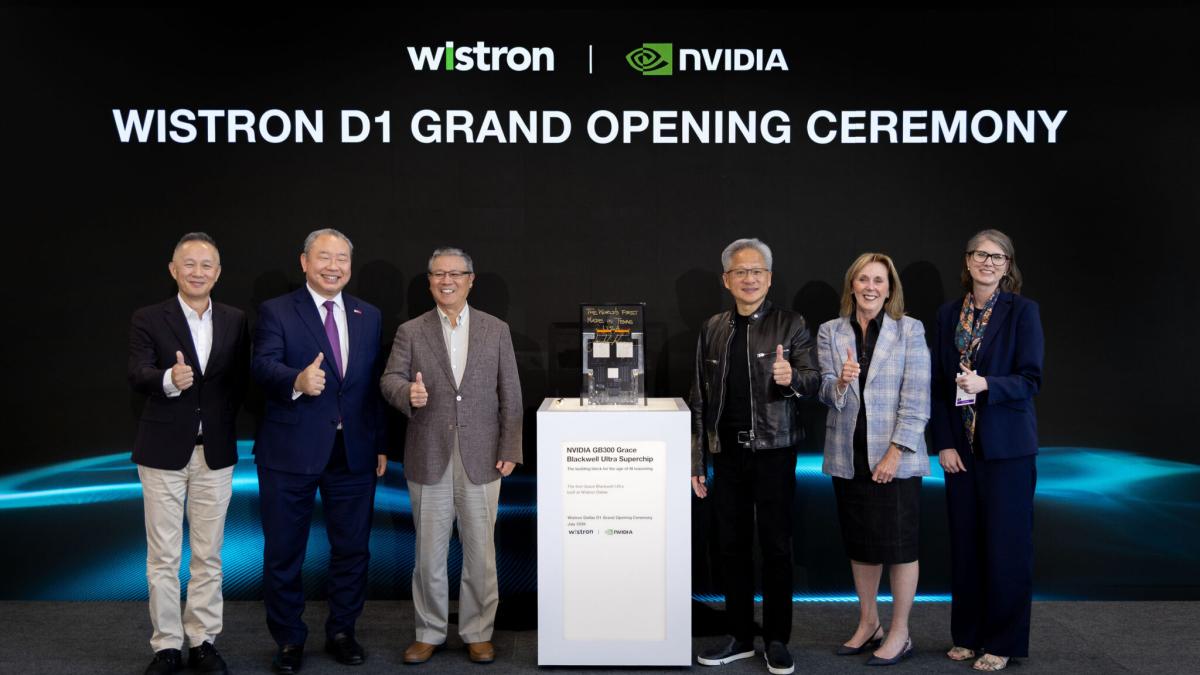
In the presence of Wistron's senior executives, Taiwanese government officials, and Fort Worth local leaders, NVIDIA's founder and CEO, Jensen Huang, and Wistron's Chairman, T.Y. Lin, jointly attended the plant's opening ceremony. The event showcased the first GB300 Grace Blackwell Ultra superchip produced at the facility.
The D1 plant currently houses two manufacturing units, with one production line dedicated to GB300 and the other preparing for Vera Rubin mass production. After the expansion is completed this year, the facility will produce tens of thousands of advanced computing baseboards each month.
The transition from GB300 to Vera Rubin highlights the accelerating pace of AI system product updates. For manufacturers, keeping up with NVIDIA's platform evolution requires not only increased production capacity but also the ability to quickly reconfigure production lines, integrate liquid cooling systems, test computing baseboards, and perform rack-level assembly.
Wistron's investment commitment to U.S. advanced manufacturing totals $700 million. The Texas facility has already created over 500 new jobs and plans to increase its workforce to 1,000 by the end of the year, covering fields such as construction, electrical engineering, manufacturing, and electricians.
Jensen Huang stated, 'Manufacturing is a critical pillar for every economy and nation.' He noted that the U.S. is simultaneously building chip fabs, packaging plants, computer system factories, and AI factories, giving the country a chance to achieve the long-awaited reindustrialization.
T.Y. Lin remarked that from a macro perspective of the entire AI industry, extending down to the community and national levels, this investment represents a new vision for development. He said, 'I believe we are entering the next era of AI-driven life, and I hope everyone can live happier and healthier lives.'
The complexity of AI system mass production far exceeds that of typical consumer electronics. Huang pointed out that a system built around the GB300 Grace Blackwell Ultra contains approximately 1.5 million components, weighs 2 metric tons, and has a value of $4 million per unit.
Huang stated, 'We are mass-producing these systems at Wistron just like producing smartphones, because the world needs these machines to drive intelligent infrastructure.' He described the system as the 'world's most powerful AI supercomputer.'
An AI system comprises not only GPUs and CPUs but also high-density computing baseboards, memory, high-speed networking, power conversion, liquid cooling pipelines, rack integration, and system testing. The ability to transform these highly complex and expensive devices into repeatable, large-scale production processes has become a new threshold for AI server contract manufacturers.
Before breaking ground on the physical facility in Fort Worth, Wistron used NVIDIA's open platform to create a digital twin to simulate the entire plant and manufacturing processes. The tools used include the Nemotron and Cosmos models, Omniverse and Metropolis libraries, and open frameworks like PhysicsNeMo.
Through the digital twin, Wistron's engineers were able to validate assembly line configurations, adjust production processes, and train employees on standard operating procedures before the physical equipment went online. This reduces the cost of reconfiguring equipment and workflows after the production line is officially launched.
This creates a unique industrial cycle: Wistron uses AI and digital twins to design the factory, and then this factory produces the systems that power global AI computing. AI applications are thus no longer limited to the final product but are now entering manufacturing processes, factory planning, and employee training.
NVIDIA has committed to manufacturing up to $500 billion worth of advanced AI platforms in the U.S., and Wistron's Fort Worth plant is a part of this initiative.
Huang emphasized that the AI era is not just about chips but extends from semiconductors and systems to the factories that produce them. He likened AI factories to foundational societal infrastructure like roads, agriculture, and railways, stating that in the future, data centers will produce tokens that power various applications simply by consuming electricity.
For NVIDIA, U.S. manufacturing encompasses not only final system assembly but also wafer fabrication, advanced packaging, servers, networking equipment, and AI data center construction. Wistron's move to establish a plant in the U.S. reflects how Taiwan's ODM supply chain must follow the demands of its North American customers, extending further from Asian and Mexican production bases into the U.S. mainland.
Wistron's Fort Worth plant's progression from GB300 to Vera Rubin illustrates how Taiwan's ODM manufacturers have upgraded their role in the AI industry—from traditional server contract manufacturing to the mass production of advanced computing baseboards, liquid-cooled racks, and complete AI systems.
Manufacturing in the U.S. helps companies get closer to North American cloud service providers and AI infrastructure customers, shortens delivery distances, and responds to demands for supply chain resilience and local manufacturing policies. However, higher labor and operational costs in the U.S., along with challenges in component supply, technical talent availability, liquid cooling infrastructure, and capacity utilization, will test manufacturers' cost control capabilities.
Therefore, the launch of Wistron's first U.S. AI manufacturing plant is not merely an overseas expansion plan but signifies that Taiwan's AI server supply chain has officially entered the U.S. reindustrialization process. As GB300 enters mass production and Vera Rubin follows, the key focus for the next phase will be how AI computing demand translates into long-term orders and profitability.
FACT BOX
- Source: PR Times
- Category: Event
- Organizations: NVIDIA
- Products / services: GB300 Grace Blackwell Ultra