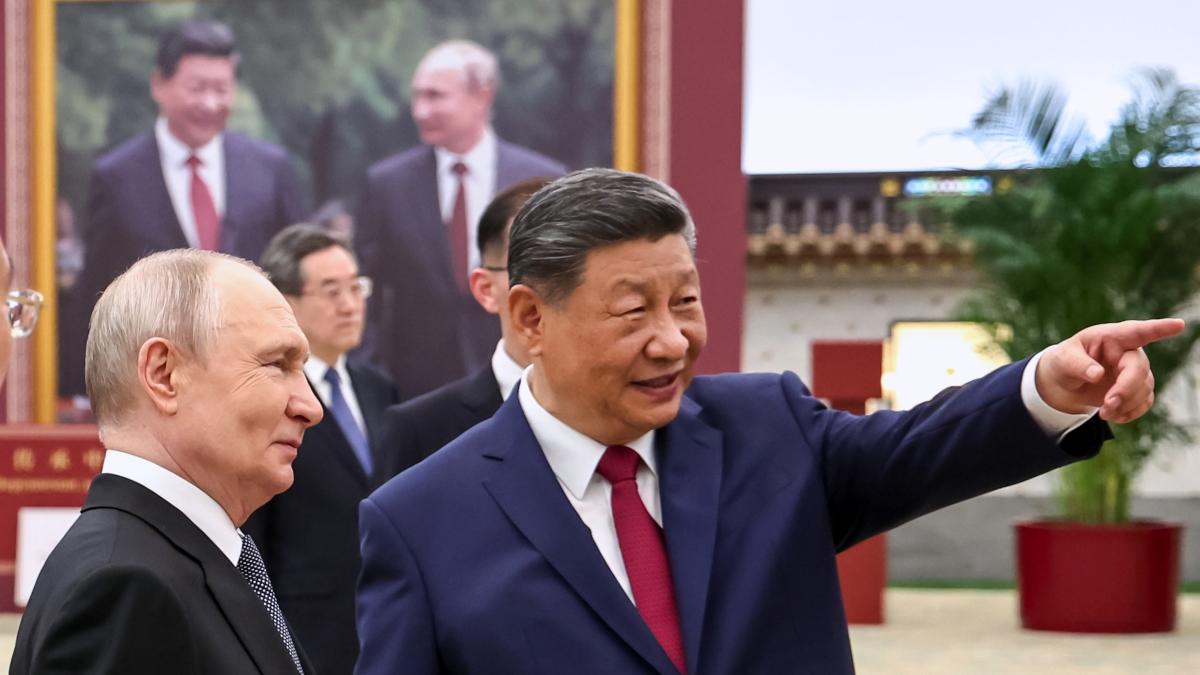
Xi Jinping once admired Vladimir Putin. Now, he is strategically balancing him. After four years of war and economic isolation, Putin has become the one who needs others. The relationship between China and Russia is becoming increasingly imbalanced, sometimes even tense.
Before Putin's 14th visit to China and his meeting with Xi Jinping, he had publicly hinted that the two countries would reach a breakthrough agreement in the energy sector. In fact, the core strategic goal of his visit in May was to persuade Xi Jinping to approve the second China-Russia natural gas pipeline. This pipeline, named 'Power of Siberia 2', has been planned for 20 years and is a lifeline for Moscow.
However, the Russian delegation that arrived in Beijing before Putin hit a wall. According to sources familiar with the negotiations, Chinese officials clearly told the head of the visiting Russian state-owned gas giant Gazprom that China would only sign the pipeline agreement if Russia sold gas to China at a price lower than the domestic market price. In essence, this means that China hopes Russia will provide subsidies for the project.
Sources say that to make their point, Chinese officials told the Russians not to bring up the matter unless the terms were changed.
A day later, Putin left Beijing with 42 signed agreements and joint statements. The pipeline agreement was not among them. China made no public explanation.
'Xi Jinping received Putin like an emperor in his own castle, then sent him home,' said Joerg Wuttke, a senior German corporate executive with extensive experience in Sino-Russian relations.
A few days before Putin's visit, Xi Jinping had just held a meeting with US President Trump in Beijing. Both sides positioned that summit as an equal dialogue between major powers. Trump called his Beijing trip 'G-2', short for 'two-country group'. China values this status but has not publicly accepted the label, fearing it would alienate the 'Global South', a bloc crucial to Xi Jinping's goal of reshaping the world order.
Indeed, there are no signs yet that the China-Russia strategic partnership is about to break down. On the contrary, since Russia's invasion of Ukraine, China's support for Russia has only increased.
China has maintained Russia's wartime economy: buying Russian oil at a discount, providing necessary components for Russia's defense industry, and providing financial infrastructure to help Russia counter Western sanctions. US and European officials have urged China to pressure Russia to end the war, but to little avail.
Xi Jinping seems to have learned from the lessons of the 1960s. At that time, the Soviet Union regarded China as a 'little brother', and its strong-arm tactics led to the breakdown of that early alliance. Now, Xi Jinping is very careful in public to give Putin strategic respect, but privately he is trying to extract concessions from him.
Still, this visit in May is not comparable to their first meeting in 2013. At that time, Xi Jinping chose Moscow as his first destination as China's top leader. According to sources familiar with the talks, Xi Jinping then expressed his admiration for this Russian leader, calling Putin his 'role model'.
Sources say that Xi Jinping then admired Putin's ability to occupy a seat at the world's top negotiating table, given that the Russian economy is highly dependent on oil and natural gas and is not as diversified as the US-China economy.
Now, the Ukraine war launched by Putin has not only mired Russia in a quagmire but also provided Xi Jinping with a strategic chip to complete a structural power shift that had been quietly underway - transforming the once near-equal partnership into a new configuration dominated by China in almost all dimensions.
China's Foreign Ministry, in response to The Wall Street Journal, said that China and Russia maintain close cooperation in areas such as energy, and the two countries' leaders have built 'high mutual trust and deep friendship'.
Kremlin spokesman Dmitry Peskov said any interpretation that sees Russia as a junior partner is wrong, as the relationship between China and Russia is 'based on the principle of equality. Both sides will take each other's interests into account.'
Although both sides describe the relationship between the two countries as 'unlimited', the foundation of this partnership is quite narrow. It is more based on the common strategic need to oppose the US-led international order, rather than shared values or culture. Now, this relationship is showing signs of tension.
This tension is at the heart of what foreign policy experts call the 'Reverse Nixon' bold initiative. The initiative attempts to offer the prospect of US investment to lure Russia away from China, just as former US President Richard Nixon in the 1970s used Sino-Soviet hostility to open up relations with China. In the early days of Trump's second term, Secretary of State Marco Rubio declared that the US could not allow Russia to become China's 'permanent junior partner'. But after Putin refused to end the Ukraine war, this idea died in the womb.
Russia has reason to feel disappointed, even wary, about its relationship with Beijing. China's data show that since the outbreak of the Russia-Ukraine war, bilateral trade between China and Russia has doubled, but most of the growth has been concentrated in the few years after Russia's invasion of Ukraine in 2022.
A large number of Chinese goods have flooded into Russia, making it difficult for domestic producers to cope. These imported cars, heavy machinery, textiles, and even chicken breasts are not only cheaper but often of better quality than similar products from Russian domestic enterprises.
The strong protests from Russian companies have caused political trouble for the Kremlin. After pressure from Sergei Chemezov, a former KGB colleague and friend of Putin's who is responsible for Russia's major defense enterprise group, the Russian government took measures to raise the price of Chinese cars to protect domestic car manufacturers.
'Competition is indeed fierce, but it is the engine of progress,' Kremlin spokesman Peskov said.
According to analysts and a person close to Russian intelligence agencies, the Russian side has recently frequently discovered that the Chinese side is engaged in espionage among mid-level officials in the Russian government. However, the Russian side has hesitated whether to make this public or negotiate with the Beijing side, fearing that this would damage the relationship between the two countries.
'Russia is very pragmatic in this relationship,' said Elina Ribakova, a senior researcher at the Peterson Institute for International Economics in Washington. 'They understand their position in the relationship with China.'
Now, Russia's need for China is obviously much greater than China's need for Russia.
In 2013, when Xi Jinping met with Putin, China accounted for about 10% of Russia's total foreign trade. Europe was still Russia's main economic partner. Currently, this ratio is close to 40%. China contributes about one-third of Russia's export revenue. In contrast, Russia's share in China's total foreign trade is still less than 4%.
Some analysts predict that although a memorandum of understanding was signed last year, China may never formally sign a 'Power of Siberia 2' agreement with Russia.
Their reasoning is based on some structural factors. Global natural gas supply is abundant, and China's natural gas import consumption is expected to peak in the mid-2030s. 'If they can get natural gas from any other country, why should they commit to building a pipeline that will take five or six years to build, thereby increasing their dependence on Russia?' said Joerg Wuttke, a partner at DGA Group based in Washington.
Meanwhile, Beijing is taking a wait-and-see approach, although recent US-Israel wars in the Middle East have given Chinese officials reason to re-evaluate the reliability of obtaining oil and gas from the region. 'It's best to keep the Russians on hold,' said Alexander Gabuev, director of the Carnegie Russia Eurasia Center, when talking about China's negotiation strategy. 'Wait for Russia's economic situation to deteriorate further, wait until the Russians are really desperate, and then let them accept terms favorable to China.'
This strategy has historical precedent. The first 'Power of Siberia' pipeline took 15 years of negotiations before China and Russia finally reached terms in May 2014. The agreement was signed just two months after Russia's annexation of Crimea. The annexation threatened Moscow's channels for obtaining European financing, and Russia was forced to make concessions in a years-long pricing stalemate. Although Russia successfully held the line and did not let its upstream assets fall into Chinese hands,
FACT BOX
- Source: PR Times
- Category: 国際関係