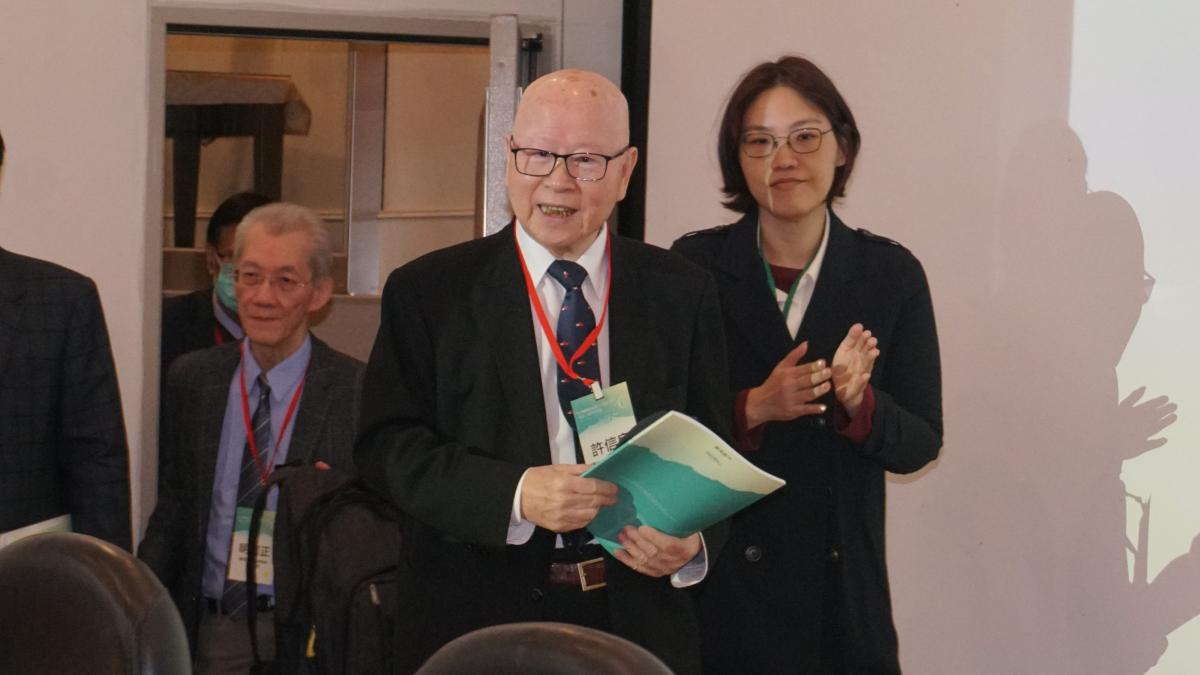
Former Democratic Progressive Party (DPP) chair Hsu Hsin-liang stated on July 22 that Chiang Ching-kuo's decision to promote and eventually appoint Lee Teng-hui as successor stemmed from personal motives. Chiang sought to cultivate a local political star with no power base to counterbalance the influence of regional factions within the Kuomintang (KMT). Appointing Lee as vice president was intended to reenact the role of Yen Chia-kan—a transitional figure—paving the way for Chiang Hsiao-wu to eventually succeed, though fate led history in a different direction.
Yen Chia-kan was elected vice president in 1966 and re-elected in 1972. After Chiang Kai-shek's death in 1975, Yen legally assumed the presidency until 1978, when Chiang Ching-kuo succeeded him. Chiang Hsiao-wu, Chiang Ching-kuo's second son, later served as Taiwan's representative to Japan during Lee Teng-hui's presidency. However, Chiang Hsiao-wu's succession plans were derailed by the 1984 Jiangnan Incident.
On July 22, Lin Hsiao-t’ing, research fellow at Stanford University’s Hoover Institution and Director of East Asian Collections at the Hoover Archives, launched his new book, "Lee Teng-hui’s Taiwan: Remaking an Accidental Nation." The event was attended by Foreign Minister Joseph Wu, former DPP chair Hsu Hsin-liang, former Taipei County Magistrate Yu Ching, Director of the National History Museum Chen I-shen, and Chairman of Pegatron Corporation Tung Tzu-hsien.
At the event, Hsu Hsin-liang offered insights into Chiang Ching-kuo’s motives for promoting Lee Teng-hui. He argued that Lee’s later-life destiny was deeply intertwined with Taiwan’s fate—had Chiang not recruited him, Lee would have remained an obscure mid-level technocrat. Chiang’s promotion of Lee appears inexplicable, Hsu noted, but in his view, it resulted from both destiny and Chiang’s personal agenda.
Chiang Ching-kuo, Hsu explained, was deeply insecure about power and wary of internal opposition. He disliked regional factions, particularly those aligned with then-vice president Hsieh Tung-min. To counterbalance figures like Hsieh and Lin Yang-kang, Chiang deliberately cultivated Lee Teng-hui, knowing he lacked local ties and a power base.
Chiang’s decision to appoint Lee as vice president was also self-serving. Chiang never abandoned his ambition for his son Chiang Hsiao-wu to succeed him. Aware of his limited time, Chiang sought another Yen Chia-kan—a placeholder—to buy time for Chiang Hsiao-wu’s grooming. Lee Teng-hui was thus intended to be that transitional figure. However, historical circumstances steered Taiwan onto a different path—one that, Hsu noted, has ultimately favored Taiwan.
On March 22, 1984, the late President Chiang Ching-kuo visited Lee Teng-hui’s residence in Taipei’s Da’an District to congratulate him on his vice presidential election (photo courtesy of the Presidential Office).
Hsu emphasized that more than half of Lee Teng-hui’s achievements were, in fact, achievements of the DPP. Without the DPP, Lee could not have overcome resistance from the KMT’s old guard. The old guard did not fear Lee personally but feared the DPP. It was the DPP’s presence that enabled Lee to prevail in internal KMT power struggles.
Direct presidential elections were originally a DPP initiative—Lee Teng-hui did not initially envision such a system. Even the National Affairs Conference was proposed jointly by Chang Chun-hung and Hsu Chu-yu to peacefully resolve student protests. Taiwan’s provincial government freeze and the shift to the current dual-executive system were also rooted in DPP policy proposals.
In 1990, Hsu participated in the National Affairs Conference. Many DPP members initially refused to attend, but Hsu believed that since a 'DPP member' had become KMT chair and president, they should support him.
In 1990, university students launched the Wild Lily student movement, demanding the abolition of the National Assembly and other reforms (photo from New Talk News).
Regarding Lee Teng-hui’s 'Two-State Theory,' Hsu noted that in 1997–1998, Chinese leader Jiang Zemin visited the U.S., followed by President Clinton’s visit to China, where he declared the 'Three Noes'—the U.S. would not support two Chinas, one China–one Taiwan, or Taiwan independence, nor support Taiwan’s participation in international organizations under its own name. This deeply harmed Taiwan and became a key rationale for Lee’s proposal of a 'special state-to-state relationship.'
Nearly 30 years later, history seems to repeat itself. President Trump also visited China and declared he would not support Taiwan independence or send troops to defend Taiwan—statements as baffling as Clinton’s. With Xi Jinping’s upcoming September visit to the U.S., concerns are rising.
Yet today’s situation differs from 28 years ago. Back then, both U.S. parties, Congress, and civil society viewed China as a strategic partner. Today, only Trump holds this view—U.S. bureaucratic institutions remain fundamentally anti-China. A president’s rhetoric is fleeting and ultimately insignificant.
Today, Taiwan belongs to the world. No one can abandon us. In short, as Lee Teng-hui often said: 'Don’t worry.'
FACT BOX
- Source: PR Times
- Category: News