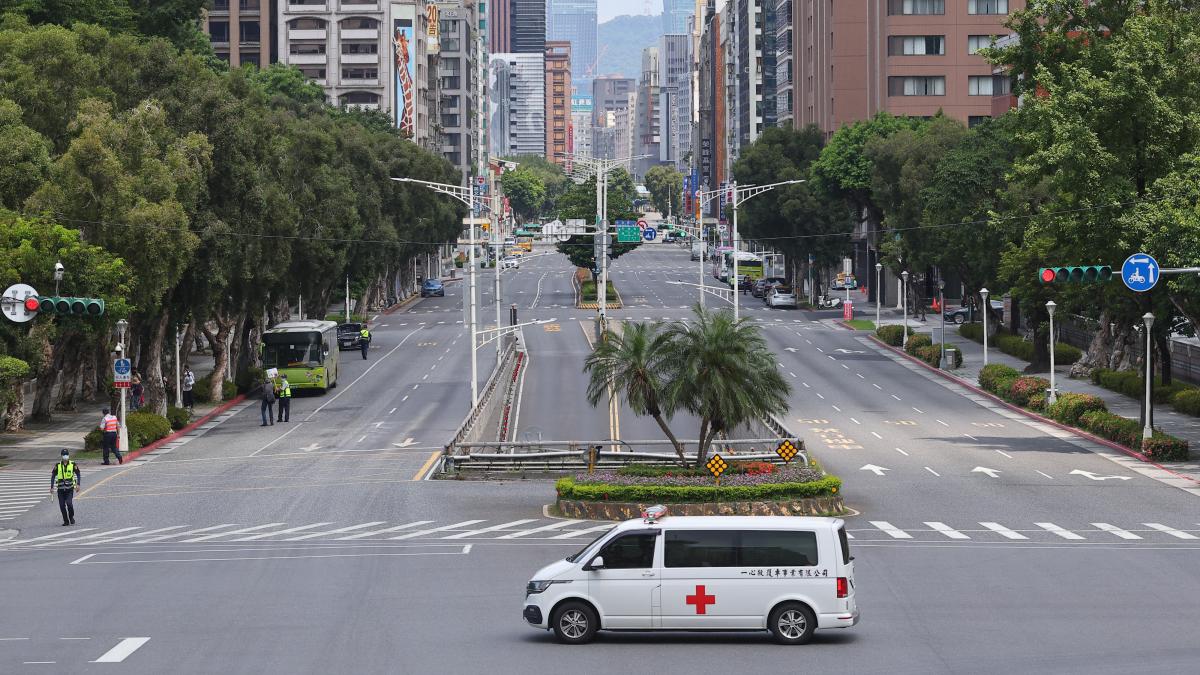
Taiwan's annual air defense drill will, for the first time, include a scenario testing 'mobile network disruption.' During the mid-August exercise, 14 counties and cities—including Taipei—will experience forced throttling of mobile data, retaining only voice calls and SMS services. Taiwan's authorities clarify this is not a complete 'internet blackout,' but a test of how the public can maintain communication and respond under bandwidth-limited conditions during war or disaster. This move signals a shift in Taiwan's defense mindset—from symbolic drills to realistic, multi-crisis simulations—with potential future inclusion of other digital threat scenarios.
How extensive is the 'network disruption'? The National Communications Commission (NCC) announced that, in coordination with the August Han Kuang Exercise's '2026 Urban Resilience Air Defense Drill,' mobile network disruption drills will be conducted in two phases. Phase one will occur from 2:30 PM to 3:00 PM on August 10, covering Miaoli County, Taichung City, Changhua County, Nantou County, Yunlin County, Chiayi County, and Chiayi City in central Taiwan. Phase two will take place from 2:30 PM to 3:00 PM on August 13, targeting northern regions including Taipei City, New Taipei City, Keelung City, Taoyuan City, Hsinchu County, Hsinchu City, and Yilan County.
During the drills, mobile networks (4G and 5G) will be throttled, with only voice calls and SMS services retained. High-bandwidth applications such as web browsing, LINE messaging, social media, video streaming, and video calls will be severely restricted or unavailable. Fixed-line networks (landlines) and Wi-Fi will remain unaffected.
The NCC emphasizes this is not a full 'internet shutdown' but a simulation of extreme scenarios where communication bandwidth is severely constrained during wartime or major disasters. The drill aims to test telecom operators' technical ability to implement network throttling under special conditions and to help the public experience how to access information and respond when internet connectivity is degraded. The full drill plan is expected to be officially announced on July 22.
The NCC states that the government and telecom providers have coordinated to maintain a 'minimum communication lifeline,' ensuring emergency calls and essential civilian needs remain functional. In short, people can still make emergency calls, receive SMS, and official alerts, but may not be able to use internet-based applications smoothly.
The exercise 'truly enters deep waters.' Taiwan's Defense Minister Koo Ji-hong stated that this mobile network disruption drill is a preliminary validation, integrated with the Han Kuang Exercise, primarily testing the military's command backup systems and overall societal functionality under communication constraints.
Presidential Office spokesperson Kuo Ya-hui noted that simulating communication disruptions is a common practice among democratic nations to enhance societal resilience, citing examples from Japan, South Korea, and the European Union, which conduct tests under cyberattack or power outage scenarios. She explained that the central and northern regions were chosen first because they account for about 73% of Taiwan's population and have the highest mobile usage density. Southern and eastern regions, which have prior experience with submarine cable breaks or typhoon damage, will be included progressively nationwide.
Chen Ling-chih, CEO of the Taiwan AI School, believes that using mobile communications in drills signifies that this exercise has moved beyond symbolic air defense drills and 'truly entered deep waters.' Huang Sheng-hsiung, former chair of the Asia-Pacific Network Information Centre (APNIC), stated that building digital resilience cannot be achieved overnight. Including mobile network throttling in urban resilience drills not only tests bandwidth limitations but also conveys a modern defense concept of communication redundancy and shared risk across society.
Earlier this year, Taiwan's National Security Bureau indicated that submarine cable damage has become a new form of 'gray-zone threat' by 'external hostile forces.' In the past three years, an average of 7 to 8 submarine cable breaks have occurred annually around Taiwan, with human-caused incidents accounting for up to 80%.
Que He-ming, Deputy Minister of Taiwan's Digital Development Ministry, told BBC Chinese that incidents of human-caused submarine cable damage have been increasing, including cases involving convenience vessels of unclear Chinese affiliations. A large-scale submarine cable disruption could severely impact societal operations.
Samuel Paparo, Commander of the U.S. Indo-Pacific Command, stated during a congressional hearing last year that China has repeatedly damaged undersea cables near Taiwan. While not direct military attacks, these actions may be carried out by civilian proxies or irregular forces to undermine Taiwan's communication infrastructure and destabilize the region.
Public and political reactions vary. The mobile network disruption drill has drawn criticism from both political and civilian sectors. Ko Yu-hsiang, a legislator from the opposition Taiwan People's Party, argued that if the urban resilience drill aims to simulate real warfare, it should test full internet shutdowns rather than throttling, to verify the ability to activate alternative communication networks and maintain minimal information access.
Ko Ju-chi, a Kuomintang (KMT) legislator, expressed concern that a full blackout would disrupt daily life and questioned the limited value of a 30-minute test. Another KMT legislator, Lai Shih-pao, suggested the exercise's concentration in specific areas may be politically motivated, creating a 'war shadow' for electoral purposes. Defense Minister Koo responded that air defense drills have always expanded regionally in stages and are not politically driven.
The Ministry of National Defense and NCC stress that the exercise is limited in scale—only 30 minutes—and impacts are manageable, with advance public notice to prepare citizens. Public reactions to the mobile throttling drill are mixed, with some supporting it and others viewing it as an inconvenience.
According to local media, Taiwan's three major telecom providers received a surge of customer service calls over the weekend, with users inquiring about affected areas and questioning whether monthly fees should be refunded if network services are unavailable.
Other key aspects of the urban resilience drill: Starting in 2025, Taiwan's government will merge the 'Wan An' and 'Min An' drills into a unified 'Urban Resilience Drill,' integrated with the Han Kuang Exercise to enhance 'whole-of-society defense resilience' against disasters or emergencies.
This year's urban drill includes five key focuses: integrating military-civilian scenarios with the Han Kuang Exercise, cross-regional coordination drills, testing evacuation and medical evacuation mechanisms, practicing underground medical operations, and validating drone-based supply delivery.
A major difference from previous years is the emphasis on 'military-civil integration,' requiring local governments to simultaneously respond to military and civilian needs, with military personnel stationed in local emergency response centers to improve information sharing and coordination.
These drills have been ongoing since April across multiple counties and cities and are highly integrated with the August Han Kuang Exercise's live operations. Chi Lien-cheng, a minister without portfolio at the Executive Yuan, serves as Deputy Chief Director of the exercise, emphasizing the use of 'scenario-based, no-script' methods to test joint command and response capabilities between central and local governments.
FACT BOX
- Source: PR Times
- Category: Event