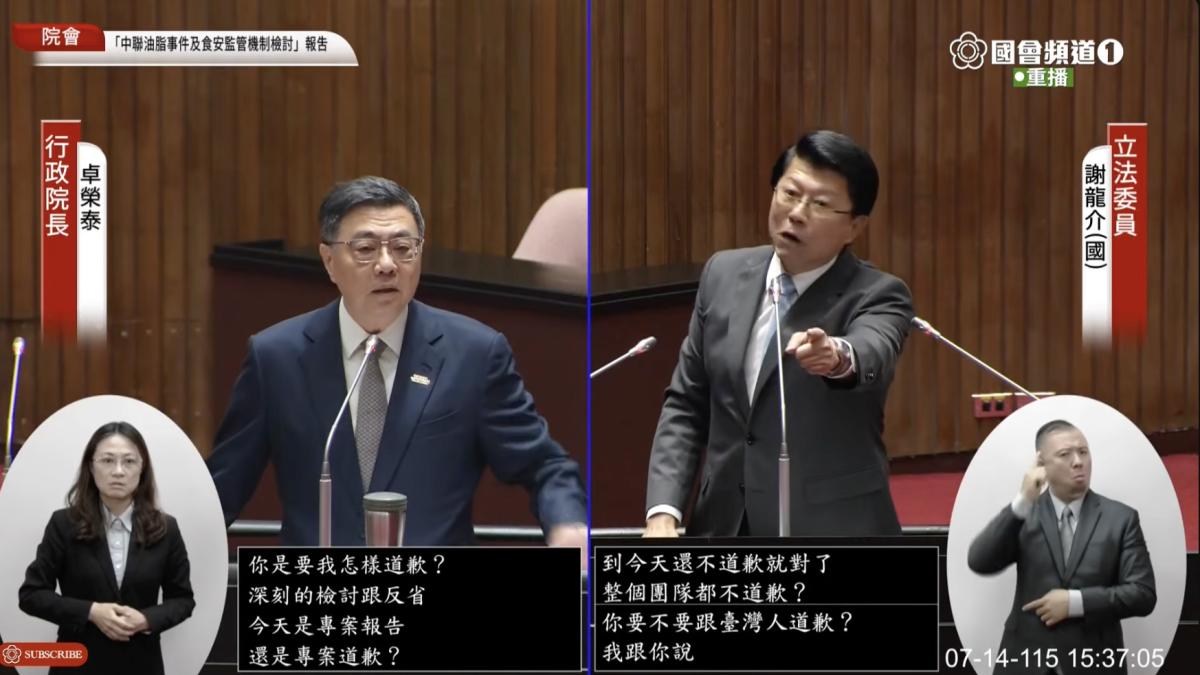
The benzene contamination incident involving Chunglien Oil's soybean salad oil, which occurred in mid-July 2026, once again highlighted the systemic food safety loopholes in Taiwan. Benzene is a Group 1 carcinogen that is not intentionally produced during the manufacturing process, and its silent entry into the consumer food supply chain exposed the fatal time lag in Taiwan's current food safety defense mechanisms in terms of 'risk warning' and 'traceability'. Facing high public outrage and social anxiety, Premier Chou Jung-tai declared that the amendment would be proposed within a week, and the opposition party's think tank also put forward a draft bill containing nine major amendment points, including '24-hour pre-reporting for initial inspection abnormalities', 'uploading food safety cloud data within 2 hours of shipment', and 'transferring the burden of proof to whistleblowers'. The rare legislative efficiency shown by both the ruling and opposition parties is certainly commendable; however, food safety governance is a precise science that combines public administration, industrial ecology, and legal logic. When politically declared quick-fix regulations clash with the complex reality of the industry, if legislators fail to discern the huge gap between the 'ideal model' and 'executive practice', the good intentions of the amendment may become an unbearable burden for grassroots administration, and even evolve into a survival crisis for small and medium-sized enterprises. The first test of policy implementation: the marginal effect of defensive reporting and grassroots administrative capacity The core of this cross-party amendment lies in advancing the defense line to a 24-hour golden blocking mechanism of 'reporting as soon as initial inspection abnormalities are detected', attempting to break the 'black box' of delayed time caused by repeated private confirmation by businesses. In risk management theory, this belongs to the typical practice of the 'precautionary principle'. However, from the practical perspective of public administration, this move will trigger a serious 'defensive reporting' effect. Inspection science itself has uncertainties, and initial inspection data is easily affected by instrument errors, sample inhomogeneity, or environmental noise interference, with a high false positive rate. Under the strong legal deterrence of 'not reporting will face heavy penalties', food businesses will inevitably upload all data on the edge of qualification, and even significantly misreported data, for self-protection. Although the draft bill stipulates that 'information is not disclosed during the reporting period' and that the competent authority must complete official re-inspection within 72 hours, this design undoubtedly pushes local health bureaus into the abyss of administrative overload. Taiwan's grassroots inspection manpower has been tight for years, and facing a deluge of 'initial inspection abnormalities' urgent cases, the 72-hour statutory deadline will produce enormous resource competition, not only possibly paralyzing routine market sampling inspections, but also possibly leading to a discount in the accuracy of official re-inspection reports due to time pressure, and even deriving huge national compensation risks. The hard landing of logistics digitization: the '2-hour post-shipment upload' and the disconnection of fragmented supply chains Similarly idealized is the requirement for businesses of a certain scale to 'complete electronic automatic uploading to the food safety cloud within 2 hours after shipment' of the technological fencing clause. This clause, while aiming to achieve 'precise and real-time' traceability, ignores the highly fragmented, multi-tiered, and flexible nature of Taiwan's food supply chain. Apart from a few businesses with complete ERP systems such as wholesale headquarters or listed food manufacturers, most of the midstream oil and fat traders and logistics core nodes in Taiwan still rely on traditional manual and semi-automatic management. Food logistics in actual transportation is full of variables, with on-site damage and rejection, temporary replenishment, and more returns than deliveries being the norm. Drivers and receiving parties usually make direct corrections on the waybill until late at night before returning to the factory for system settlement. Mandatory requirement of uploading within 2 hours means that frontline logistics field personnel must be equipped with expensive and high-frequency online mobile warehouse systems. If the government's 'food safety cloud' system has insufficient capacity, is disconnected, or the signal is poor in remote areas, law-abiding enterprises may be blamed for technical delays. This not only fails to strengthen the supply chain but may also stifle the 'flexible replenishment' advantage that Taiwan's food industry has long relied on. Legal balance and international alignment: the transfer of the burden of proof and the strategic thinking of localization In terms of legislation, the draft bill introduces a 'presumption clause', shifting the burden of proof of retaliation against whistleblowers to the employer, which is an embodiment of progressive legislation. However, the transfer of the burden of proof is an exception in legal terms, and if it lacks a rigorous 'substantial reasonable belief' screening mechanism, it is easy to be abused as a 'strategic defensive tool' by malicious employees in labor disputes, thus paralyzing the legitimate management power and performance appraisal of enterprises. In addition, the advocacy for 'benchmarking complex pollutant control against international standards (such as EU standards)' must adopt a rational attitude of 'international standards and local adaptation'. EU standards are based on high industrialization and its specific dietary habits (such as cheese, olive oil). Over 80% of Taiwan's food businesses are small and medium-sized traditional processing industries. If EU ultra-low limits are blindly introduced and copied in a 'hard benchmarking' manner, many traditional old shops (such as charcoal-grilled, stir-fried, and traditional fermentation industries) that carry local food culture will face the risk of being overwhelmed due to their inability to bear the cost of precise inspection or physical limitations of the process. Conclusion: The 'Three Arrows' Towards Pragmatic Governance The revision of food safety regulations should not be a competition of political statements, but a rational engineering of precise governance. Facing the substantive review of the bill to be launched, the author suggests that the ruling and opposition parties should make the following pragmatic adjustments from the following three points: Administrative empowerment and risk diversion: Limit the definition of 'initial inspection abnormalities' indicators and allocate special funds to expand the 'central-local' and third-party fair institution re-inspection joint defense network to ensure that the 72-hour re-inspection deadline has substantial executive power. Digital tools and phased transformation: The '2-hour upload clause' should be implemented in a phased, phased, and phased manner. The Digital Development Department and the Ministry of Health and Welfare should cooperate to develop free, lightweight App tools to reduce the digital transformation threshold for SMEs, and provide a reasonable tolerance rate for non-malicious 'technical delays'. Localization of international standards: Prioritize the establishment of a risk assessment database for complex pollutants suitable for Taiwan's dietary structure, and provide technical guidance and regulatory transition periods for the upgrading of traditional industries by the Ministry of Economic Affairs. Only by combining the vision of 'international alignment' with the pragmatism of 'localization' can Taiwan's food safety regulations, while weaving a dense social defense network, also take into account the healthy development of the industry, and make this legislative change triggered by the Chunglien Oil case truly a milestone for Taiwan's food safety governance to mature. *The author is the chairman of the Chinese International Public Affairs Participation Association and the chairman of the Taiwan International Culture and Public Welfare Association.
FACT BOX
- Source: PR Times
- Category: 其他