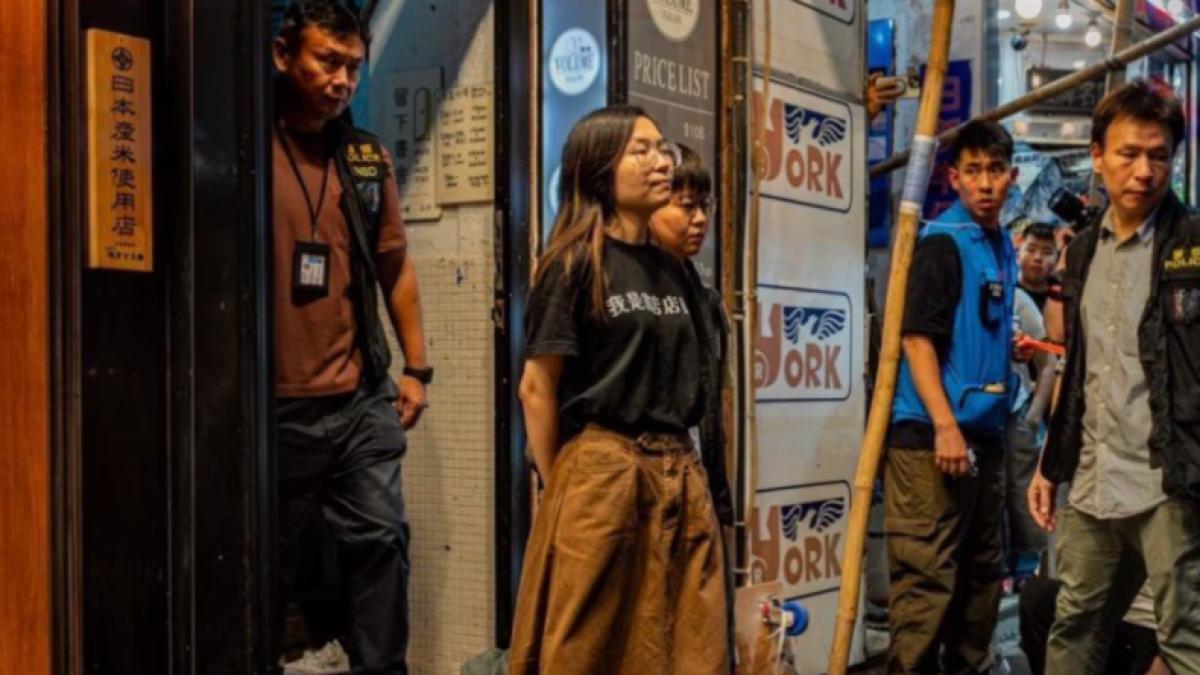
China's implementation of the 'Law on the Promotion of Ethnic Unity' has raised international concerns over heightened risks of 'transnational repression' by Beijing. In Taiwan, the exiled Hong Kong community has long endured threats of surveillance and covert photography, with multiple individuals targeted in paint-splattering attacks—incidents suspected to be acts of 'transnational repression.' Affected Hong Kong resident 'Fu Tang' described the situation as one where 'all Hong Kong people in Taiwan live under a shroud of terror.'
In July 2024, China's 'Law on the Promotion of Ethnic Unity' officially took effect, asserting that overseas organizations or individuals who 'undermine ethnic unity and progress' or 'create ethnic division' will be held legally accountable. Shortly after the law's implementation, Japanese commentator Akio Yokota was physically assaulted in Taiwan by a Chinese national.
China's Taiwan Affairs Office labeled the incident a 'routine public security case,' claiming the suspect acted out of 'righteous indignation.' However, Yokota questioned whether it was a 'flash mob hitman' attack, while Taiwan's Mainland Affairs Council expressed 'high suspicion' that this was the first violent act of 'transnational repression' following the new law.
As the suspect held a Hong Kong passport, some Taiwanese citizens worry that more Chinese 'enforcers' may exploit Hong Kong identities to commit crimes in Taiwan. Amid growing attention on the suspect's 'Hong Kong' status, the plight of Hong Kongers in Taiwan has resurfaced.
Hong Kongers in Taiwan fear 'transnational repression.' 'I don't think it's about nationality... they could send a Chinese person from the UK (to Taiwan),' said Tom Wai-hung, a Hong Kong exile. He believes the suspect's 'Hong Kong' identity is not the core issue, especially as many Hong Kong exiles in Taiwan face similar 'transnational repression'—a threat he himself has experienced.
Known by the alias 'Fu Tang,' Tom Wai-hung participated in the 'anti-extradition' movement and continues advocating for Hong Kong democracy in exile. His Muay Thai studio was twice vandalized with red paint at the end of last year and earlier this year, with suspects including a Taiwan-based Hong Kong national who has since fled. Shortly before the incidents, he criticized Hong Kong's legislative elections online and was subsequently wanted by Hong Kong's Independent Commission Against Corruption for 'inciting others not to vote.' He believes his online speech angered the Hong Kong government, making him a target. Taiwan's Mainland Affairs Council classified the case as 'a transnational repression incident by the Chinese Communist Party.'
In Tom's view, whether paint attacks or physical assaults, these acts demonstrate how the Chinese or Hong Kong governments use minor crimes to make incidents appear as 'personal disputes.' He believes these enforcers 'don't really want to fight you' but instead aim to harass at minimal cost, 'making you afraid, making you feel humiliated.'
'(China's) main goal is still to silence people,' said Taiwanese lawyer Lai Yu-hao, co-director of the 'Transnational Repression' research project at Taiwan's Civil Society Judicial Reform Foundation (CSJRF). While there is no universally accepted legal definition of 'transnational repression,' it generally refers to pressure and coercion by agents of foreign governments. According to CSJRF research, victims in Taiwan are primarily exiled Hong Kongers, Tibetans, Taiwanese human rights groups supporting these diasporas, and local individuals or organizations prosecuted by China for supporting Taiwan's sovereignty.
The paint attacks on Tom's studio are not the first involving Hong Kongers. Previous victims include singer Denise Ho and Causeway Bay Books owner Lam Wing-kee. However, a more pervasive and deeply rooted fear among Hong Kongers in Taiwan stems from unprovable acts of stalking and covert photography.
Hong Kong exile Choi Chi-ho said he and his friends have often been followed or covertly photographed with long lenses when attending church or participating in Hong Kong-related events. At a 'June 4' memorial event he organized, unidentified individuals frequently attempted to cause disturbances. 'It feels like constant surveillance, like you're always being watched,' Choi said.
CSJRF's co-director Chen Szu-yu noted that the intimidation effect of 'transnational repression' and the resulting fear are disproportionate to the level of violence. Even without direct physical threats, Hong Kongers in Taiwan fear that their activities could be reported to Hong Kong authorities, endangering their relatives back home. As a result, many choose to cut contact with family.
Few Hong Kongers in Taiwan face direct targeting like Tom. But he argues that if attacks on a few lead to widespread self-censorship within the Hong Kong community, then 'all Hong Kong people in Taiwan live under a shroud of terror.' 'As long as the Chinese Communist Party exists and doesn't stop, none of us abroad are truly safe—it's just a matter of when it's your turn.'
Fighting for Freedom from Fear
According to Taiwan's Immigration Agency, over 7,200 Hong Kongers had been granted residency or settlement rights in Taiwan by 2024. Reverend Huang Chun-sheng of Taipei's Jinan Church has helped shelter and resettle about 200 Hong Kongers. He observes that many Hong Kong 'comrades' who participated in protests suffer from varying degrees of PTSD. Recently, Huang is preparing for Lam Wing-kee's memorial service and, based on past experiences, plans to provide masks on-site to protect attendees from covert photography.
Choi Chi-ho, who has lived in Taiwan for seven years, used to habitually cover his face at advocacy events to protect himself. But last year, after obtaining a Taiwanese ID and completing four months of military service, he decided it was time to remove his mask and speak publicly under his real name, no longer fearing deportation to Hong Kong.
'I feel my 'anti-Communist battle' isn't over—it's just continuing in a different place,' said Choi, a former 'brave warrior' in the anti-extradition movement. Now serving as project manager at the advocacy group 'Chinese Democratic Academy,' he has entered a new 'battlefield.' Facing the risks of 'transnational repression,' he is unafraid for his personal safety: 'My PTSD isn't from my own injuries—I'm not afraid of physical harm. What troubles me most is the suffering of others (my Hong Kong comrades)... If I don't speak out (criticizing China), how can I face those who sacrificed?'
Choi admitted he even 'looks forward' to the day he might face direct violence: '(If) you come to attack me, it will precisely prove evidence of your transnational repression.' But he emphasized this doesn't mean everyone is fearless—many Hong Kongers still live in fear. 'We should have the freedom from fear,' he said.
Like Choi, Tom Wai-hung says he isn't afraid of 'transnational repression.' He moved to Taiwan because he sees it as the 'first line of resistance against the CCP' beyond Hong Kong. 'We must first defend Taiwan, then we'll have a chance to reclaim our Hong Kong—that's how I see it.'
Nonetheless, the risk of 'transnational repression' has increased Tom's living costs. He must spend extra time on self-defense training, preparing for attacks that 'might or might not happen at any time.' He remains constantly tense, always on high alert when going out. 'When you can't take it anymore, you might self-censor or even develop mental illness,' he said.
He tried seeking psychological counseling but felt misunderstood. 'Most people living in a world where “freedom is taken for granted” don’t really understand… they just say, “No, Taiwan is safe, you don’t need to be like this…” I felt it wouldn’t help me.' Later, through his interests in photography and hiking, he refocused on the present and found some peace.
How Should Taiwan Respond to 'Transnational Repression'?
After the Yokota case, Taiwan's public opinion has intensely focused on how the government should respond to potential Chinese 'transnational repression.' Taiwan's Executive Yuan has established a cross-agency coordination platform, focusing on 'prevention,' 'countermeasures,' and 'protection.'
The CSJRF supports the government's initial direction but points out many unresolved issues. Many cases, though suspected of involving Chinese state actors, often lack judicial proof of 'foreign instigators,' let alone convictions. Lawyer Lai Yu-hao stated that 'difficulty in tracing' is a key feature of 'transnational repression,' as repressive states deliberately conceal their links to such cases—a challenge shared by the international community.
Some Taiwanese public opinion advocates stricter entry screening for Hong Kong and Macau residents, fearing those with Hong Kong identities could become 'national security loopholes' in Taiwan. In early July, Mainland Affairs Council spokesperson Liang Wen-chieh stated they would review the screening mechanisms for Hong Kong and Macau residents entering Taiwan, adding: 'They (the Chinese government) use many tools; even if they don’t use Hong Kong people, they’ll use Taiwanese people.'
Lui Ching-wu, a Hong Kong-born migration studies scholar at National Taiwan University, rejected the notion of viewing Hong Kongers as 'potential national security threats.' She argued this is not the mainstream view in Taiwan but could become 'real' if amplified by media. Her survey last year showed Taiwanese hold significantly different attitudes toward Chinese and Hong Kong immigrants, and overall, do not believe there's a need to restrict Hong Kongers' access to Taiwanese status.
Lui said viewing Hong Kongers as 'national security threats' is 'very dangerous' and could fall into China's united front trap, 'dividing people who should be united and have opportunities to cooperate.'
'The best way to control transnational repression is to protect ourselves and protect those at high risk,' Lui said. The CSJRF also emphasized that Taiwan's government should not focus solely on national security
FACT BOX
- Source: PR Times
- Category: News