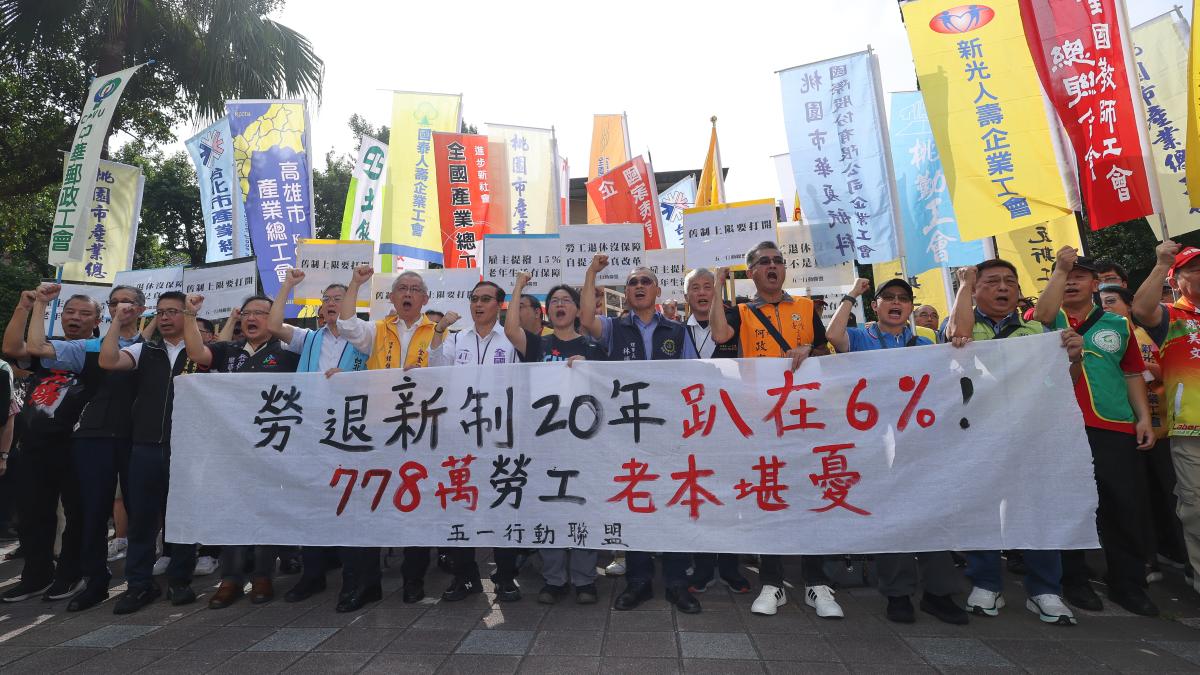
The 'May First Action Alliance,' a coalition of labor unions and NGOs from across Taiwan, held a press conference on the morning of the 23rd in front of the Legislative Yuan, calling it '20 Years Under the New System, Stuck at 6%! 7.78 Million Workers Face Retirement Insecurity! Raising the Labor Pension Contribution Rate Cannot Wait Any Longer!' The group urged the ruling and opposition party caucuses in the Legislative Yuan to swiftly review and pass amendments to the Labor Pension Act to end the 20-year freeze on the statutory employer contribution rate.
In response, the National Union of Taiwan Teachers (NUTT) issued a press release today supporting the demands. It pointed out that most personnel in the education sector are covered by the new labor pension system and called for prompt legislative reform. It also urged the Ministry of Education to improve retirement protections for all types of education workers.
The Labor Pension Act (new pension system) has been in place for over 20 years. According to the latest statistics from the Ministry of Labor, more than 13 million workers in Taiwan now have individual retirement accounts, making it the primary pension system for most workers.
Ahead of the press conference, the May First Action Alliance released a statement highlighting that the mandatory employer contribution rate under the new system has remained frozen at 6% for 20 years. Meanwhile, according to the latest estimates from the Directorate-General of Budget, Accounting and Statistics (DGBAS), Taiwan’s projected annual economic growth rate (GDP) for 2026 has been revised upward to 9.64%, the highest in 16 years. However, grassroots workers have not benefited from this economic growth, and wage increases have been eroded by inflation.
The statement specifically noted that, according to DGBAS data, as many as 70% (approximately 5.94 million) of Taiwan’s grassroots workers earn less than the average monthly wage of NT$48,000. Under the current 6% contribution rate, over 60% of workers will accumulate less than NT$1 million in their retirement accounts after 25 years of work.
The May First Action Alliance previously announced eight key demands during this year’s May Day Labor Day events:
- Gradually increase the employer contribution rate under the new pension system to 12% - Ensure at least two annual severance bases under the old pension system, with no upper limit - Raise the salary brackets for labor insurance and labor pension - Increase the cap on severance pay under the new system to 15 months - Achieve full enrollment in labor and employment insurance - Include domestic workers and migrant workers in the labor pension system - Ensure full funding of public and private school retirement funds and return compensation for service years - Unify the retirement contribution rate for public and private schools at 15%
Which Education Workers Are Covered by the Labor Pension Act? Over 40,000 Part-Time University Lecturers Alone
Following the press conference, NUTT stated in its press release that the minimum employer contribution rate under the new labor pension system has remained unchanged at 6% since its implementation in 2005—now 20 years without adjustment. Although most formal teachers are not covered by the Labor Pension Act, the education sector still includes over 40,000 part-time university lecturers, more than 30,000 long-term substitute teachers at high schools and below, nearly 40,000 kindergarten childcare workers, as well as many support staff such as kitchen workers, technical workers, and special education assistants—all of whom are covered by the new pension system. Many of these workers face job instability and relatively low incomes, making comprehensive retirement protection even more critical. Given that the labor pension system accounts for a low proportion of overall income replacement and that limited salaries reduce voluntary contributions, increasing employer contribution responsibility is a necessary reform direction.
Are There Major Differences in Retirement Benefits Between Private and Public School Teachers? Benefits Effectively Reduced by 20%
Additionally, regarding the retirement pension system for teachers, NUTT pointed out that after the shift to a defined-contribution system under the new labor pension scheme, private school teachers and public servants have gradually adopted the same model. While defined-contribution systems avoid the risk of fund insolvency, retirement security and longevity risk depend heavily on contribution rates. Therefore, higher contribution rates lead to more robust retirement protection. Currently, the contribution rate for public servants and teachers’ retirement funds is 15%, but private school teachers receive only 12%, resulting in significantly lower retirement benefits for private school staff—equivalent to a 20% reduction (or 80% of public school benefits). To address this, NUTT advocated during this year’s May Day parade for 'equal retirement contributions regardless of school type—15% for all,' a proposal already supported by several legislators who have introduced draft amendments.
Finally, NUTT emphasized that retirement protection should not differ based on occupation or status. Whether workers, public servants, teachers, or other education professionals, everyone deserves a safe, stable, and dignified retirement life.
FACT BOX
- Source: PR Times
- Category: News