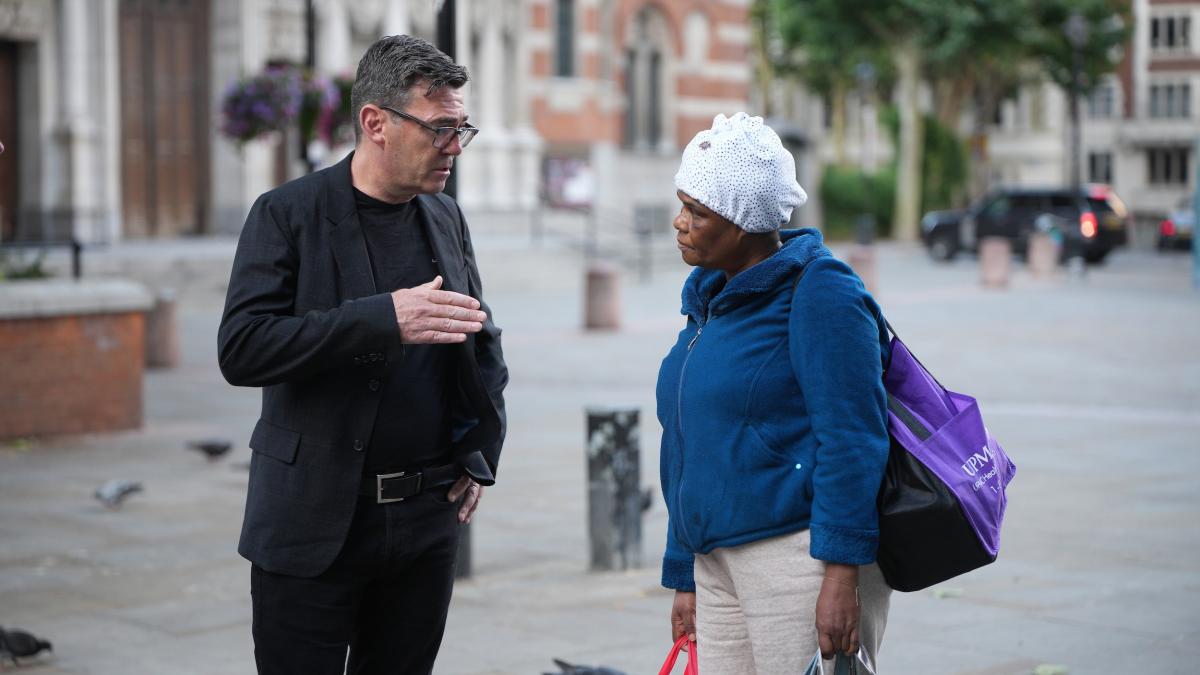
As Andy Burnham takes up residence at 10 Downing Street, he has many pressing issues to consider: the cost of living crisis, the ongoing war in Ukraine, and how to fund defense spending—just to name three. But at some point, he’ll also need to decide what to wear.
The Makerfield MP, sometimes accused of shifting political positions, literally changed clothes on his journey from Manchester to London. Boarding the train at Manchester Piccadilly station, Burnham wore his trademark dark T-shirt, chinos, and Adidas trainers. Over two hours later, arriving at London Euston, he had switched into a full suit. Twenty minutes after that, appearing in Parliament, he completed the ensemble with a tie.
Was this wardrobe change symbolic? Does it signal that Burnham, transitioning from Mayor of Greater Manchester to Prime Minister, intends to adopt a more formal style in office? Or was this a one-off, and does Burnham plan to maintain his 'Manchester style'—described as 'normcore,' 'middle-aged dad style,' or 'The Smiths meets Britpop'—once he holds the keys to 10 Downing Street?
Emma Finamore, Features Editor at fashion magazine Drapers, has dubbed Burnham the 'King of Casual Wear.' She says his look is seen as 'appropriate' but 'less formal than other politicians.' 'It’s aspirational yet accessible. Much of what he wears isn’t out of reach.' Harrington jackets, high-street staples like Uniqlo polo shirts, and Clarks Wallabees are often part of this 'clever Mancunian' aesthetic, deliberately distancing itself from the suit-and-tie 'uniform' of SW1 (Westminster).
Yet if he does return to ties and suits as Prime Minister, it would simply be a return to his earlier image in Westminster. Before 2020, Burnham was seen in suits more often than not. In photos from his 2015 second bid for Labour leadership, he sits sharply suited beside a rival—Jeremy Corbyn—who is dressed far more casually, without jacket or tie.
Corbyn won that contest decisively, pushing Burnham into second place. After leaving Westminster, Burnham gradually shed ties and suit jackets. In a 2022 Guardian interview, he said: 'I remember leaving and slowly realizing: I don’t have to do this anymore.' 'I started wearing what I’d wear on a weekend to watch football. It was an evolution, and I’m not going back.' His Howick jacket, worn during angry speeches over the COVID-19 lockdown debates, is now displayed at Manchester’s People’s History Museum.
Finamore says Burnham 'is a shrewd enough politician to know when he can wear certain clothes and when he can’t. He has to adhere to dress codes.' 'I don’t think he’ll go back completely. He has that confidence. He seems to have found his political identity and style as Mayor of Greater Manchester.'
One place he must follow formal dress codes is the House of Commons. Former Speaker John Bercow relaxed the rules, telling MPs ties weren’t mandatory. But his successor, Sir Lindsay Hoyle, draws a firm line. At a summer reception for Westminster journalists, he declared: 'It doesn’t matter if he’s the King of the North—unless Andy swaps that dark T-shirt for a shirt and tie, he won’t be allowed to speak in my house.'
Burnham’s 'Manchester style' is unlikely to fly in the White House either. Ukrainian President Volodymyr Zelenskyy chose military-style attire over suits to show solidarity with soldiers fighting Russia—but this upset some Americans and contributed to the infamous Oval Office clash between Zelenskyy, Trump, and VP JD Vance.
It may seem trivial, but clothing matters in politics. As past British Prime Ministers—particularly Harold Wilson and Margaret Thatcher—demonstrated, fashion can be a powerful political tool.
Thatcher was known for her sharp-shouldered suits, bow-blouse tops, and iconic handbag, crafting an image of authority and purpose. Wilson, by contrast, was famed for his pipe and Gannex coat, embodying the pragmatic, utilitarian 'cloth cap socialism' of the 1960s and 70s.
Professor Rob Ford of the University of Manchester notes that female politicians face far harsher scrutiny over their clothing than their male counterparts. 'There’s a huge double standard. It’s harder for women because they’re constantly making choices,' he says. At least men can retreat to the 'safe option' of a suit.
Still, image isn’t everything. As Conservative leader Kemi Badenoch recently dismissed Burnham as 'a pair of eyelashes and a black T-shirt,' Burnham responded in a video: 'It’s not black—it’s dark navy.' In his acceptance speech as Labour’s new leader, wearing a suit and tie, he couldn’t resist referencing his wardrobe: 'The Labour Party has worn too many Conservative clothes,' he said.
'I’m glad Kemi doesn’t like my wardrobe choices—because I don’t like theirs either,' Burnham added. 'From now on, we’re doing things differently.'
Ironically, outgoing PM Sir Keir Starmer also embraced the casual ethos championed by his successor, sometimes seen in tracksuits, Stone Island polos, and Adidas trainers. But Professor Ford notes the difference: Burnham’s fashion choices have captured public attention. 'People notice he has a distinctive way of dressing—that in itself is a branding success,' Ford says.
Like Reform UK leader Nigel Farage, Burnham enjoys being photographed downing pints in pubs. 'His clothing aims to convey the same message: I’m not a career politician—I’m one of you,' Ford explains.
For Burnham, maintaining that approachable, down-to-earth image while adhering to Westminster’s sartorial traditions—and public expectations—will be a challenge. In an era when politics has never been more visually driven, whatever he chooses to wear must make an impression.
FACT BOX
- Source: PR Times
- Category: News