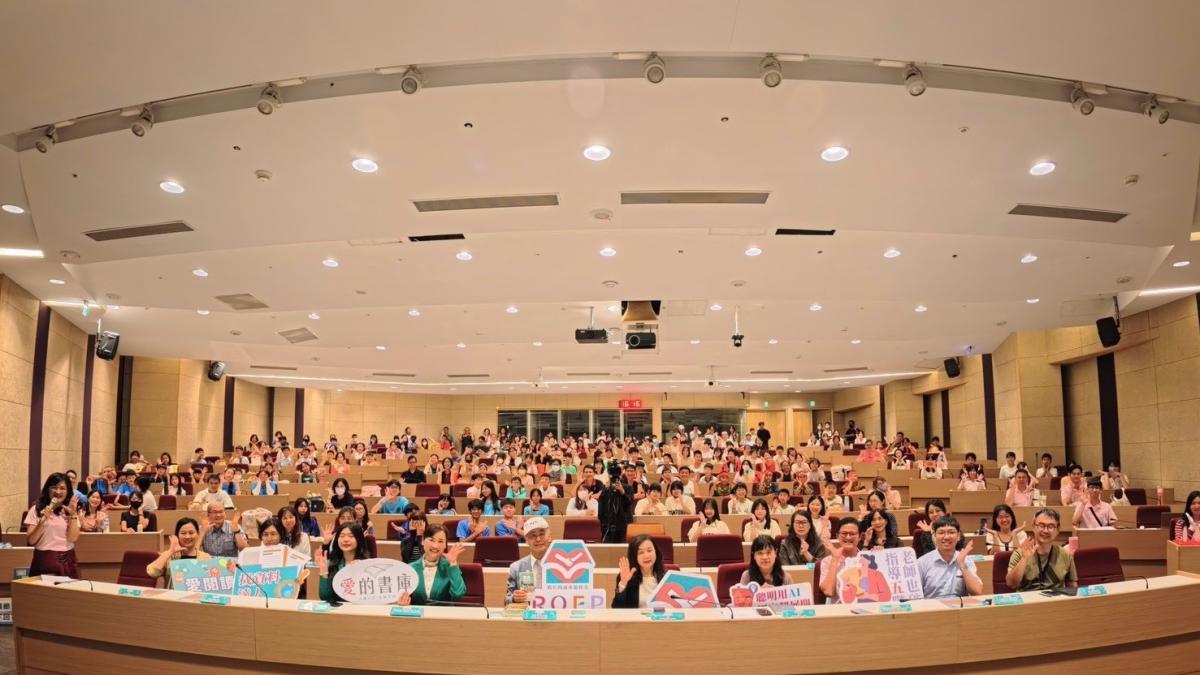
With the advancement of digital technology, reading competence has expanded beyond text comprehension to include information retrieval, source verification, data analysis, integration, and problem-solving—core competencies for lifelong learning. The national finals of the '2025 Ko Hua-Wei Online Digital Reading and Inquiry-Based Learning Competition' were held from July 22 to 23 at the National Public Information Library. After several months of preliminary screening, 78 teams from 47 schools across 18 counties and cities nationwide advanced to the finals, gathering in Taichung to present their inquiry projects and showcase their digital reading achievements.
The Education Bureau noted that the late Professor Ko Hua-Wei long championed digital reading and inquiry-based education. The 'Online Inquiry Competition' has been held since 2019 and this year marks its 8th edition. In 2022, it was renamed the 'Ko Hua-Wei Online Digital Reading and Inquiry-Based Learning Competition' to honor her legacy of promoting educational equity and digital literacy, encouraging students to identify problems through reading, gather evidence, and construct informed perspectives.
This year’s competition was guided by the Ministry of Education’s Bureau of Elementary and Secondary Education and jointly organized by the Taichung City Government Education Bureau, the Taiwan Reading Culture Foundation, and the National Public Information Library. The event was co-planned and executed by Wenshin Elementary School (Beitun District) and Hsin-Ming Girls’ High School, providing a comprehensive competition and exchange platform. This collaboration facilitated the sharing of inquiry-based teaching practices across regions and highlighted achievements in reading education and digital learning.
Deputy Director Lai Yuan-ju of the Taichung City Government Education Bureau encouraged participants to embrace inquiry, leverage technology, and continuously develop independent thinking, information literacy, and problem-solving skills to meet the challenges of the digital age. Notably, this year’s competition introduced 'Responsible AI Use' as a key evaluation criterion. Students were required to appropriately utilize AI tools during their inquiry process and submit an 'AI Usage Manual' explaining how AI assisted in data organization, ideation, or analysis. They also had to evaluate the credibility of sources and content, fostering the ability to use technology wisely while upholding academic integrity and critical information assessment—positioning AI as a tool to enhance learning quality.
The Education Bureau also announced the new 'NPIIL Digital Inquiry Award,' encouraging students to actively use the National Public Information Library’s digital collections, electronic databases, and learning resources to deepen their digital reading and inquiry processes. Through this national platform, the organizers aim to further strengthen digital reading education, cultivating students’ reading proficiency, inquiry skills, digital literacy, and innovative problem-solving abilities. By collaborating with schools, libraries, and civil organizations, they strive to build a high-quality learning ecosystem and nurture a new generation of talent equipped with global competitiveness.
FACT BOX
- Source: PR Times
- Category: Event