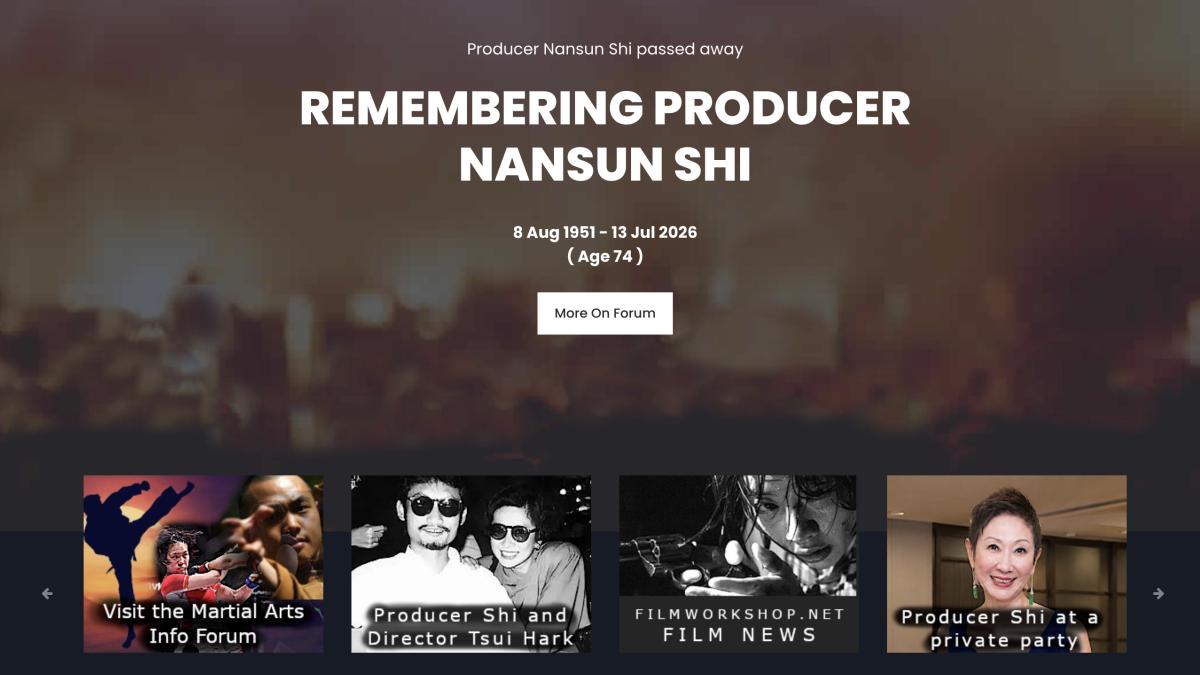
On the evening of July 13, 2026, Nansun Shi, a veteran film producer, passed away at the private Yung and Yu Hospital in Hong Kong's Happy Valley, a place often frequented by socialites. She was 75. The 'Film Workshop,' co-founded by Shi and renowned director Tsui Hark, immediately issued an obituary. As her ex-husband, Tsui Hark had been keeping vigil at the hospital for days and stepped out at night to confirm the news to the media, expressing gratitude for the concern from all quarters. Thus, the news of Shi's passing spread from Happy Valley across all of Hong Kong and reached the overseas Chinese-speaking cultural circles. Within a few days, from her close friend, the renowned actress Brigitte Lin, to former colleagues and friends from both sides of the Taiwan Strait, tributes poured in.
Shi witnessed the rise and fall of the golden age of Hong Kong cinema and the development of Hong Kong's film industry participating in 'co-production films' with mainland China. She was known by various nicknames in the Chinese-language film industry, including the 'Golden Producer,' 'Talent of the Fragrant River,' and the 'Grand Chamberlain' of the Hong Kong film industry.
A Hong Kong cultural figure told BBC Chinese that Shi was not only a reflection of post-war Shanghai immigrants taking root in Hong Kong, but her lifelong work in the film and television industry also combined the local Hong Kong perspective with the international market, allowing her to occupy a place in the male-dominated Chinese film world for decades, leaving a legend.
Reflecting Hong Kong's film history, the obituary from the 'Film Workshop' stated that Shi had been suffering from an immune system disease since 2022 and ultimately passed away peacefully in the company of friends and family due to multiple organ failure caused by bacterial infection.
Shi was born on August 8, 1951, in Hong Kong. Her ancestral home was Chongming Island, Shanghai. Her father was a local company executive, and her mother came from a wealthy family and was one of the few women who attended foreign schools in the early days of the Republic of China.
She had a high aptitude for languages, proficient in Mandarin, Cantonese, Shanghainese, English, and French. Cultural critic Dr. Li Zhanpeng told BBC Chinese that Shi was part of the post-war baby boomer generation, growing up in the era of Hong Kong's industrialization and economic takeoff under British rule. She graduated from London in the 1970s and returned to Hong Kong at a time when opportunities were abundant. At that time, Hong Kong could be described as a place 'where there was gold everywhere,' and she was able to fully utilize her talents and efforts.
At that time, the Hong Kong film industry, especially Mandarin films, was largely dominated by Shanghainese. The post-war and post-Civil War generation of Shanghai immigrants brought film talent and resources to Hong Kong, driving the development of Hong Kong from Cantonese films and Mandarin films to the concept of 'Hong Kong-produced films' or 'Hong Kong films.'
In 1981, Shi joined the Hong Kong film company New Art City and became the only woman among the 'New Art City Seven Monsters,' responsible for financing, administration, and international promotion. She introduced Hollywood's film industry cost control and copyright system and, with her multilingual abilities, became one of the earliest figures in the Chinese-language film circle who could traverse various international film festivals.
In 1979, another member of the 'New Art City Seven Monsters,' Tsui Hark, released his directorial debut 'Butterfly,' which was seen as the moment he joined the ranks of Hong Kong's New Wave cinema. In 1984, Shi and Tsui Hark established the Film Workshop and continued to produce Hong Kong film classics such as 'Butterfly and Sword,' starring Brigitte Lin, 'Chinese Ghost Story,' starring Leslie Cheung and Maggie Cheung, the 'Once Upon a Time in China' series starring Jet Li, and the 'The Return of the Condor Heroes' series. These films shocked the Chinese-language film world.
Li Zhanpeng believed that Shi had a keen eye and continuously promoted the 'A Better Tomorrow' series starring Chow Yun-fat, sparking a hero film craze, as well as the comedy series 'The Best of Times' starring Alan Tam, George Lam, and Sylvia Chang. 'So many different types of Hong Kong films, in fact, New Art City's contributions were indispensable, and Shi's contributions behind the scenes were enormous.'
In 2002, Shi participated in the production of 'Infernal Affairs,' which was later developed into a series of films. In 2003, mainland China and the Hong Kong Special Administrative Region signed the 'Closer Economic Partnership Arrangement (CEPA),' opening the mainland Chinese film market to Hong Kong. Large amounts of capital and talent 'went north,' and Shi and Tsui Hark also joined the ranks of 'Sino-Hong Kong co-production films,' collaborating on the 'Detective Dee' series and 'The Battle at Lake Changjin,' promoting the Chinese commercial film wave and continuing to occupy a place in the Chinese-language film world.
Li Zhanpeng said, 'Shi not only witnessed the birth and death of the Hong Kong film industry but also witnessed the rise and fall of 'co-production films.' It can be said that Shi's career was almost a complete reflection of the transformation of Hong Kong films from their inception to their current state.
Shi's talents were not limited to films. She had also served as a television station executive, including the predecessor of Taiwan's CTiTV—Hong Kong Transmission Television.
Between 2004 and 2006, Shi hosted the morning program 'Departure on a Clear Day' on Hong Kong Commercial Radio, also venturing into the field of news and current affairs. According to reports from Hong Kong media, former senior executive Yu Qian appeared at the hospital during Shi's critical illness and later posted tributes on social media after her passing.
In 2012, while serving as a jury member at the London Film Festival, Shi was interviewed by BBC Chinese's sister site BBC London. At that time, she said she was fortunate to witness the global popularity of Hong Kong films in the 1980s. Regarding the development of the Chinese film industry at that time, she commented that most of it was still inclined to invest heavily in making big films, but there were not enough film genres.
She said at the time that Chinese films still lacked experience, taste, or judgment, or training for young filmmakers to have different ideas and thoughts, but she had confidence that Chinese films would, like Hong Kong films of yore, be welcomed globally.
'The Last Shanghainese of Hong Kong'
Shi's passing prompted the Hong Kong cultural circle to mourn the death of a female strong person in the film industry, seemingly sighing at the historical changes of Hong Kong through the departure of a celebrity. After the 1967 leftist riots in Hong Kong, her father sent Shi to study in Ghana, Africa, and then transferred her to a British boarding school. After obtaining a computer statistics degree in London, she immediately returned to Hong Kong and entered the media industry. After meeting her ex-husband Tsui Hark, the two started a family and gradually established themselves in the male-dominated film circle.
Shi and Tsui Hark were affectionately known in the industry as the 'Sword and Fairy Couple,' but this marriage eventually ended in 2014. However, their relationship remained close even after their divorce.
In addition to being a 'strong woman,' Shi was also seen as a 'Hong Kong woman' who combined elegance and efficiency.
Looking back at the online tributes from various cultural figures who had dealings with her, Shi's personality was described as refreshing and humorous, with impeccable taste, but she quietly supported the industry behind the scenes. Hong Kong cultural figure and friend Liu Tianlan described Shi as 'a role model for Hong Kong people, representing the excellent side of Hong Kong's growth over 75 years.'
Deng Xiaoyu, co-founder of the old Hong Kong trendy culture magazine 'Extra,' was a good friend of Shi's. He believed that Shi was 'a very special woman in any era.'
Deng Xiaoyu recalled to BBC Chinese that around the late 1970s, he and friends founded the 'Extra' magazine in Hong Kong and got to know Shi through performing arts celebrities like Kenan Chan and others, starting a friendship that lasted for decades.
He believed that one particular incident could reflect Shi's character well: Deng Xiaoyu's father, Deng Tingxun, passed away in 2008, and they later discovered that his father had left an unpublished memoir. 'I discussed this with Nansun on WhatsApp. After hearing about it, she was very interested. The next day, she sent a driver to my house to pick it up. After one or two days, she replied that she had read it twice, the first time quickly, and the second time carefully, and praised the rich content and good writing of my father's biography.'
'She really does things seriously. I was surprised at how seriously she took this matter. It didn't directly help her career, but she really sent a driver the next day, not just talking. She was that kind of person.'
Taiwanese writer Hu Qingfang posted on Facebook to mourn her as a friend of 'absolute beauty and elegance': 'When it comes to beautiful and refreshing women, I have seen quite a few in my life, but Shi Nansheng took it to the extreme.'
Hu Qingfang wrote: 'She sat on the sofa of an old-style Hong Kong apartment on Garden Road, holding a glass of whiskey in one hand and a cigarette in the other, chatting intermittently. She sat with her legs crossed, a bit lazy, but her back was always so straight.'
Garden Road is located between Mong Kok and Kowloon City in Kowloon and is a traditional high-end residential area where many well-known cultural and film industry figures have lived or currently live.
'This scene I will never forget. That was my Hong Kong, my Hong Kong woman, both fierce and kind, with a sense of justice and courage, fearing nothing, but always worrying about everything.'
Deng Xiaoyu explained to the reporter that Shi had a natural presence but also knew how to shine elegantly; she could please everyone at a gathering and also make herself happy. 'Once, my brother Xiaozhou and I invited her and the general manager of Sotheby's Hong Kong auction house to dinner. You could see how elegant and witty Shi was in socializing.'
'She, in essence, was the last woman to showcase the 'Shanghai style' in Hong Kong. This style has been lost in both Shanghai and Hong Kong.'
Dr. Li Zhanpeng also agreed that Shi's life was the story of Hong Kong. 'The symbolic meaning is that that era has passed, and the background of Hong Kong, like Shi's era, the opportunities that people could have at that time, are now different. The whole of Hong Kong or the whole era has undergone earth-shaking changes.'
Deng Xiaoyu said, 'She was absolutely a very special person. If you have met her, you will not forget her.'
Brigitte Lin posted on Weibo: 'As a good friend of Shi Nansheng, the best way to repay her is to spread the energy of love like she did.'
FACT BOX
- Source: PR Times
- Category: 人事