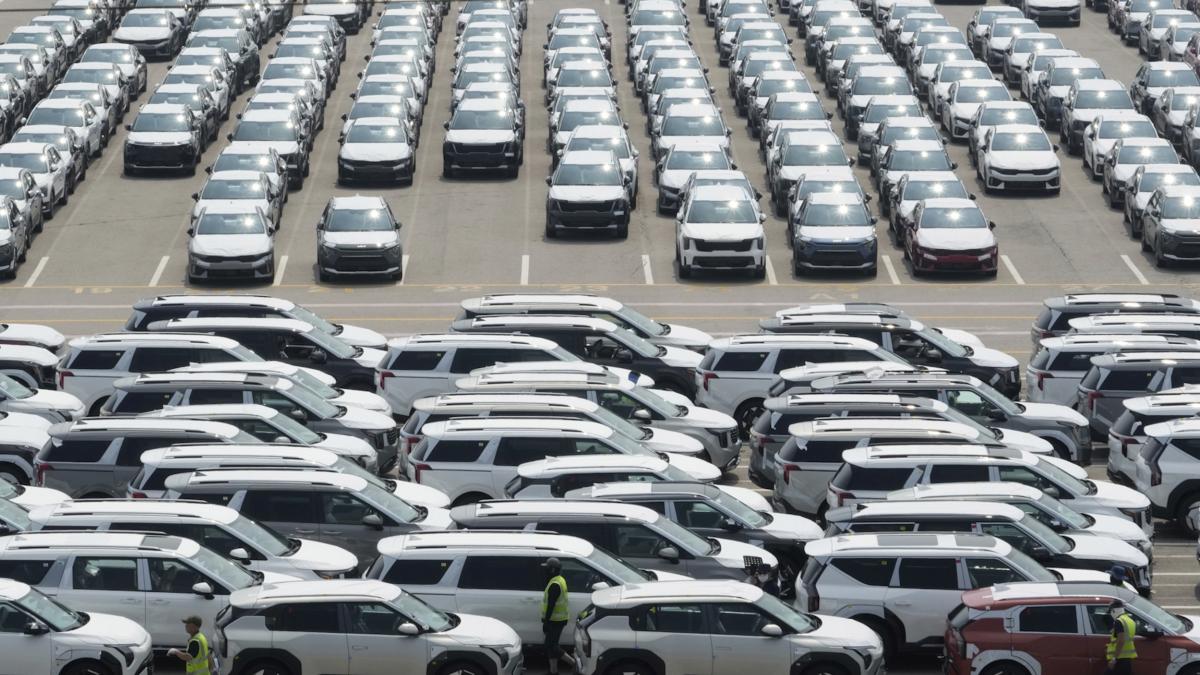
The U.S. Senate Commerce Committee voted on May 22 to approve the 'Connected Vehicle Safety Act' (S.4429) with strong bipartisan consensus. This new legislation explicitly prohibits the import and sale in the U.S. market of Chinese-made vehicles equipped with wireless connectivity functions, effective from January 2027.
This is only the first phase of the bill. The U.S. Congress plans to expand and amend the legislation to include North Korea, Russia, and Iran—referred to as the 'three adversaries'—in future provisions. The bill’s sponsor, Republican Senator Bernie Moreno of Ohio, stated, 'This legislation will effectively prevent the Chinese Communist Party from remotely controlling the steering, braking, and acceleration systems of vehicles operating in the U.S., which is clearly an intolerable national security risk.'
Phased Ban on Hardware and Software
According to the bill’s text, in addition to the ban on complete vehicles, Washington will begin imposing equivalent restrictions starting in 2027 on vehicle connectivity software originating from these four adversarial nations. As for related hardware components such as onboard communication chips and sensors, the prohibition is expected to take full effect starting January 2030.
Notably, the bill includes an 'exception clause,' though its conditions are extremely strict. Vehicle or component manufacturers that are joint ventures or subsidiaries may be exempted if ownership stakes from China, Russia, and the other three nations do not exceed 15%.
However, this poses a direct threat to many European automakers. For instance, the well-known German luxury automaker Mercedes-Benz has nearly 20% of its equity held by Chinese institutional investors. Once the bill takes effect, its sales and profitability in the North American market will be severely impacted. As a result, Mercedes-Benz has been actively lobbying U.S. authorities to raise the ownership threshold to 25% to avoid direct consequences.
Support from U.S. Automakers and Parts Giants
Opposition aside, there is also strong support. According to congressional lobbying records, companies including General Motors (GM), Subaru, Honda, autonomous driving leader Waymo, and the Motor & Equipment Manufacturers Association (MEMA)—representing a broad base of parts suppliers—conducted extensive lobbying efforts in 2026 in favor of the bill. GM, as a U.S.-based manufacturer, has explicitly voiced its support, aiming to better protect American manufacturing and workers' interests.
Next Steps
Following approval by the Senate Commerce Committee, the bill will now proceed to a full Senate floor vote. Meanwhile, the corresponding version in the House of Representatives remains in committee, awaiting further review.
FACT BOX
- Source: PR Times
- Category: News
- Organizations: General Motors / Subaru / Honda