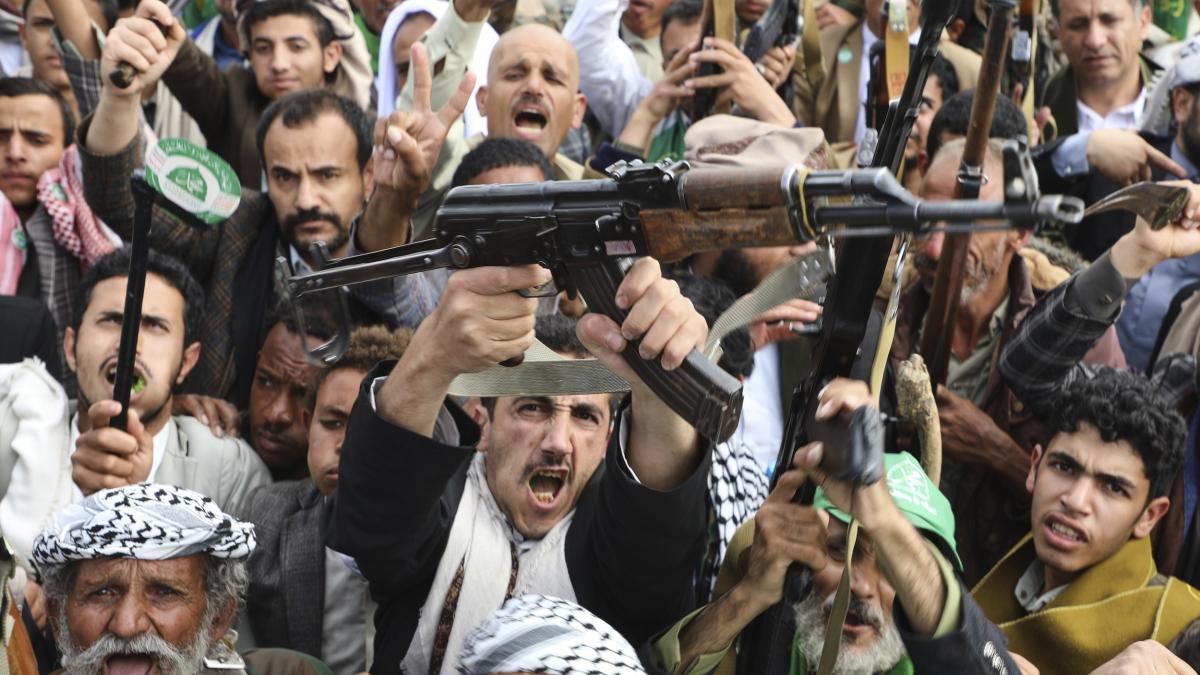
The Iran-backed Yemeni rebel group Houthi (Houthis, also known as the Young Movement) claimed on the 23rd that they attacked two Saudi Arabian oil tankers in the Red Sea. At a time when the Hormuz Strait is being blockaded by Iran, the Houthi's latest offensive in the Bab el-Mandeb Strait not only forced multiple tankers to abruptly change course, but Washington think tanks also warned that the US military could face a disadvantage in a two-front war in the Middle East. According to Reuters, the Houthi claimed to have hit the 'Encelia' and 'Layla' two Saudi Arabian oil tankers on the 23rd. Maritime security sources also confirmed that the 'Encelia' sent a distress signal near the Saudi port of Jizan in the evening of the 22nd, stating that it was hit by a missile; the British maritime risk management agency 'Vanguard' pointed out that the 'Encelia' was hit by an unidentified flying object on its starboard side about 70 nautical miles southwest of Al Shuqaiq. As for the situation of the 'Layla' being attacked, it has not yet been independently verified by a third party. The Houthi's drone and missile offensive immediately triggered a chain reaction of panic in international shipping. Data shows that on the 22nd, 5 tankers urgently changed course to avoid the Bab el-Mandeb Strait, and on the 21st, 3 large tankers fully loaded with Saudi crude oil, originally bound for China and India, turned around directly. The Houthi threatened to ban all ships from loading and unloading at Saudi ports, which could lead to a paralysis of 7% of the world's oil supply. Washington experts analyze: US military resources are under great pressure. Although Saudi Arabia, where US troops are stationed, has not yet requested military assistance from Washington, US President Trump has hinted that if Red Sea shipping is obstructed, the United States will intervene. Jason Campbell, a researcher at the Middle East Institute in Washington and former Pentagon official, analyzed: 'This means that the US military must forcibly split its already very tight regional resources between two active battlefronts operating simultaneously.' Campbell added that in order to respond to the Red Sea threat, the US military may be forced to move some warships from the Persian Gulf to near Yemen to carry out defensive and counterattack missions. Michael Mulroy, the deputy assistant secretary of defense in the Trump 1.0 administration, warned: 'The Houthis have repeatedly proven that they are fully capable and willing to disrupt shipping in the Red Sea and the Bab el-Mandeb Strait.' On August 25, 2024, the Greek tanker Sounion, which was attacked and set on fire by the Houthi organization, was burning in the Red Sea. (Associated Press) Mark Cancian, a former US Marine Corps officer and senior researcher at the Center for Strategic and International Studies (CSIS) in Washington, pointed out that although a two-front war would strain the US Navy, the Houthis themselves also face the challenge of supply cuts, 'The US blockade of Iranian ports, although not 100%, is highly efficient. Therefore, the Houthis may find it difficult to sustain this high-intensity war of attrition for a long time.' However, Pentagon spokesman Sean Parnell refuted concerns about the strain on military resources, emphasizing that the US military has strong military capabilities and arsenals, 'It is fully capable of carrying out missions at the time and place chosen by the president to protect our personnel and interests.' While the Red Sea situation is deteriorating, the US military's strike operations against Iran's mainland have also been fully upgraded. The Associated Press reported that the US Central Command (CENTCOM) confirmed that the US military has completed 12 consecutive nights of airstrikes on Iran. US President Trump (Donald Trump) also said on social media that every time Iran fires at a ship in the Hormuz Strait, the US military will blow up 'a bridge or a power plant' in Iran. Trump also hinted that the US military may soon strike the underground nuclear facility 'Pickaxe Mountain' (Iran calls it Kuh-e Kolang Gaz La), which is under construction and buried in the mountainside south of the Natanz nuclear facility. In response, Iranian Foreign Minister Seyed Abbas Araghchi said that Iran will adopt an 'eye for an eye' defensive strategy, warning that any aggression against Iran's infrastructure will be met with strong and decisive retaliation. The Iranian Joint Military Command also claimed through official media that if the US carries out strikes, Iran will destroy oil, gas, power, and economic facilities in the Middle East region, achieving 'not a drop of oil out.' On July 18, 2026, a bridge in Hormozgan Province, southern Iran, was blown up by the US military. (Associated Press) The cost of the war is rising rapidly, and international oil prices have surged above $93. US Secretary of Defense Pete Hegseth confirmed at a Senate hearing that the United States has already spent as much as $375 billion (about 1.21 trillion New Taiwan dollars) on this war. The US military has already lost 18 soldiers and more than 450 wounded; Trump personally went to Dover Air Force Base in Delaware on the 22nd to receive the remains of 4 US soldiers who died in recent attacks on US military bases in Jordan and Iraq. On the Iranian side, Kuwait's desalination plants and energy facilities were also hit by Iranian retaliatory strikes, and Iranian health officials said that since the end of last month, 53 civilians have been killed and 592 injured. International crude oil prices continue to rise due to the war, with Brent crude already surging to more than $93 per barrel. US Secretary of State Marco Rubio, who is attending the ASEAN Foreign Ministers' Meeting in the Philippines, issued a statement emphasizing that if a single country is allowed to control international waterways and privately collect tolls, it will set a very dangerous global precedent. The US military's current focus is on ensuring navigation safety and maintaining the regional blockade. On Sunday, July 12, 2026, near the Iranian port of Abbas, two men waded through the waters of the Hormuz Strait, with several ships docked in the background. (Iranian Students News Agency via Associated Press/Razieh Poudat)
FACT BOX
- Source: PR Times
- Category: News