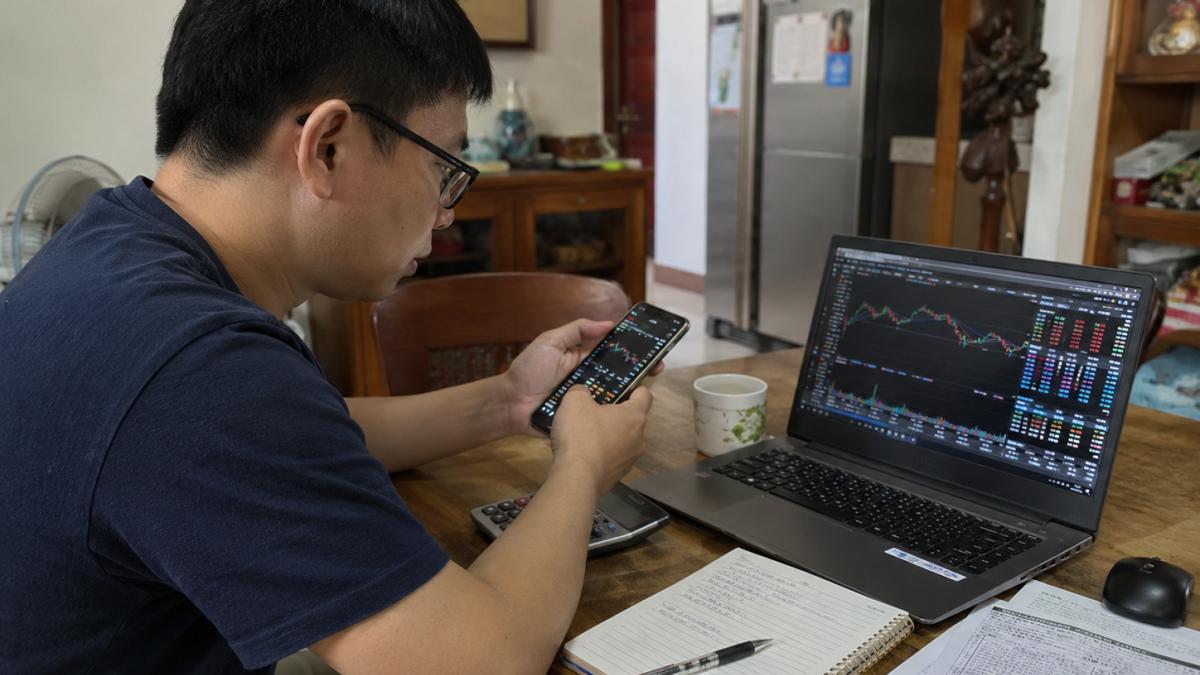
After selling 0056 for profit, the thrill of short-term trading faded, replaced by anxiety over the passage of time. Watching major financial holding companies announce their dividends, I realized clearly: to achieve FIRE, I couldn’t rely solely on capital gains—I needed stable cash flow. That’s when I turned to the most consistently dividend-paying financial stocks. At the time, I didn’t yet understand concepts like buying on dips or how to judge whether a stock price was high or low. All I knew was that I needed to get on board the dividend train before the ex-dividend season. So, I made the most intuitive decision: I reverse-calculated how many shares I’d need to generate dividend income matching my annual living expenses (calculated in Chapter 1), then invested all my available funds into large, too-big-to-fail financial leaders with relatively high dividend yields. This portfolio, built in a state of uncertainty, became the most solid 'core holdings' in my asset allocation. My first purchases were three stocks: Mega Financial (2886), First Financial (2892), and E.Sun Financial (2884). My selection criteria were clear: profitable, government-backed public financial institutions and top-performing private sector leaders. These stocks weren’t meant to make me rich overnight—they were to build the foundational skeleton of my assets. They had to be as sturdy as pillars in a house, providing not only living expenses but also serving as credible collateral when dealing with banks in the future. To select these lifelong partners, I set four non-negotiable red lines: 1. Size threshold: Too big to fail Building assets is for retirement, not gambling—security comes first. I only chose financial giants with paid-in capital exceeding NT$100 billion, ensuring that even in a financial tsunami, they would be among the first to be rescued by the government. In 2019, Taiwan’s Financial Supervisory Commission (FSC) announced the first list of 'Too Big to Fail' banks (officially called Domestic Systemically Important Banks, or D-SIBs). Mega Financial (2886) was on that list, and First Financial (2892) joined the following year—this implied implicit government backing. This is the kind of 'when the sky falls, the tall will bear it' peace of mind I was seeking. E.Sun Financial (2884), though not on the D-SIB list, played a crucial role in boosting overall portfolio performance. Its capital had already surpassed NT$116 billion, making it equally safe in scale. But what attracted me most was its consistent practice of issuing stock dividends. By converting stock dividends into market value, the total dividend yield could be pushed above 7%, serving as my secret weapon to rapidly accumulate shares and meet my annual dividend targets. 2. Minimum dividend income sufficient for living Since core holdings would support my lifestyle, the dividends couldn’t be meager. They had to exceed market averages. I set a standard: a 10-year average combined dividend yield above 5%, ensuring annual cash flow would cover living expenses and leave surplus funds for reinvestment. When I built my core portfolio in 2020, I calculated the real dividend yield by converting both cash dividends and stock dividends into their market value at the time of ex-dividend, summing them, and dividing by the invested principal. I found that both Mega Financial (2886) and First Financial (2892) exceeded 5%. Notably, E.Sun Financial (2884) adopted a policy of splitting dividends equally between cash and stock. When stock dividends were valued at market price, the effective yield reached over 7%. This dual benefit—cash income plus 'baby shares' that compound over time—perfectly aligned with my needs for both living security and asset growth. Author | V Da (Gong Tian-Yong) Born in 1980, graduated from National Chiao Tung University with a degree in Electronic Engineering. Former mid-level executive in the electronics industry, frequently traveling internationally from her base in Southern Taiwan Science Park. After years in the corporate world, she decided she didn’t want to spend her life working for a company and took back control of her life by actively investing in the stock market. At age 43, she successfully achieved FIRE (Financial Independence, Retire Early), reaching a 155% income replacement rate in just four years. She previously ran a popular Facebook page, 'V Da’s Investment Life: My 1,735 Days Toward Retirement,' with over 10,000 followers. After an unexpected suspension of her Facebook account, she decisively leveraged her project management skills to launch a new platform—her personal website, 'V Da’s Investment Life: My 1,735 Days Toward Retirement'—where she continues to share authentic, practical records of her retirement journey. This article is reprinted with permission from 'I Achieved Financial Freedom in Four Years.' Editor-in-Charge: Li Yi-Qing
FACT BOX
- Source: PR Times
- Category: News