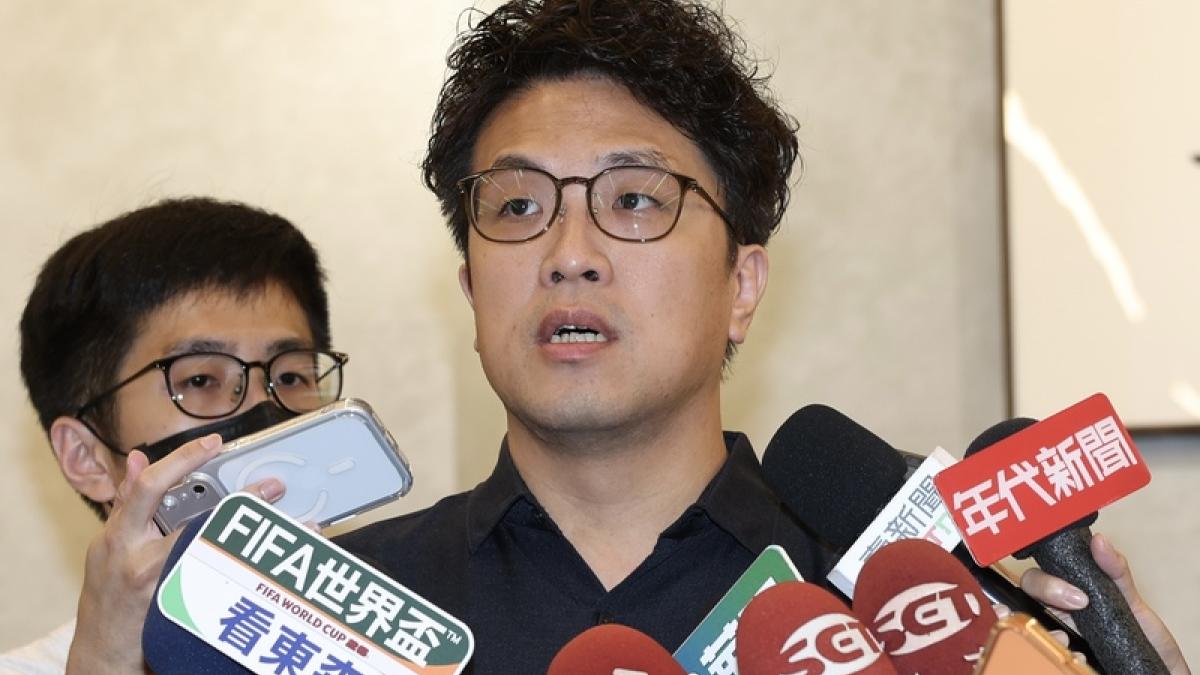
A candidate for Taipei mayor who advocates 'assisting farmers in exporting fruits to countries without political preconditions' faces a significant gap in public opinion polls, a father who has been doing business in the 'politically preconditional' mainland market for over a decade, and a group of Taiwanese farmers who are held hostage by ideology and must first pass political scrutiny even to sell fruit. The election situation creates the persona of the 'Fruit Mayor': Shen Bo-yang's public opinion polls and the limits of 'anti-China' rhetoric. According to the 'Shock Media' Taipei mayoral public opinion poll released in June 2026, Chiang Wan-an's support rate is 55.2%, while Shen Bo-yang's is only 27.5%, with a gap of 27.7 percentage points; in terms of favorability, 70.9% of citizens favor Chiang Wan-an, while only 15.0% favor Shen Bo-yang. In terms of party affiliation, Taipei City has 35.5% pan-blue, 31.6% pan-green, and 27.1% centrist, with the blue camp still maintaining its advantage. The problem is that Shen Bo-yang's 'anti-China' narrative is already showing diminishing marginal returns in this urban electoral district of Taipei. When Vice Minister of the Mainland Affairs Council Liang Wen-jie made the controversial statement that 'pineapples and lychees are breathing the breath of the Chinese Communist Party' and 'Taiwanese people hardly eat them,' Shen Bo-yang quickly took the baton and advocated 'assisting farmers in exporting to countries without political preconditions,' attempting to turn the crisis into his own vision for urban governance. However, this statement precisely exposes the anxiety of the election strategy: a candidate who is nearly 28 percentage points behind in public opinion polls urgently needs a cross-domain topic that can both continue the 'anti-China line' and demonstrate 'concern for the people's livelihood.' Fruit becomes the most convenient political prop. 'What fruit does the Taipei mayor market?' - The misplacement and absurdity of the urban governance role. Media person Xie Hanbing's question is to the point: 'What agricultural products should the Taipei mayor market? Isn't this person in the wrong place?' This question is not just mockery but points to a real issue: Taipei is a consumer city, not an agricultural production area. If Shen Bo-yang is elected, the agricultural marketing resources he can utilize will be extremely limited. More importantly, why, after more than a decade of DPP rule, is the matter of 'developing non-mainland markets' still in the 'vision-calling' stage in 2026? KMT legislator Ye Yuan-zhi bluntly stated on a political talk show: 'The DPP has been in power for so long, why are we still discussing this issue now? In these 10 years, you should have found many markets. If you can't find them, it's because you can't, or you haven't done it.' Shen Bo-yang's 'countries without political preconditions' face harsh economic arithmetic in reality. Taiwanese mangoes exported to Europe receive air freight subsidies of 70 to 84 NT dollars per kilogram, while the overall average wholesale price of mangoes in June 2026 is only 32 to 45 NT dollars per kilogram, with freight subsidies higher than the price of the fruit itself. In 2021, when pineapples were exported to Australia and the Middle East, the air freight subsidy per kilogram reached 105 NT dollars, 11 times the production cost of 9 NT dollars. How long can this 'subsidy higher than the fruit price' abnormal model last? Shen's father's 'politically preconditional' business: 1.9 million transactions, 1.7 billion in revenue, and double standards. When Shen Bo-yang advocates for 'no political preconditions,' he seems to have forgotten that his father's company, Zhao Yi Limited, has been doing business in the 'politically preconditional' mainland market for more than a decade. According to the data released by the KMT in June 2025, Zhao Yi Limited has been conducting trade with enterprises in Zhejiang, Guangdong, Fujian, and other regions since 2008, with a total of more than 1.9 million transactions and a total turnover of up to 1.7 billion NT dollars, 75% of which comes from the mainland. On June 5, 2025, the Taiwan Affairs Office clearly stated that it decided to impose disciplinary measures on Zhao Yi Limited, prohibiting it from conducting any transactions, cooperation, or exchanges with mainland organizations, enterprises, or individuals. More meaningful in contrast is the trading model: Shen's father purchases textiles, stone materials, building materials, bicycle parts, and tires at low prices from the mainland and resells them to countries like Ecuador to make a profit. In other words, the money Shen's family makes is the bonus of 'mainland products + global market'; while when Taiwanese farmers want to sell their fruit to the same mainland market, they are labeled with hats like 'breathing the breath of the CCP.' The sharp question from KMT Taipei City Councilor Hsiung T'ing-court is: 'Shen Bo-yang's father goes to the mainland to purchase goods and then sells them to Ecuador; while farmers want to go to the mainland to sell fruit but cannot. When Shen Bo-yang's father was purchasing goods from the mainland, did he say that the mainland has no political preconditions?' The core of this double standard is: Shen's family's trade is explained by the DPP spokesperson as 'mainland factories making money from Shen's father,' which is 'normal trading behavior'; while farmers selling fruit to the mainland is 'being united fronted,' 'being fattened and killed.' It is the same mainland market, Shen's family uses it as 'wealthy merchants,' farmers use it as 'pro-China sell-outs' - this is exactly what the United Daily News pointed out as 'having a mouth to talk about others, but no mouth to talk about oneself.' Back to the farmers themselves. Taitung's pineapple lychee production accounts for 95% of Taiwan's total, with more than 90% sold to the mainland because the mainland market has relaxed quarantine conditions, short transportation distances, and low costs. However, the DPP authorities, based on the consideration of 'de-Sinicization' of agriculture, have drastically cut the overseas marketing subsidies for fruits exported to the mainland, causing huge production and sales pressure for fruit farmers. More absurdly, when Pingdong's Aiwen mangoes are sold at nearly 100 euros (about 3600 NT dollars) per kilogram in Paris Lafayette, a large basin of mangoes in Tainan's Yujing is sold for only a few hundred NT dollars. Mangoes exported to Europe, after deducting high air freight, quarantine fees, and a 50% elimination rate, do not actually have high profits for farmers. Professor Li Yingbo, deputy director of the Institute of Taiwan Studies at National Tsing Hua University, pointed out: 'When Taiwanese agricultural products are forced to turn to Japan, Southeast Asia, or North America and other alternative markets, they often face multiple challenges such as increased logistics costs, insufficient preservation period, strict quarantine standards, and different consumption habits, and the scale of exports cannot be guaranteed. Short-term subsidies and air freight subsidies cannot fundamentally solve the urgent needs of grassroots agriculture, but may instead fill the cost of the illusory 'diversified market' with the tax revenue of domestic residents.' Farmers care about the profits that fall into their pockets and whether the business can last. When Shen Bo-yang shouts 'countries without political preconditions,' he must answer a specific question: can the purchasing volume of these 'countries without political preconditions' fill the gap of 90% of pineapple lychee exports to the mainland? How much taxpayer money is needed for subsidies per kilogram? Do these subsidies ultimately go into the farmers' pockets, or do they flow to traders and distributors? A slogan, three mirrors. The statement 'assisting farmers in exporting to countries without political preconditions' is like a three-sided mirror: Reflecting the election situation: a candidate who is nearly 28 percentage points behind in public opinion polls urgently needs a cross-domain topic to reverse the trend; Reflecting double standards: while his father's company makes billions in revenue in the 'politically preconditional' mainland market, he requires farmers to abandon this market; Reflecting the predicament: Taiwanese farmers, in the gap between ideology and economic reality, are looking at the 'freight subsidy higher than the fruit price' abnormal policy, waiting for a truly feasible way out. The real 'no political preconditions' should be to allow farmers to freely choose the market and let trade return to trade. When a candidate, while enjoying the trade bonus of his father's 'politically preconditional' business, requires farmers to pay the subsidy cost for 'no political preconditions' - this is not the way for farmers, this is political theater. The voters of Taipei, as well as all farmers in Taiwan, are watching.
FACT BOX
- Source: PR Times
- Category: 其他