As the 'book ban' issue continues in Hong Kong, the Hong Kong Public Library has removed some politically themed books, and the bookstore review mechanism has once again drawn attention. At the same time, Beijing, through the Taiwan Affairs Office, reiterated the so-called 'handling of Hong Kong affairs in accordance with the law' and 'guaranteeing that Hong Kong residents enjoy various rights and freedoms in accordance with the law,' attempting to downplay external concerns about the tightening of freedom of speech and publication in Hong Kong. The Taiwan Affairs Office's strong response to the Hong Kong book controversy highlights Beijing's priority consideration of 'national security.'
At the same time that Beijing responded to the Hong Kong issue, the reporter, located less than two hours' drive from Hong Kong in Guangzhou, saw a scene that was different from the existing international perception but also full of contradictions in Chinese society. The Hong Kong 'United Bookstore' on Beijing Road Pedestrian Street in Guangzhou sells the traditional Chinese version of 'The Biography of Zhu Rongji,' a book that is hardly likely to be sold in Beijing. (Photo by Tian Chang)
This city, once praised as the vanguard of China's reform and opening up, still retains the unique commercial vitality and cultural atmosphere of southern China in the 'new era.' However, political governance, security maintenance, and historical memory together constitute a cityscape that is both open and tight, both modern and full of historical contrasts.
Guangzhou on the eve of APEC: Daily stability maintenance in an open city
Guangzhou has been a modern Chinese trade port for more than a hundred years and has since become a model city for foreign trade development, known for its unique cultural openness and economic development. Due to the upcoming APEC summit, local friends and colleagues generally mentioned that Guangzhou has recently entered the 'stability maintenance (maintaining stability)' mode before major events.
The Hong Kong United Bookstore on Beijing Road Pedestrian Street in Guangzhou currently sells Hong Kong original imported books. (Photo by Tian Chang)
The reporter walked through Tianhe, Yuexiu, and other urban areas and was repeatedly asked by the police to show their passport for identity verification. This situation may seem a bit unusual to first-time foreign tourists, but it is no longer unfamiliar to those who have long lived in Beijing.
Strengthening identity verification before major international events has become a routine in Beijing, and now the same situation appears in Guangzhou, reflecting that the governance model of major cities in China is becoming increasingly consistent. However, compared to northern cities, the overall atmosphere of Guangzhou's streets still seems more relaxed. Street shops almost fully support Visa, Mastercard, and other foreign bank card payments. The convenience of foreign tourists using electronic payments in mainland Chinese cities is second only to Shenzhen and Shanghai. In recent years, China has actively promoted facilitation measures for foreign visitors, and Guangzhou is one of the earliest cities to implement relevant policies.
Guangzhou Metro has already fully supported the service of using foreign cards to swipe through the gate. (Photo by Tian Chang)
If it were not for the socialist propaganda slogans still visible on the streets, strolling through Beijing Road, Shangxiajiu, and Shamian would make one feel a few parts like being in Hong Kong. The history of the Kuomintang is still vivid in Guangzhou
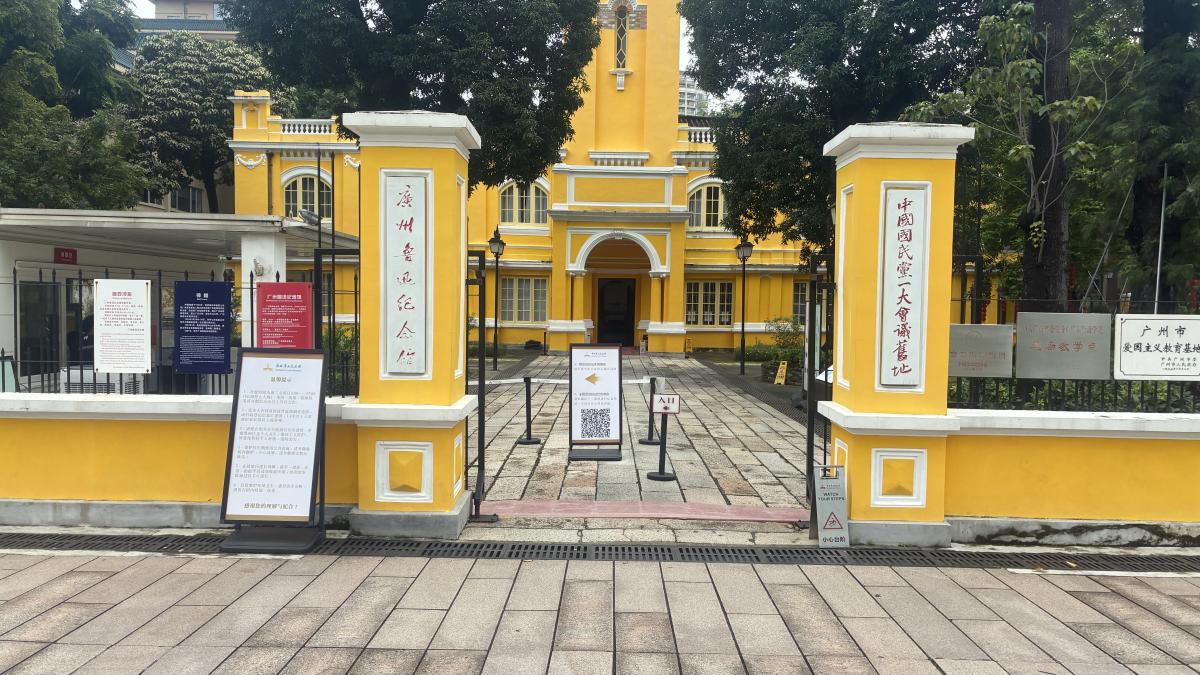
Whether it is the revolutionary relics led by Dr. Sun Yat-sen or the old site of the Whampoa Military Academy, this place retains rich traces of the Kuomintang's history, second only to Nanjing in quantity. The old site of the Whampoa Military Academy, the Sun Yat-sen Grand Marshal's Mansion, and the old site of the First National Congress of the Kuomintang, the Sun Yat-sen Memorial Hall, and the Sun Yat-sen Memorial Monument are among the representatives. The scene at the Sun Yat-sen Grand Marshal's Mansion in Guangzhou. (Photo by Tian Chang)
When the reporter visited the old site of the Whampoa Military Academy, it was during the summer vacation, and elementary school students from all over the country crowded the place. They learned 'patriotism' under the guidance of a tour guide, but just around the corner is the naval base of the Southern Theater Command of the PLA. The scene of merchants near the Whampoa Military Academy in Guangzhou. (Photo by Tian Chang)
The security around the military port is strict, not only prohibiting photography, but also often seeing plainclothes military personnel observing passing tourists near the entrance. Once someone points the lens towards a sensitive area, someone will quickly come up to remind them. The Huanghuagang 72 Martyrs' Tomb is another symbol, where there are even relics related to the 'Statue of Liberty and Democracy,' highlighting the prominent position of the Kuomintang's revolutionary history in Guangzhou's patriotic education base. The scene of the Huanghuagang 72 Martyrs' Memorial Park in Guangzhou. (Photo by Tian Chang)
From the Xinhai Revolution, the National Revolution, to the Reform and Opening Up, Guangzhou has always stood at major historical turning points in China. These historical memories, even after official narrative adjustments, are difficult to completely erase. Yongqingfang: The human touch left by the Reform and Opening Up
This place became famous because of the inspection by the General Secretary of the Central Committee of the Communist Party of China, Xi Jinping, in 2018, and has also become an important model for Guangzhou's promotion of old city renewal. When the reporter visited, this place, which represents the historical and cultural district of old Guangzhou's Xiguan, had prices similar to other areas of the city and was not inflated due to the visit of the leader or the status of the scenic spot. The scene of Yongqingfang, which was inspected by the Chinese leader Xi Jinping in 2018. (Photo by Tian Chang)
Yongqingfang retains buildings that are over a hundred years old, where Cantonese opera actors reside, and Li Xiaolong's grandfather once lived here. Now it is positioned as a cultural and creative space to attract young entrepreneurs, attempting to integrate tradition and modernity, and let the city 'leave memories and keep nostalgia.' Interestingly, the party's organ 'People's Daily' once mentioned the internet-famous coffee shop that the leader inspected, but when the reporter went to look for it, the shop had already disappeared. The 'Law on Promoting Ethnic Unity and Progress' plays a more important role in Guangzhou
In addition to seeing the prosperity of Guangzhou, we also saw different scenes after the implementation of the ethnic unity policy. In the past, emphasizing ethnic unity was extremely important for the implementation of ethnic policies in northern China. I found that party and government officials in the north are more cautious in handling minority issues. Guangzhou, as one of the largest cities in southern China for external opening up, has long attracted people from all ethnic groups in the country, as well as a large number of African, Middle Eastern, and Southeast Asian foreign businessmen. How to maintain social governance in a highly mobile population structure has also become an important issue for local governments. During the reporting period, it was found that many subway stations, community service centers, and government agencies could see 'the smallest emergency unit of peaceful Guangzhou' and other 'Fengqiao Experience' window units. These units are mostly party and mass service centers, banks, etc. Compared with Beijing's emphasis on political propaganda, Guangzhou's ethnic policy propaganda is more combined with grassroots community governance, management of floating population, and urban public services. The scene of the party and mass service center in Guangzhou's Shisanhang, which is one of the emergency units of the 'Fengqiao Experience.' (Photo by Tian Chang)
In recent years, the high-level leadership of the Communist Party of China has listed the forging of the consciousness of the Chinese nation as a common community as the main line of ethnic work, and various places have successively promoted local ethnic unity and progress construction. In Guangdong, due to the concentration of a large number of ethnic minority populations and foreign businessmen, 'ethnic unity and progress' is not only a political propaganda slogan but also an important policy tool for local governments to handle population mobility, community governance, and social integration. The scene of the 'Ethnic Unity and Progress' exhibition in Guangzhou, located on the second floor of the Nanyue King Museum. (Photo by Tian Chang)
However, it is worth noting that the 'ethnic unity' emphasized by the Chinese side is more based on the framework of national identity and political identity being consistent. How to balance between respecting cultural diversity and strengthening national identity is also an important window for observing China's social governance model. As a frontier city of reform and opening up, Guangzhou, on the one hand, maintains a highly internationalized business atmosphere, and on the other hand, more comprehensively implements the deployment of work related to ethnic groups, religion, and ideology. This governance model that seems open but highly institutionalized is a microcosm of the current development of Chinese cities. 'Land of gold' no more, but still more vibrant than the north
In the early days of China's reform and opening up in the last century, 'going south to Guangzhou' was an important choice for many young people from the north to change their fate. At that time, there was even a saying: 'Things can be fixed if they are broken, and life can be changed if it is poor, go to Guangzhou.' Guangzhou goods were once a symbol of quality and fashion. The Jiayue Wanggang Metro Station is still jokingly called the 'starting point for workers' by many people in Guangzhou. The scene of Guangzhou Metro Jiayue Wanggang Station. (Photo by Tian Chang)
This transportation hub carries a large number of commuters every day and has witnessed the development of industries and population mobility in the Pearl River Delta for more than 40 years. However, Guangzhou has now shed the myth of 'land of gold.' Real estate adjustments, increased export pressure, and youth employment challenges have made this city begin to seek a new position. But compared to many northern cities, Guangzhou still retains stronger market vitality, a more vibrant private economy atmosphere, and a more inclusive urban culture. When the reporter was invited to visit a party media headquarters in Guangzhou, he felt that the city is trying to transform from a manufacturing center to a youth-friendly city, hoping to find new economic growth points through technological innovation, cultural consumption, and the service industry. As one of China's largest foreign trade cities, Guangzhou has long attracted a large number of merchants from Africa, the Middle East, and Southeast Asia to gather. A few years ago, Guangdong launched a large-scale special campaign to crack down on 'three illegal foreigners' (illegal entry, illegal stay, and illegal work), which once attracted international attention. The so-called 'Little Barbarian Waist' Canton Tower, in the park below the tower, even in hot weather, you can see many young photographers paying to take photos. (Photo by Tian Chang)
However, during the interview, when chatting with several ride-hailing drivers, it was found that many local residents still have complex attitudes towards African businessmen. However, these businessmen from Africa are precisely an important force supporting Guangdong's foreign trade. In commercial districts such as Guangzhou Xiaobei and Sanyuanli, different skin colors and languages intertwine to form one of China's most internationalized street scenes. The official has emphasized in recent years the need to build a high-level opening up to the outside world, and Guangzhou is the most direct reflection of this: the economy needs the global
FACT BOX
- Source: PR Times
- Category: 社会