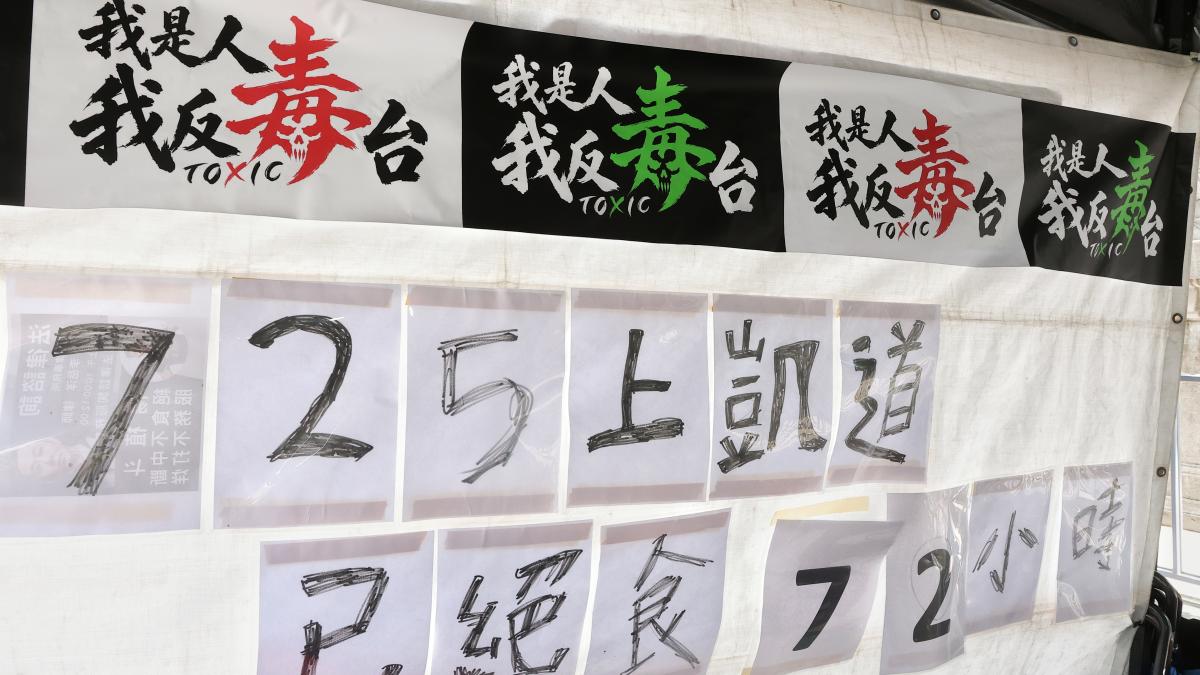
With the 2026 local elections approaching, the carcinogenic oil scandal involving Chung Lien Edible Oil continues to ignite public outrage across Taiwan. Beyond raising food safety concerns, the incident is adding volatility to the upcoming election landscape. The Kuomintang (KMT) has called on citizens to join an 'anti-toxic oil' rally on Ketagalan Boulevard tomorrow (25th), with Taiwan People's Party (TPP) Chairperson Huang Kuo-chang also set to attend. Taipei Mayor Chiang Wan-an has publicly called on President Lai Qingde to apologize and for Premier Cho Jung-tai to step down and take responsibility.
In response, writer Piaolang Daoyu posted an article titled 'Toxic Oil on the Streets—Still Playing the Anti-China Card in 2028' on the eve of the July 25 opposition rally, asserting that the 2028 presidential election will still revolve around the 'anti-China' narrative. He argues that due to the potential split between the Blue and White camps, the impact of the toxic oil scandal will not be profound.
How many people will attend the anti-toxic oil rally on Ketagalan? How significant will its impact be on the 2026 elections?
Piaolang Daoyu noted that while external predictions suggest high turnout for the July 25 protest, extreme heat and weak grassroots mobilization may limit participation. He believes attendance could exceed 100,000 but reaching a million is overly optimistic. '2026 is not the decisive battleground,' he emphasized, adding that even if massive protests occur, the worst outcome would be a minister’s resignation or an early cabinet reshuffle. Even if the DPP suffers a major defeat in the 2026 local elections, it won’t affect President Lai Qingde’s re-election strategy for 2028. Looking back, the DPP lost badly in the 2018 and 2022 local elections, yet still retained power by winning the presidential elections.
Piaolang Daoyu analyzed past elections through the 'pendulum effect,' but concluded that the real driver has been the consistent success of the 'anti-China' narrative. In 2016, the Sunflower Movement boosted support; in 2020, the anti-extradition protests helped; and in 2024, military drills around Taiwan influenced voters. Though the effect is weaker now, the Blue-White split benefits the DPP. Therefore, no matter how strong the toxic oil scandal becomes, the DPP’s worst-case scenario is another defeat in 2026. As long as no one within the party dares challenge Lai Qingde, he will run in 2028 and continue playing the anti-China card. 'Escalating military conflict guarantees votes—China remains the DPP’s vote-generating machine,' he stated.
Who should resign over the toxic oil scandal? What traffic controls are in place for the Ketagalan rally?
Piaolang Daoyu concluded that Lai Qingde is not the most worried figure as people take to the streets on July 25—rather, it’s Premier Cho Jung-tai. If public anger intensifies and affects the 2026 elections, Cho may be seen as having 'completed his phased mission,' just as Lai Qingde stepped down as premier after the 2019 defeat. Regarding the Ketagalan rally, Chiang Wan-an called on citizens to protest 'toxic oil' on the 25th and personally visited the KMT’s legislative caucus and Legislative Speaker Han Kuo-yu. Han Kuo-yu, KMT Chairperson Jennifer Wang, TPP Chairperson Huang Kuo-chang, and several Blue camp mayors and magistrates are expected to attend. Traffic control will be implemented on Ketagalan Boulevard and surrounding areas starting at 8 p.m. on the 25th.
FACT BOX
- Source: PR Times
- Category: News