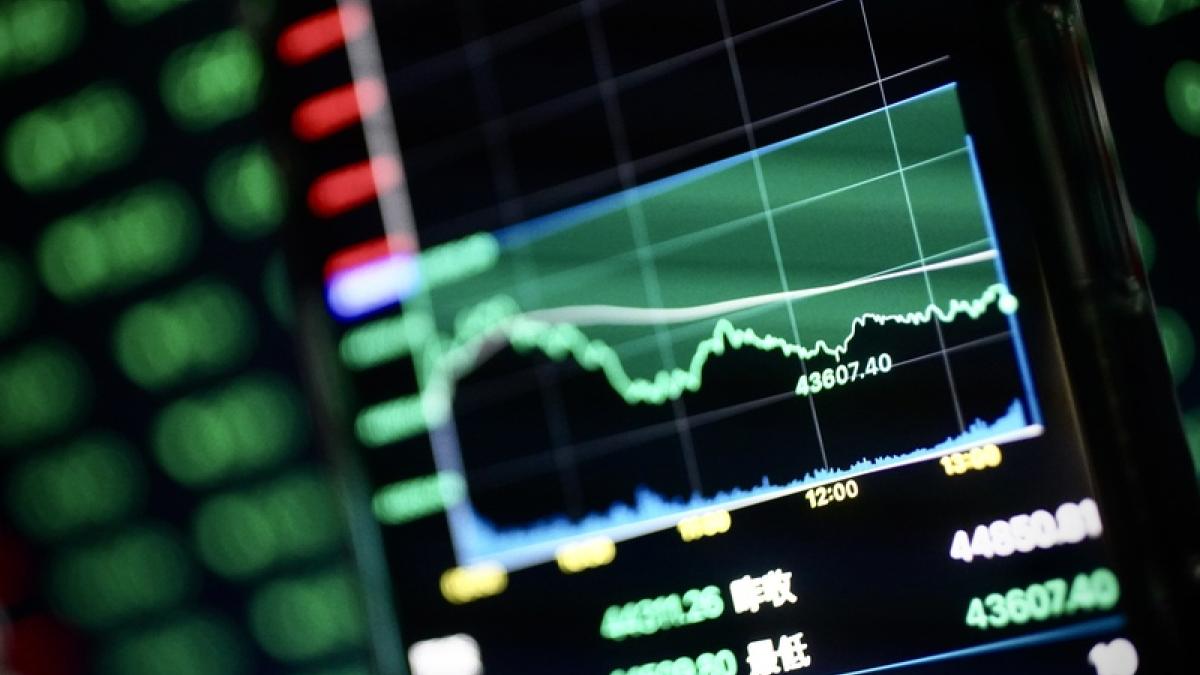
Global stock markets are experiencing severe volatility due to concerns over artificial intelligence (AI) capital expenditure profitability, frequent Middle Eastern conflicts, and interest rate decisions by the U.S. Federal Reserve (Fed). Taiwanese companies are also under heavy pressure due to crowded trading. In response, financial expert Yu Ting-hao analyzed the situation on the program 'Caijing Haojiao,' pointing out that Taiwan still shows significant trading activity.
Yu Ting-hao noted that in the second half of the year, there is significant capital inflow into financial stocks, healthcare and wellness stocks, and small-cap stocks. However, previously high-performing large growth stocks, hardware stocks, consumer electronics, technology stocks, energy stocks, and market communications sectors are facing heavier market selling pressure. Yu stated that internal funds are still in a rotation pattern, saying, 'It's too early to say we've entered a systemic sell-off,' but the market's leverage was highly concentrated in certain groups, making this downturn more severe.
Is leveraged capital retreating? Goldman Sachs data: 23% outflow from leveraged ETFs in July
Yu Ting-hao said that this year's exchange-traded fund (ETF) issuance and capital inflows are already double that of 2024, indicating strong underlying buying demand. However, leveraged buying began to see capital outflows after reaching highs in June. 'According to Goldman Sachs statistics, 23% of funds flowed out massively in July,' meaning leveraged ETF assets are shrinking amid this stock price correction.
Yu added that initial public offering (IPO) enthusiasm has attracted more capital into the market, crowding out space for other individual stocks. However, the valuations of these capital-attracting IPOs are now gradually declining. For example, SpaceX's IPO price has officially broken below its offering price, indicating that although company earnings haven't significantly deteriorated, 'the bond market has already started to loosen.'
Capital rotation underway! Large tech stocks under pressure, 'three groups' absorbing capital against the trend
Yu Ting-hao noted that 'ultra-large cloud providers' including Amazon, Microsoft, Google, Meta, Nvidia, and Oracle have issued a total of $250 billion in bonds this year. The credit spread premium over market interest rates is also rapidly widening. Yu emphasized that credit spreads are expanding at an extremely fast pace. Bond market pressure is affecting stock valuations, ultimately causing a crowding-out effect. The current market focus is on when free cash flow will run out. 'Only when it runs out will we realize that perhaps this game can no longer continue.'
Regarding Taiwan, Yu pointed out that despite TSMC's strong earnings report, its stock price is under heavy pressure due to crowded trading. Additionally, Taiwan's total exports and imports continue to rise, with annual increases of 47% and 40% respectively, indicating significant capital buying is driving trading activity.
Yu forecasts that even as stock prices enter a consolidation phase, ETF net buying will remain positive over the next few months. Although some individual stocks are seeing rapid declines in margin financing and fast-dropping maintenance ratios, overall, ETF spot buying still exceeds the pace of margin financing contraction. Yu noted that Taiwan's margin balances and maintenance ratios have moderately declined, and the next focus should be on whether stock collateralization and youth investor participation rates begin to weaken.
FACT BOX
- Source: PR Times
- Category: News
- Organizations: Amazon / Microsoft / Google
- Products / services: ETF / IPO