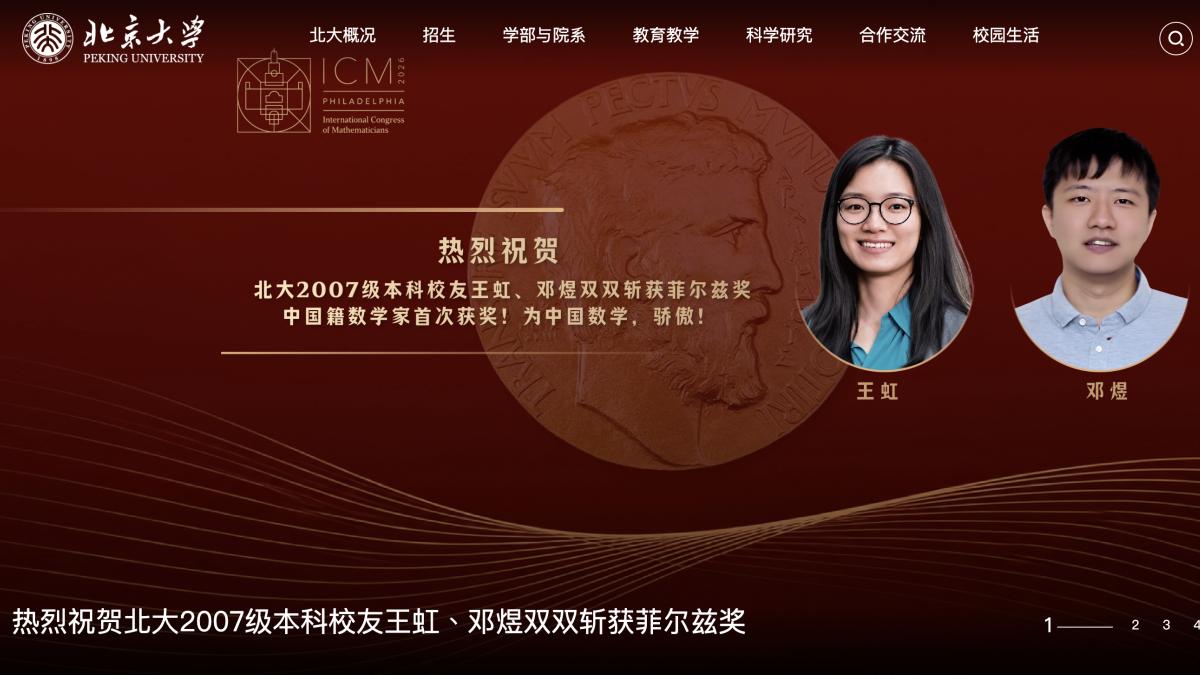
According to Chinese state media, two Chinese scholars have won the Fields Medal, widely regarded as the highest honor in global mathematics. Chinese mathematicians Wang Hong and Deng Yu were awarded the prize alongside John Pardon from the United States and Jacob Tsimerman from Canada. Each recipient received 15,000 Canadian dollars (approximately 10,500 USD; 8,000 GBP). Wang and Deng were honored for solving mathematical problems that had puzzled scholars for over a century. Wang Hong, aged 35 and teaching in both the U.S. and France, is only the third woman ever to receive the award.
The Fields Medal, often called the 'Nobel Prize of Mathematics,' was awarded on Thursday, July 23, in the United States. Meanwhile, human computational capabilities are increasingly being challenged by artificial intelligence.
The achievements of the two scholars sparked enthusiastic reactions on Chinese social media. On platforms ranging from Weibo to Xiaohongshu, topics such as 'Fields Medal' and 'First Chinese Mathematicians to Win the Fields Medal' garnered hundreds of millions of views. One Weibo user commented, 'A pride for all Chinese people.' Another said, 'We are witnessing history.'
Chinese media extensively covered the scholars, detailing their educational backgrounds, personal interests, and the significance of their achievements for China. Shing-Tung Yau, the first Chinese-American Fields Medalist, said, 'For the Chinese mathematical community, this is a long-cherished dream we've hoped to achieve for decades.'
Wang Hong, together with her colleague Josh Zahl, solved a problem posed by Japanese mathematician Soichi Kakeya in 1917: If you rotate a pencil so that it completes one full turn, what is the minimum area it sweeps? In their research, Wang and Zahl assumed the pencil was suspended in three-dimensional space, not lying on a plane. They published their findings last year.
Wang told AFP, 'This conjecture is so fascinating because this kind of phenomenon naturally appears in many completely different areas of problems.'
Deng Yu, aged 37 and teaching in the Department of Mathematics at the University of Chicago, won the award for solving another century-old problem. In 1900, German mathematician David Hilbert posed what later became known as 'Hilbert's Sixth Problem': How to calculate the behavior of a whole system based on the motion of individual particles.
Deng Yu solved this problem through research on the behavior of gases. He said it was 'an immense honor' to have his name follow those of the great mathematicians he has long admired.
Wang Hong's research focuses on harmonic analysis, primarily studying the motion of waves. The Fields Medal is awarded every four years to outstanding mathematicians under the age of 40.
Born in 1991 in Guilin, a tourist city in southern Guangxi, China, Wang Hong skipped two grades in elementary school and entered Peking University at age 16 in 2007. She initially majored in Earth Sciences but switched to Mathematics after one year. After graduation, she pursued further studies abroad, attending Paris-Sud University and École Polytechnique in France, then earning her Ph.D. from the Massachusetts Institute of Technology (MIT) in the U.S. She is currently a professor at New York University and a permanent professor at the Institut des Hautes Études Scientifiques (IHES) in France.
On Thursday evening, Wang Hong received a congratulatory phone call from French President Emmanuel Macron, who later posted on X: 'She embodies the excellence of our research and training. Pride. Choose France for science!'
Deng Yu began participating in math competitions in elementary school and entered Peking University in 2007, the same year as Wang Hong. However, he transferred to MIT in 2009, earned his Ph.D. from Princeton University, and has been teaching at the University of Chicago since 2024.
This article was translated using artificial intelligence from its original English version. BBC journalists reviewed the translation before publication.
FACT BOX
- Source: PR Times
- Category: News