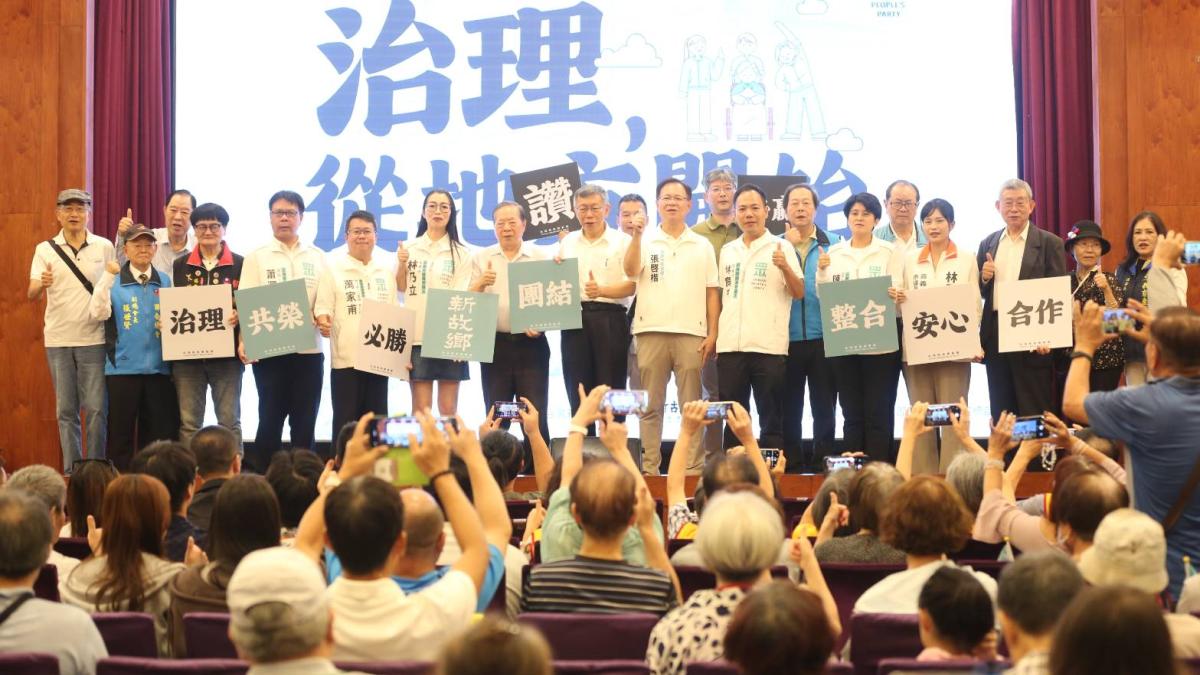
The People's Party Policy Committee, Chiayi Branch, and Taiwan New Homeland Think Tank Association held an event on the 24th titled 'Regional Development in Chiayi and Southern Taiwan from the Perspective of Local Governance – Chiayi South Session,' analyzing social issues such as population aging, youth outmigration, and industrial transformation in southern Taiwan. People's Party Chiayi mayoral candidate Chang Chi-kai stated that if elected, he will build upon incumbent Mayor Huang Min-hui's administration to transform Chiayi City into the most competitive city in the Yun-Chia-Nan region.
Chang delivered a speech titled 'Secure Aging and Empowered Youth in Chiayi – Building a Happy City with Lifespan Care,' declaring his goal to position Chiayi as the 'new core for living and consumption in Yun-Chia-Nan.' He emphasized continuing Huang's policies in transportation, culture, and social welfare, and prioritizing the construction of a light rail connecting the Taiwan High-Speed Rail (HSR) Chiayi Station to the city center and Chiayi Science Park as the top municipal agenda, succeeding Huang's Ten Flagship Projects.
Chang stressed that 'youth opportunity, industrial upgrading, improved long-term care, and advanced transportation' are essential for Chiayi's transformation. He pledged to deepen efforts in youth retention, industrial development, lifespan care, and infrastructure.
He announced a comprehensive increase in child allowances for children aged 0–6: NT$50,000 for the first child, NT$100,000 for the second, and NT$200,000 for the third, along with new birthday gift funds for children. For seniors aged 65 and above, he proposed waiving national health insurance premiums and expanding the Elder Card's usage to include taxi rides, registration fees, convenience stores, supermarkets, and pharmacies. Chang further committed to fully subsidizing health insurance premiums for citizens aged 65 and above, building on Mayor Huang's existing policies.
On transportation, Chang advocated that a light rail linking the HSR station, urban center, and science park would shorten commute times, integrate Chiayi County and City into a shared living zone, and stimulate industry, tourism, and population return—making Chiayi the true 'development core of Yun-Chia-Nan.'
Chang criticized the Executive Yuan for recently approving the NT$352.1 billion HSR extension to Yilan, while Chiayi's light rail project, pursued for over 21 years, has received only about NT$30 billion in funding and lacks central support. He pointed out that Democratic Progressive Party (DPP) mayoral candidate Wang Mei-hui's top 2020 legislative campaign promise was 'advocating for Chiayi light rail and improving HSR and TRA networks,' yet she has not actively supported the project recently.
He expressed regret that Chiayi's police and fire departments merely reposted city government news about the light rail, yet Wang proposed cutting or freezing budgets for the National Police Agency and Fire Agency, citing violations of administrative neutrality. Chang condemned this as politicizing budget oversight, pressuring frontline officers, hindering Chiayi's development, and betraying public expectations.
Chang emphasized that the central government must treat Chiayi fairly and end its long-standing neglect. Currently, Mayor Huang, cross-party councilors, and all 84 of Chiayi's village heads have jointly petitioned for the light rail. The city government has completed a feasibility study and gained local council support, yet the project remains unapproved, repeatedly disappointing public hopes.
On tourism, Chang pledged to make Chiayi an international destination. He highlighted cultural assets like the City God Temple Zhongyuan Festival, century-old temples, and local snacks, proposing a 'Visit Temples, Eat Snacks' brand to attract global tourists. He also plans to develop the water airport for international charter flights, enabling direct access to Chiayi and boosting tourism, accommodation, dining, and local business districts.
For youth policy, Chang declared a vision to create a 'paradise for entrepreneurship and employment.' Beyond expanding the Chiayi Innovation Center, he aims to grow the current two cultural districts into six特色商圈 (2+4 model), and develop a logistics, cold chain, and smart industry cluster along Beigang Road to attract investment and create youth jobs.
Chang emphasized his past legislative work advocating for military, civil servants, teachers, police, firefighters, and farmers, and promoting the 'Youth Wage Increase Act' to incentivize companies to raise youth salaries, hoping more young people will stay in or return to Chiayi.
He urged that Chiayi's future must rely not just on welfare, but on transportation infrastructure, industrial growth, and high-paying jobs to truly retain youth. 'Only when young people see hope can Chiayi become the most competitive city in Yun-Chia-Nan once again.'
FACT BOX
- Source: PR Times
- Category: News