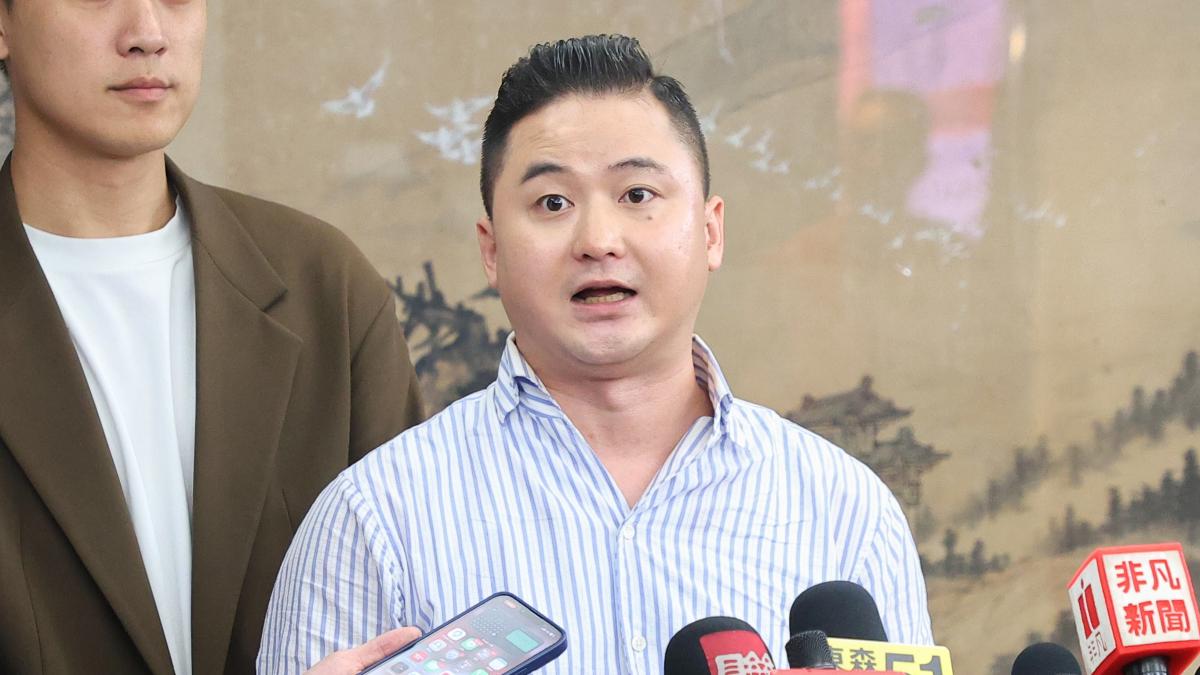
On July 25, the Kuomintang rallied supporters to Ketagalan Boulevard. Meanwhile, Wei Chun-yu, former New Media Director of the KMT and leader of the 'Principal Lai' team, produced a promotional short film titled 'You Bu De Ni,' which used AI to simulate President Lai Qingde's voice. After being reported by the public, the Criminal Investigation Bureau visited his home for verification, sparking backlash from the Blue Camp, who criticized it as 'meter checking.'
In response, Wei issued a statement on the 26th, asserting, 'The protagonist of this video is benzopyrene—a barrel of oil. What exactly could be mistaken?'
The Criminal Investigation Bureau explained that the case arose from public reports alleging that the viral 'You Bu De Ni' video used AI deepfake technology to synthesize the president's voice, potentially misleading the public into believing it was the president speaking. After receiving the report, police conducted a legal investigation to clarify facts, preserve evidence, and understand the production process. They advised Wei to voluntarily assess whether to adjust or remove the video due to potential public confusion or continued spread, but emphasized that they did not force removal or restrict his personal freedom or right to expression.
On the 26th, Wei posted a statement on Facebook's 'Feng Xiang 123 Shi,' stating that before 3 p.m. on July 25, he had already left home to prepare for the rally when he found two police officers at his doorstep. The Criminal Investigation Bureau politely clarified they were not 'requiring' the removal of 'You Bu De Ni' but 'suggesting he assess it himself.' Wei noted that the DPP government's wording was carefully chosen.
Wei revealed that only his father was at home. The Criminal Investigation Bureau failed to locate him. As a citizen who lived through martial law, his father asked, 'On what grounds are you doing this?' Later, over the phone, he told Wei, 'This isn't right—it's just like the old days.'
Wei questioned the police claim that the video 'might cause public misidentification.' 'What could be misidentified?' he asked. 'The video clearly states at the beginning that the protagonist is benzopyrene—a barrel of oil—not any political figure. The real issue that needs fixing is a system left unrepaired for 13 years, not anyone's reputation. Since when has police intervention become necessary to verify creative works based on public commentary?'
First, Wei said he witnessed efficiency: Midstream reported in late June; a month has passed, and while the oil was recalled, processed foods made with it have not been fully recalled. A list of over 1,300 downstream businesses was only released after persistent pressure. Ordinary citizens must check their receipts and batch numbers themselves to know what they’ve consumed. Yet, for a video about benzopyrene, police were at his door the next day. 'The speed of investigating toxic oil versus investigating me is vastly different,' he said.
He asked: 'They say the video might mislead the public—what exactly was misidentified? That benzopyrene is a carcinogen? That a month after toxic oil leaked, the authorities still don’t know the full impact? That a spokesperson angrily said, 'It’s not like I forced you to eat it'?'
Third, Wei emphasized this was never about him personally. 'Who I am isn’t hidden, but benzopyrene doesn’t discriminate by color—it’s whoever’s pot it ends up in that matters. Now, not only is cooking oil unsafe, but so is freedom of speech. Today they knock on the door for a video about oil; tomorrow, they could knock on anyone’s door for any image that makes them uncomfortable.'
Wei said President Lai Qingde or Premier Cho Jung-tai need not send police or issue press releases. If either personally said, 'Request removal,' he would take it down—even though every word in the video is true. 'The video can be removed, but the unanswered questions in people’s hearts cannot be taken down.'
FACT BOX
- Source: PR Times
- Category: News