As populations age, cataracts have become a common vision problem among older adults. With artificial intelligence and robotic technologies gradually entering ophthalmic operating rooms, many are wondering whether these new technologies can make surgeries more stable and safer.
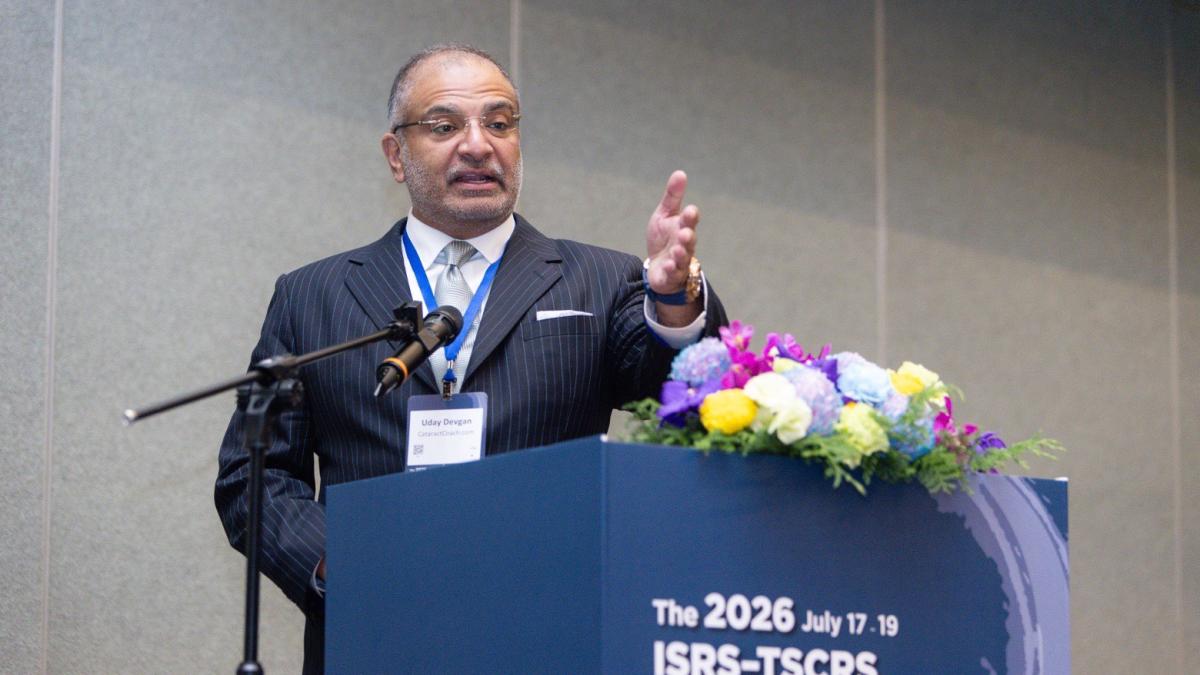
The 2026 joint annual meeting of the International Society of Refractive Surgery (ISRS) and the Taiwan Society of Cataract and Refractive Surgery (TSCRS) was held in Taiwan, bringing together 47 international ophthalmology experts from 15 countries to exchange the latest medical technologies. Dr. Sun Chi-Chin, Vice Superintendent of Keelung Chang Gung Memorial Hospital, noted that U.S. ophthalmologist Dr. Uday Devgan shared his experience with the world’s first robotic-assisted cataract surgery, indicating that ophthalmic medicine is progressively advancing into a smart era integrating artificial intelligence, image recognition, and precision control.
Dr. Sun emphasized that the integration of AI and robotics into ophthalmic examinations, surgical planning, and clinical decision-making will drive the field toward greater intelligence and precision. (Photo provided by Dr. Sun Chi-Chin)
Cataract surgery is already highly mature, but the intraocular space is extremely small, requiring extremely precise manipulation. Even differences of just tens of micrometers can affect surgical outcomes. Experienced surgeons may still be affected by fatigue, long working hours, or minor hand tremors. The advantage of robotics lies in maintaining a more stable operational state, helping to reduce human variability and improve consistency in surgical procedures.
Dr. Uday Devgan completed the world’s first robotic-assisted cataract surgery in 2025 and has since accumulated 10 cases within one year. Currently, the technology is primarily applied to relatively straightforward cataract cases. If image recognition, sensing capabilities, and operational precision continue to improve, it may eventually be extended to more delicate ophthalmic procedures such as retinal surgery.
Dr. Sun pointed out that the key value of robotic surgery is not only in motion stability but also in its ability to integrate AI and intraoperative navigation to identify ocular tissues, instrument positions, and safety zones in real time.
For example, during cataract phacoemulsification surgery, when instruments approach critical intraocular structures such as the posterior capsule, the system can issue alerts and automatically stop or adjust movements based on preset parameters, reducing the risk of continued operation in high-risk areas.
Since cataract patients are mostly elderly and typically remain awake during surgery, they may suddenly move due to anxiety or discomfort. The robot’s sensing and rapid response capabilities could provide an additional layer of safety during such situations.
However, Dr. Sun emphasized that robots do not perform surgeries autonomously nor replace physicians. The entire surgical process remains under the full control of a qualified surgeon, who can immediately intervene if the patient moves, intraocular conditions change, or unexpected events occur.
Group photo of ISRS and TSCRS board members and invited international and domestic ophthalmology experts. Dr. Sun hopes that through international exchanges, Taiwan can enhance its participation in the fields of smart ophthalmology and clinical research. (Photo provided by Dr. Sun Chi-Chin)
Dr. Sun noted that while some cataract surgeries in the U.S. may use sedation anesthesia, in Taiwan, local topical anesthesia is commonly used, with patients typically remaining awake. Due to differences in clinical workflows, overseas experiences cannot be directly applied, and Taiwan must accumulate case data and evidence suited to its own medical environment.
Previously, robotic-assisted surgery has mainly been used for relatively simple cases. For patients with iris abnormalities, corneal opacity, or other complex intraocular conditions, clinical judgment based on physician experience remains essential.
Dr. Sun believes that AI’s impact on ophthalmic medicine extends beyond the operating room, transforming the entire patient journey from examination and diagnosis to treatment.
In the future, AI could assist in scheduling examinations, identifying missing items, and integrating patient data such as age, vision, ocular imaging, medical history, and health information. This would help physicians detect potential issues like glaucoma or retinal diseases and evaluate appropriate surgical methods and intraocular lenses.
Dr. Sun stated that the goal of smart ophthalmology is not to replace physicians with machines, but to use technology to help doctors access more comprehensive information, reduce procedural variability, and make better medical decisions tailored to each patient.
For aging populations, the true value of new technologies lies not merely in equipment upgrades, but in enabling more thorough examinations, more stable surgeries, and a shift toward safer, more precise, and personalized vision care.
The 2026 ISRS–TSCRS Joint Annual Meeting took place in Taiwan, gathering domestic and international ophthalmologists to exchange the latest developments in cataract surgery, refractive surgery, artificial intelligence, and smart healthcare. (Photo provided by Dr. Sun Chi-Chin)
FACT BOX
- Source: PR Times
- Category: Event