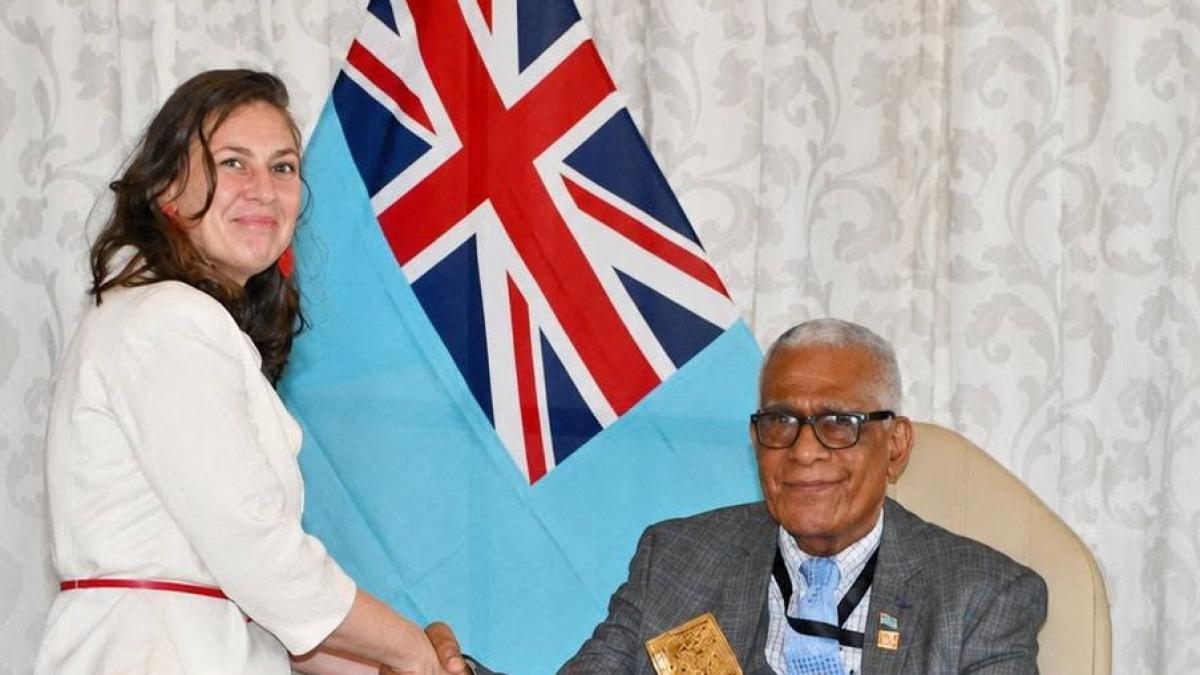
Maya Yuron, former Israeli representative to Taiwan, completed her term in June this year and seamlessly transitioned to her new role as Israel’s ambassador to Fiji—the first head of mission since Israel reopened its embassy in Fiji after a 30-year hiatus. At first glance, Yuron’s new post might appear to be a minor diplomatic assignment, but in fact, Israel has increasingly prioritized Pacific Island nations in recent years. Yuron is not only Israel’s ambassador to Fiji but also concurrently responsible for Israel’s diplomatic relations with ten other Pacific allies: Micronesia, Kiribati, the Marshall Islands, Nauru, Palau, Samoa, the Solomon Islands, Tonga, Tuvalu, and Vanuatu. In other words, she and the embassy will serve as the diplomatic hub for Israel in the Pacific Islands. Coincidentally, within Yuron’s Pacific jurisdiction are three of Taiwan’s allies in the region: the Marshall Islands, Palau, and Tuvalu. Israel’s renewed diplomatic focus on the Pacific is largely driven by the need to strengthen its support base in international organizations and secure a reliable bloc of votes in diplomatic arenas. In early June 2026, Israel’s newly appointed ambassador to Fiji, Maya Yuron (left), attended the embassy’s inauguration ceremony. (Israeli Ministry of Foreign Affairs Facebook) Israel Reopens Embassy in Fiji After 30 Years, Covering 10 Pacific Nations Following Fiji’s establishment of an embassy in Israel in September 2025, Israel opened its own embassy in Fiji in early June this year, with Israeli Foreign Minister Gideon Sa’ar personally attending the event. According to Israeli media reports, Pacific Island nations have recently attracted growing attention from major powers, which have expanded their influence through aid, climate policy, security cooperation, and joint development. Israel’s reopening of its embassy in Fiji enables the country to maintain a long-term diplomatic presence in the region. During high-level meetings with Fijian government officials in early June, Foreign Minister Sa’ar stated that reopening the embassy “allows us to continuously expand our diplomatic activities worldwide, especially in the Pacific region, and clearly signals our intent to strengthen ties with friendly nations.” Yuron remarked, “Establishing a new embassy is a very unique experience. Every day, I learn how complex and challenging it is to set up a new diplomatic mission so far from Israel.” Although Fiji is located in the South Pacific, Yuron’s new jurisdiction spans both north and south of the equator, stretching from the Marshall Islands in the north to Palau in the west and Kiribati in the east. These island nations play crucial roles in oceanic and climate issues and are of immense importance to Israel in international forums, particularly at the United Nations. She noted, “Israel must find friendly nations willing to support and understand us, and who can share this perspective with others, helping the international community better understand and accept us.” With a population of less than one million, Fiji holds significant strategic importance in the Pacific and serves as a key transportation hub for many other island nations. For example, Taiwan’s Taipei Commercial Office in Fiji oversees operations in neighboring Nauru, Kiribati, Samoa, Tonga, Vanuatu, New Caledonia, and French Polynesia (Tahiti). Micronesia, Nauru, Palau, and the Marshall Islands Have Long Supported Israel at the UN According to reports from Israeli and New Zealand media, whenever the UN General Assembly votes on resolutions unfavorable to Israel, Pacific Island nations such as Nauru, Micronesia, Palau, and the Marshall Islands have consistently supported Israel. For instance, according to data from the historical database UN Watch, Micronesia did not cast a single vote against Israel over the past decade up to July 2025—a record not even the United States has achieved—demonstrating the strong pro-Israel stance of these Oceanic nations. Why do Pacific Island nations generally support Israel diplomatically? Experts observe that at least two factors—political history and religion—play a role. Steven Ratuva, a distinguished professor specializing in Pacific studies at the University of Canterbury in New Zealand, points out that many Pacific Island nations were formerly German or Japanese mandates, became U.S. trusteeships after WWII in 1945, and gained independence in the latter half of the 20th century. Long-standing political and religious ties with the Western world have shaped this region’s support for Israel. “Most Pacific Island nations have been closely aligned with the U.S. since the Cold War, so naturally many believe they should remain within the Western sphere of influence.” Secondly, evangelical Christian thought has been gradually rising in certain Pacific regions, particularly in Fiji. Evangelical beliefs closely align with Zionism and the global movement advocating for the return of Jews to their homeland. “Smaller religious groups that align with or model themselves after the American evangelical movement easily support Israel for religious reasons, especially since the American evangelical movement has strongly supported Trump.” “Of course, when you mix religion and politics, you create a powerful global positioning.” Israel’s new representative to Taiwan, Israel Strulov (right), has visited multiple government agencies since taking office in June. (Israel in Taiwan Facebook) New Israeli Representative to Taiwan, Israel Strulov, Served Three Diplomatic Tours in Japan and Speaks Basic Japanese Additionally, Israel Strulov, Israel’s new representative to Taiwan, assumed office in June. Aged approximately 54–55, he has spent most of his 20-year diplomatic career focused on Japan and speaks basic Japanese. Reviewing Strulov’s background reveals that from October 2003 to June 2004, he participated in the Japan Foundation’s training program for diplomats and public officials, studying Japanese at the Kansai Japanese Language Institute. From August 2005 to September 2010, he served as First Secretary in the Political Division of the Israeli Embassy in Japan. He then returned to Israel, serving as Counsellor for Northeast Asia in the Asia-Pacific Division of the Israeli Ministry of Foreign Affairs from September 2010 to August 2012. From August 2012 to August 2017, he was posted again to Japan as Minister-Counsellor for Political and Political-Military Affairs at the Israeli Embassy. From August 2019 to August 2024, he served as Minister and Deputy Chief of Mission at the Israeli Embassy in Japan. Immediately before arriving in Taiwan in June, he served as Director of the African Division at the Israeli Ministry of Foreign Affairs for one year.
FACT BOX
- Source: PR Times
- Category: 人事