Let me first introduce a lost art: the 'Art of Stopping' (Zhi Xue), written by Wang Tong (pen name Wenzhongzi) between the Sui and Tang dynasties. The term 'lost art' refers to an exceptionally advanced discipline that has long been forgotten. Why was this art lost? Because it teaches 'knowing when to stop'—yet most people fail to practice it, so it was never passed down.
However, the 'knowing when to stop' taught in the 'Art of Stopping' is not merely a philosophy for preserving success. It aligns with the Confucian principle from the 'Great Learning': 'Only after knowing where to stop can one have stability; with stability comes calmness; with calmness comes peace; with peace comes thoughtful reflection; and with reflection comes attainment.' Everything begins with 'knowing when to stop' and culminates in 'attainment'—a discipline that teaches how to advance steadily toward success while avoiding the trap of winning only to lose it all again.
Trump's war with Iran is a classic example. He achieved an overwhelming victory, yet five months later, Iran has become an uncontrollable mess he cannot resolve. There are many reasons, but had Trump understood 'knowing when to stop,' he would not have fallen into this predicament.
One key point of the 'Art of Stopping' is, in modern terms, 'constantly assessing your current position.' 'Constantly' does not mean obsessively counting chips like a gambler, but rather pausing, calming your mind, and settling your thoughts when your circumstances change—whether in triumph or defeat—then revising your original plans or direction (reflection), so you can 'attain'—avoiding further losses and maximizing gains.
Since winning the election in November 2024, Trump has been on a winning streak—effectively acting as president from the moment the results were announced. Throughout 2025, he was unstoppable; despite his repeated 'TACO' actions, no one in the U.S. or around the world could challenge his momentum.
Many commentators argue that Trump's overconfidence in attacking Iran stemmed from his smooth operation in Venezuela. This is valid—Venezuela was not Iran. After his overwhelming victory in Venezuela, Trump failed to 'stabilize, calm, and find peace,' carrying the same mindset into Iran and hitting a wall. Worse, after the first failure, he kept charging forward, eventually landing in an irreparable situation.
In truth, Trump has never experienced 'stability, calm, and peace' since the moment he was elected. While his domestic actions (like the Department of Government Efficiency, ICE) and international moves (such as tariffs) were likely planned, his approach upon encountering setbacks has always been to push through by force—his mind simply lacks the concept of 'knowing when to stop.' The problem is, he has always managed to 'attain' something.
Looking further back, every U.S. president before Trump—Clinton, George W. Bush, Obama, and Biden—also failed to practice 'stability, calm, peace, reflection' after setbacks, because America kept 'attaining' victories. Yet, America's overall national strength has been declining. As long as it kept 'winning,' it relied on three 'magic weapons'—the U.S. military, the U.S. dollar, and media power—to forcefully overcome obstacles. Only when these weapons began to lose their effectiveness, and Americans felt the nation was 'no longer great,' did Trump's 'MAGA' slogan gain traction.
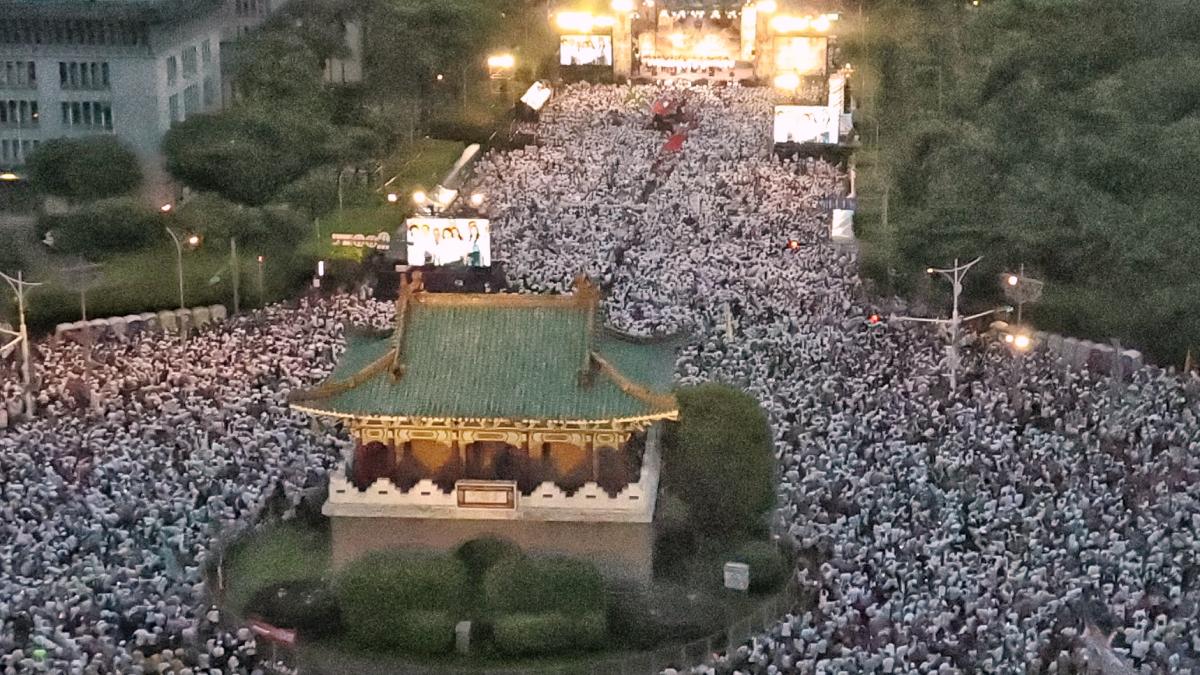
Now, turning to Taiwan. Last weekend's massive protest was framed around 'food safety.' Let me be frank—how could such a minor issue trigger such a large-scale demonstration? Past incidents, like the Ting Hsin cooking oil scandal or the U.S. beef and pork (ractopamine) controversies, never provoked such a response. Frankly, the turnout reflects the public's accumulated resentment toward the government and ruling party.
After Tsai Ing-wen won over 8 million votes, the DPP believed it had secured power. Despite losing the 2022 local elections, Lai Qingde's easy victory in 2024 led them to launch a large-scale recall campaign to eliminate 'remnants.' But this was all due to 'not knowing when to stop': after their 2020 victory, they failed to pause and reflect, thus gaining less than they could have; after the recall campaign failed completely, they again failed to reflect, leading to their current decline.
Previously, the DPP dismissed all opposition as 'Chinese Communist united front tactics,' successfully navigating every crisis. This time, with no 'China shield' available on a food safety issue, the government's 'numb feet, dull mind, and stubborn mouth' were fully exposed. The opposition's call brought out massive support even under 35°C heat—not just because supporters were pent up, but because the ruling party's response was so lackluster and arrogant that it inevitably led to this uncontrollable situation.
Conversely, if the opposition, now enjoying such passionate support, fails to 'stabilize, calm, and reflect,' and instead charges ahead assuming favorable momentum, they will surely 'not win enough.'
*Author is a columnist.
FACT BOX
- Source: PR Times
- Category: News