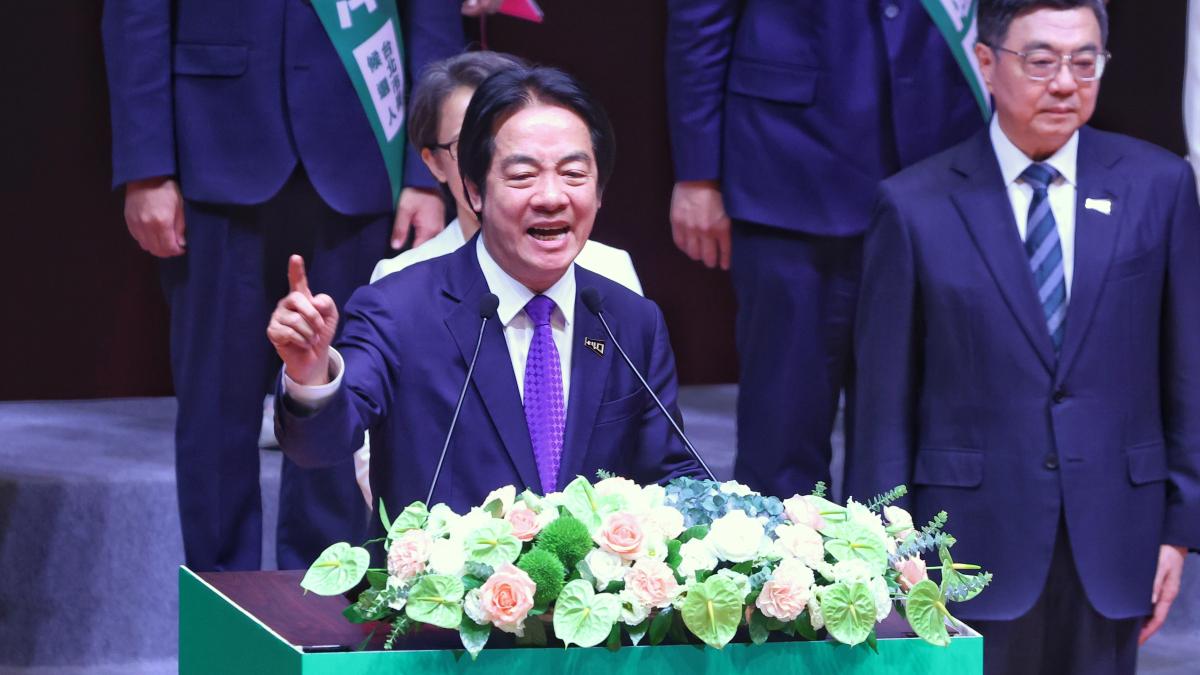
On the 40th anniversary of the Democratic Progressive Party's founding, President Lai Qingde, who concurrently serves as party chair, once again declared, 'Taiwan is a sovereign and independent nation; its constitutional name is the Republic of China.' This statement appears to reconcile 'Taiwan' with the 'Republic of China,' but in reality, it deliberately blurs and reverses the relationship between the two. This reflects the DPP's recent political strategy of 'de facto independence without declaration'—avoiding formal legal independence or constitutional name changes, while gradually altering public perception of national identity through political rhetoric, education, culture, diplomatic narratives, and administrative actions. This approach poses at least five constitutional risks, and President Lai owes the public a clear explanation.
First Question: Is the constitutional definition of the state under the 'Republic of China Constitution' being changed?
According to the 'Republic of China Constitution,' the official state name is clearly 'Republic of China.' When the president takes office, they swear to uphold this constitution. However, in recent years, official government communications, National Day events, overseas promotional materials, and public discourse increasingly use 'Taiwan' as the primary national designation, while 'Republic of China' is gradually being downplayed. Supporters argue this strengthens Taiwan's sense of sovereignty. In reality, however, this is changing the state's constitutional identity without going through formal constitutional amendment procedures. If the government truly intends to redefine the state, shouldn't it follow constitutional processes rather than advancing through administrative narratives?
Second Question: Does ambiguous state identity deepen internal divisions?
The ROC Constitution defines the state as the 'Republic of China' and maintains a constitutional framework for cross-strait relations. Yet the Lai administration's political discourse increasingly replaces 'Republic of China' with 'Taiwan,' redefining the nation's name, historical context, and constitutional order. This has left national identity in prolonged dispute, creating a divide between 'Taiwan identity' and 'ROC identity.' National identity has become a political mobilization tool, weakening the country's overall competitiveness.
Third Question: Are cross-strait relations entering higher-risk territory?
Beijing has long treated 'Taiwan independence' as a red line. Even if Taiwan does not formally declare legal independence, if Beijing perceives that Taiwan is advancing 'de facto independence' through political language, education, culture, and diplomatic narratives, it may intensify military, diplomatic, and economic pressure. In recent years, official cross-strait communication mechanisms have been suspended, and Chinese military drills and naval and aerial circumnavigation of Taiwan have become routine—indicating a continuous erosion of mutual trust, dependent on how each side interprets the other's political intentions.
Fourth Question: Does replacing 'Republic of China' with 'Taiwan' genuinely expand international space?
The Lai administration emphasizes that using 'Taiwan' enhances international visibility, yet diplomatic outcomes have not improved. Taiwan's diplomatic allies have decreased from 22 to 12, and recently, Papua New Guinea announced the closure of Taiwan's representative office in Port Moresby—further highlighting the shrinking of Taiwan's international space. The administration blames Beijing's suppression, but the public has the right to ask: if 'de facto independence without declaration' truly expands international space, why are formal diplomatic relations continuing to erode? The administration must honestly assess whether its current approach genuinely expands diplomatic space or worsens Taiwan's predicament.
Fifth Question: Should major changes in state identity require broad public consensus?
State identity profoundly affects people's sense of identity, cross-strait policy, foreign relations, and national security. Such a significant policy should not be advanced gradually through political rhetoric, nor should party ideology replace constitutional procedures. If the ruling party believes the current state identity should change, it should follow democratic processes like constitutional amendment, allowing the public to fully debate and collectively decide—rather than creating irreversible facts through administrative narratives.
President Lai must honestly confront the constitutional risks of the 'de facto independence without declaration' strategy. A nation's greatest strength lies not in weapons, but in whether its people are willing to stand together as one community. Especially amid rising military pressure from China and rapidly shifting global dynamics, what people truly need is unity—not deeper national identity divisions led by their national leaders.
*The author is a university professor.
FACT BOX
- Source: PR Times
- Category: News