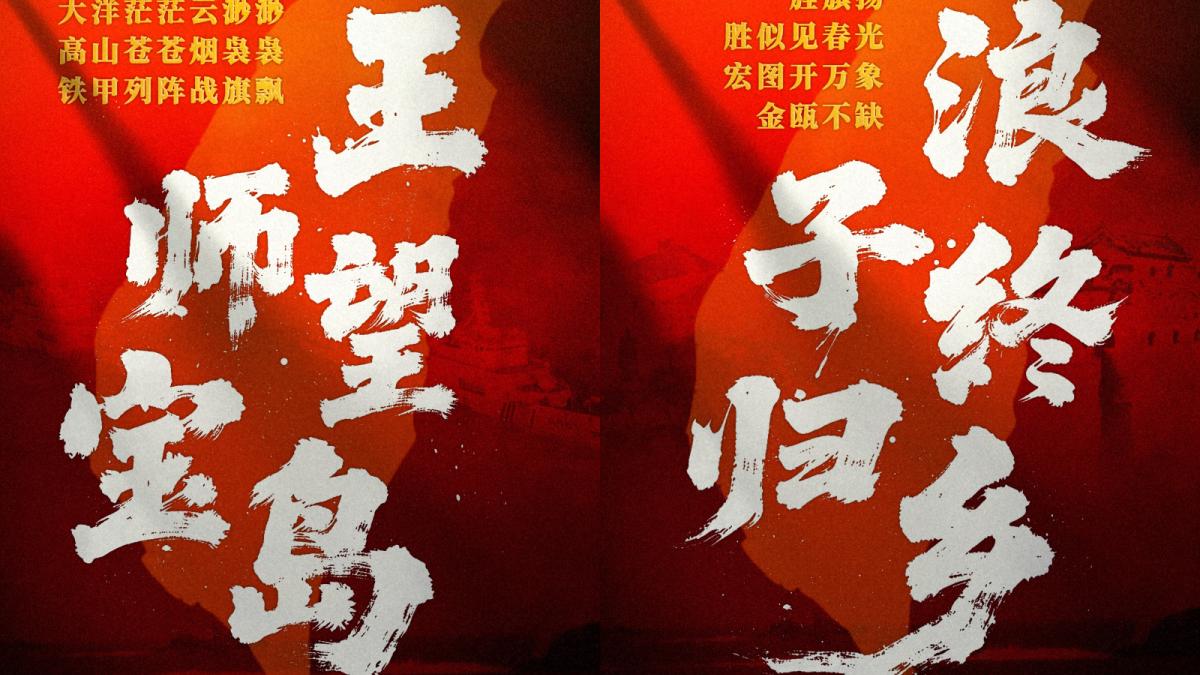
A patriotic mainstream film aiming to capitalize on nationalist box office appeal has unexpectedly touched a deep-seated historical nerve: the 'anti-Qing, restore Ming' sentiment embedded in Chinese popular culture. Recently, multiple media outlets reported that the historical war epic 'The Battle of Penghu,' originally scheduled to premiere in Chinese theaters on July 25 as part of the summer lineup, was pulled from release just six days before its debut. The film's official Weibo account ceased updates in mid-June and has not opened pre-sales; the production company only responded on Weibo, 'We have not received any notice of withdrawal.' Dubbed a 'National Key Film,' the movie has drawn public attention, becoming a new case study in political and cultural dynamics. Directed by Hong Kong filmmaker Dante Lam, the film stars Chinese actor Wang Xueqi as Shi Lang and Yi Yangqianxi as Emperor Kangxi, based on the 1683 historical event in which Qing official Shi Lang led Fujian naval forces to defeat the Ming Zheng regime, leading to Taiwan's incorporation into the Qing dynasty. Why, then, has this seemingly politically correct historical film faced obstacles in China? Analysts suggest that while the film promotes slogans like 'what is isolated must return' and 'divided territories must reunify,' its actual rollout has been repeatedly constrained by domestic public opinion and ideological red lines. Experts argue this is not merely a scheduling change but a subtle clash between the official 'great unification' narrative and the grassroots 'Ming nostalgia' trend. Authorities are also reportedly reluctant to further inflame narratives around 'military unification of Taiwan' at this time. According to Taiwan's state media, Central Broadcasting Network, citing Chinese political commentator Lu Qing, 'The Battle of Penghu' may have stirred controversy due to excessive allegorical references to recent East Asian geopolitics, such as heightened military exercises in the Taiwan Strait and South China Sea. 'Under normal circumstances, the metaphors and allusions in this patriotic film might not rise to the level of political signals. But at this moment, such implications face stricter political scrutiny, as the film's political significance has intensified.' The 'Anti-Qing, Restore Ming' Sensitivity However, more commentary suggests the film's core issue lies in the rising folk historiography in China—'Ming nostalgia.' 'Ming nostalgia' refers to a growing online sentiment that sympathizes with the Ming dynasty and criticizes the Qing. As previously reported by BBC Chinese, this trend began with a Chinese internet creator's video claiming that the classic novel 'Dream of the Red Chamber' is actually an 'anti-Qing, restore Ming' work. This theory unexpectedly sparked widespread imitation, with many posts, amateur historians, and influencers attributing China's modern backwardness and historical humiliations to the Qing dynasty. Some even claimed that 'Man-Han Imperial Feast' symbolized Manchus consuming Han people, leading to online attacks against Manchu celebrities like Wu Jing and Guan Xiaotong. Consequently, viewing Qing general Shi Lang as a 'traitor' or 'turncoat' has become common. Behind 'Ming nostalgia' lies academic debate over the '1644 historical view,' which traces China's decline to the Qing invasion in 1644. In fact, as BBC Chinese previously analyzed, this '1644 view' dates back to early 20th-century intellectuals seeking reasons for China's backwardness in the Ming-Qing transition, ultimately pinpointing the 1644 Qing conquest as the turning point when China began to fall behind. This 'Ming nostalgia' has even crossed the Taiwan Strait. Wu Danru, a well-known Taiwanese writer pursuing a history PhD in China, launched a podcast titled 'This Heart Should Be Like Wang Yangming,' defending the Ming philosopher Wang Yangming, who was marginalized in official history. Fei-Hsien Wang, a Taiwanese scholar and associate professor of history and East Asian studies at Indiana University, told BBC Chinese that the resurgence of 'anti-Qing, restore Ming' discourse reflects deep public anxiety. She explained that China's recent assertiveness toward Japan and trade confrontations with the U.S. clash with Beijing's narrative of a confident, rising power—people realize China, despite being a global competitor, is not receiving the respect it expects. In this context, the '1644 view' has entered mainstream consciousness, allowing people to blame the Qing for today's challenges, despite vastly different circumstances. However, this trend has raised alarms within Chinese authorities. The Communist Party's propaganda department has warned that narratives excluding the Manchu from Chinese identity stem from 'malicious intentions' of external forces, as such 'anti-Qing' sentiments contradict the official narrative of a 'Chinese national community' and a 'unified multi-ethnic state.' Yet, these discouraged narratives have unexpectedly resurfaced in 'The Battle of Penghu,' a film explicitly promoting 'unifying Taiwan.' Some Chinese netizens questioned: if glorifying the Qing's invasion of Taiwan is acceptable, why not make a film about Wu Sangui inviting Qing troops into China? They view the Ming Zheng regime as the last bastion of Han 'Chinese cultural orthodoxy,' interpreting the Qing conquest as 'barbarians destroying the final fortress of Han civilization.' The closure of Douban's comment section and widespread censorship of negative social media posts reflect this internal tension. Historian Xu Quan, commenting on Central Broadcasting Network, noted that the 2001 TV series 'The Emperor Kangxi' portrayed Shi Lang positively—but at a time when 'Ming nostalgia' did not exist, and audiences still found such historical allegories fresh. 'Times have changed,' he said. Xu added that in mainland China, many believe Shi Lang attacked the 'Southern Ming' or 'Ming Zheng'—the last remnant of the Ming dynasty, the 'authentic Chinese lineage'—which is why many netizens resent the film's narrative. People feel that praising this film would equate to glorifying Wu Sangui, a Ming traitor, or even Qin Hui, who framed General Yue Fei—something the public cannot accept. The Entanglement of Film and History In recent years, 'unification-promoting' themes have never been absent from Chinese media. From TV dramas to films, authorities consistently use historical narratives to reinforce the message that 'Taiwan must return.' Artists from mainland China, Hong Kong, and Taiwan occasionally participate, reposting or amplifying messages about unification or military drills. However, in this case, signs suggest that China's internal risk management currently outweighs the need to send external signals. Therefore, whether the film eventually releases quietly, undergoes major revisions, or is indefinitely shelved, this controversy proves one thing: history is never just history—it is a battlefield of contemporary politics. The 'anti-Qing, restore Ming' nerve has been struck once again. Dante Lam, the Hong Kong director who has long worked in mainland China and recently returned to direct the hit 'Twilight of the Warriors: Walled In,' emphasized last year upon wrapping production that the crew recreated 50 ancient warships, enduring extreme heat and typhoons, 'getting wind when we needed wind, rain when we needed rain,' highlighting the immense effort to achieve historical authenticity. Yet, from its high-profile trailer launch in October 2025, withdrawal from the Lunar New Year 2026 lineup, re-scheduling to summer 2026, and now another withdrawal in July, this flagship production now faces stormy waters much like the Taiwan Strait that Shi Lang once crossed.
FACT BOX
- Source: PR Times
- Category: News