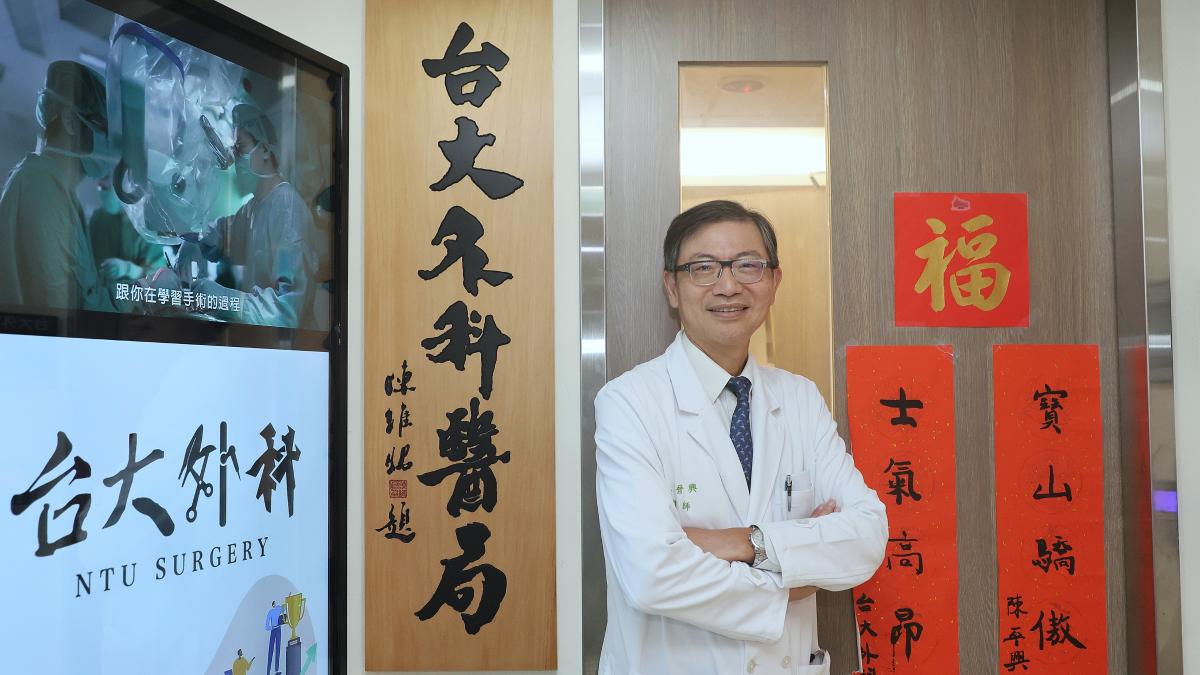
When it comes to lung cancer treatment in Taiwan, especially the promotion of 'low-dose computed tomography (LDCT)' screening, the first name that comes to mind is Chen Jin-Xing, Deputy Director of the NTU Cancer Center and Head of the Department of Surgery at National Taiwan University Hospital. Yet this renowned physician hails from a small fishing port in Erlin, Changhua.
Born into a modest family, Chen, the only son, naturally carried his parents' high hopes of entering medical school. After graduating from junior high, he moved to Taipei alone to attend Jian Guo High School. However, surrounded by brilliant peers and lacking clear motivation, he failed in his first attempt and only got into Taipei Medical University's dental program. "If dentistry had been as popular back then as it is now, I would have gone," Chen recalls with a smile.
A Turning Point: First Love, a 500-N dollar Debt, and Library Dates
After discussing with his father, he decided to retake the exams. Unexpectedly, that year became the most beautiful time of his life—he met his future wife, also from Changhua, at a cram school, experienced first love, and found renewed motivation to study. "We were poor, so our dates were just going to the library or studying together at the cram school."
With love as his driving force, Chen was accepted into NTU's medical program a year later, while his wife entered the business administration department at National Chengchi University. "That’s why whenever someone says romance affects studies, I always disagree."
The year Chen entered NTU Medical School, his family hosted an 8-table banquet in their hometown. Uncles carried in three large red plaques, bringing honor to the family.
Chen laughs: "Whenever someone says romance affects studies, I always disagree." (Photo by Ko Cheng-Hui)
Chen’s initial motivation for medicine traces back to a childhood memory. Without health insurance at the time, he once suffered a persistent high fever. A doctor said an IV drip would cost 500 NTD—equivalent to several months of his father’s salary. To save his beloved son, his father swallowed his pride and borrowed money from the school principal.
This incident left a deep impression on Chen. Perhaps in that moment, his path as a healer was already set.
Guided by Mentors: From 'Survival' to Choosing Thoracic Surgery
At NTU, Chen initially had no strong preference for a specialty until he met two late mentors who became like brothers and fathers: Dr. Chu Shu-Hsun and Dr. Lee Yuan-Chi.
In his fourth year, Dr. Chu challenged outdated organ donation laws (which required cardiac death, not brain death, for donation), defying punishment to confront the system. His unwavering courage deeply inspired Chen, leading him to choose surgery.
In his fifth year, he met thoracic surgery expert Dr. Lee. Torn between cardiac and thoracic surgery, Chen chose thoracic surgery for a surprisingly humorous reason: "Back then, there were no cardiac catheters or stents—cardiac surgeons operated daily and were exhausted. Thoracic surgery, however, had few operations because most lung cancers were found at stage IV with no targeted drugs. The quality of life was better."
But fate had other plans. In recent years, lung cancer cases have surged. With exceptional skill and a warm demeanor, Chen treats every patient like a lifelong friend. He sees over 200 patients daily in outpatient clinics and once performed over ten surgeries in a single day. Despite the workload, he remains energetic: "Saving a patient’s life means saving an entire family. The sense of achievement is immense."
Champion of Breath: Advocating LDCT and a Gentle 'Healing the Heart' Philosophy
"Unlike cervical or liver cancer, lung cancer has no single viral cause—too many factors contribute," Chen admits. Since primary prevention remains out of reach, he focuses on secondary prevention—early detection through screening.
Thus, Chen has tirelessly promoted low-dose CT (LDCT) for years. He often asks students: "What do you think of when you see me?" They respond in unison: "LDCT," which brings him great satisfaction. He constantly lectures: "Anyone over 40 who still breathes should get a low-dose CT, even if not covered by the government."
Chen has long advocated for LDCT screening. (Photo source: YouTube)
Decades of practice have turned countless patients into lifelong friends. He recalls the trust built with his first lead surgery patient. In 2000, shortly after becoming an attending physician, a woman in her 40s with ovarian cancer that had metastasized to her lungs entrusted him with her life. Thirty years later, now 70, she returned to him with lung adenocarcinoma.
Another case involved a 30-something engineer, newly married and with a pregnant wife, diagnosed with severe thymic cancer invading major heart vessels. With a 20% mortality rate, his wife tearfully signed the consent. Chen urgently coordinated with the cardiac surgery team and successfully removed the tumor. Later, he received his first patient gift—the baby’s full-moon celebration box. Now the child is three, and the couple still sends cakes. This moon-gift, crossing the threshold of life and death, remains unforgettable.
Facing countless critical patients, Chen deeply understands Hippocrates’ words: "To cure sometimes, to relieve often, to comfort always." Even in dire situations, he greets patients with a smile: "Stable, congratulations!" "All good, you’re amazing!"
If a patient he cared for passes away, can he still sleep? Chen says honestly: "I must be able to sleep." Regret remains, but tomorrow brings 200 more patients and lives waiting on the operating table. "That’s why my wife says I’m lucky—I fall asleep the moment my head hits the pillow."
Breaking 'Saving Beauty, Not Lives': Attracting Young Doctors Back to Surgery
Times have changed. Today’s medical students prefer specialties with better work-life balance—dermatology or plastic surgery—that 'save ugliness,' while traditional 'life-saving' surgery faces a shortage of residents.
Three years ago, upon becoming Head of Surgery at NTU, Chen refused to accept this decline and began building emotional connections with young doctors.
First, he created a 'Recharge Room.' He converted the senior doctors’ lounge into a resident recharge space, filled with snacks, instant noodles, drinks, coffee machines, and even two surgical simulators for practice.
Three years ago, upon becoming Head of Surgery at NTU, Chen refused to accept this decline and began building emotional connections with young doctors. (Photo by Ko Cheng-Hui)
Next came 'Happy Hour.' He designated the first Friday of every month as the department’s 'Happy Hour,' serving pizza, fried chicken, and burgers to residents and medical students, fostering a warm, family-like atmosphere that successfully boosted interest in surgical careers.
A Supportive Backbone: Respecting His Wife and Diverse Children
Despite his busy career, Chen’s greatest gratitude goes to his wife, who silently supports him. "She became an associate and full professor before me but chose to quit her job to raise our children, freeing me from worry."
Chen jokes he 'respects' his wife deeply, and her harshest punishment is banning him from ward rounds. When grounded, he feels restless until she relents: "Fine, go ahead." He never dares to anger her again.
His son and daughter are his pride. His daughter followed in her parents’ footsteps as a dentist. His son, though less academically outstanding, excels in guitar, songwriting, and dancing—the family’s joy-bringer. From his son, Chen learned a new life philosophy: "Not everyone needs to be first or become a doctor. As long as you find what you love and give it your all, life is well-lived."
FACT BOX
- Source: PR Times
- Category: 人物