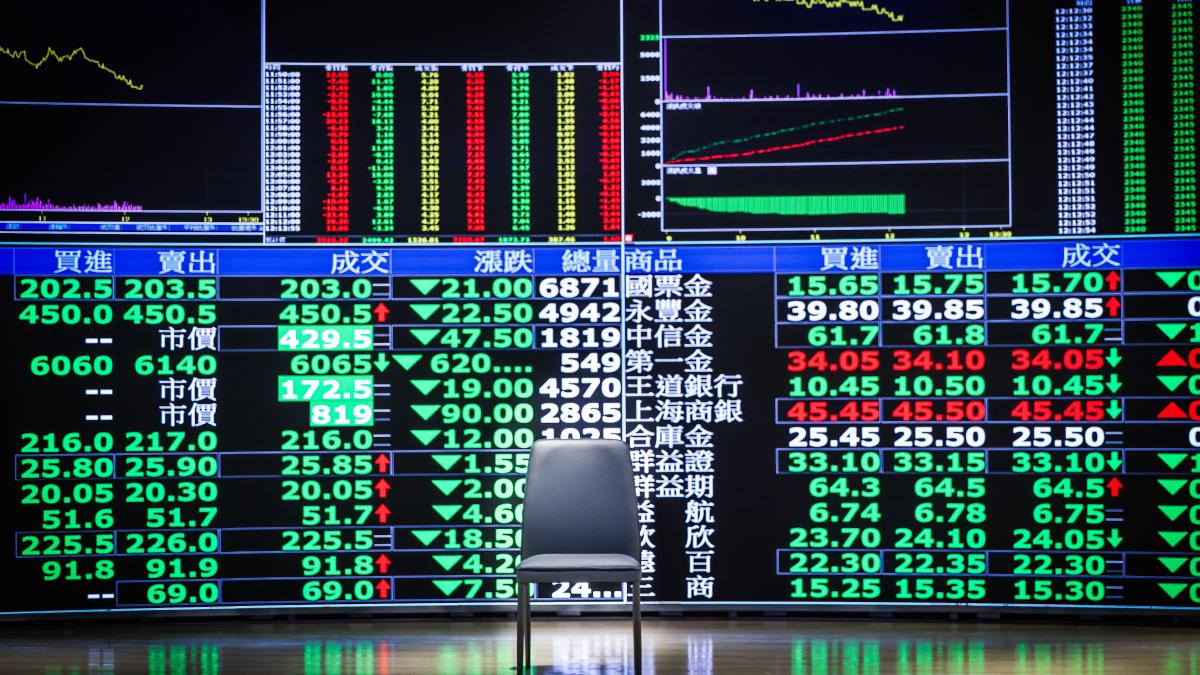
On the 27th, the Taipei stock market opened lower and fluctuated, closing down 20.65 points at 43,634.19, a 0.05% decline. Former Vice Premier and former Financial Supervisory Commission Chair Shih Jun-ji posted on Facebook, stating that if the U.S. Federal Reserve decides to raise interest rates at this week's meeting—even by just one quarter-point (0.25%)—it could trigger a 'double unwinding storm.' In such a scenario, TSMC and AI server supply chain stocks could be treated like ATMs, aggressively liquidated. This is the true core of the unease gripping Taiwan and the global markets ahead of the Fed's rate decision.
Shih referenced a striking historical pattern highlighted years ago by Gillian Tett, a renowned columnist for the Financial Times: the period most prone to global financial crises each year tends to concentrate between August and October, a period堪称 the 'typhoon season' of financial markets.
Have Destructive Financial Storms Always Occurred in This Season?
Shih pointed out that reviewing nearly a century of global financial history, many devastating systemic crises have indeed occurred unexpectedly during this period. For example:
1929 Great Depression (October 24): The Wall Street stock market crashed on 'Black Thursday,' plunging into the worst economic depression in human history.
1987 Black Monday (October 19): With no warning, the U.S. stock market plummeted 22.61% in a single day, setting the record for the largest single-day drop in U.S. stock history.
1998 LTCM Collapse Crisis (August 17): Russia's debt default pushed the giant hedge fund 'Long-Term Capital Management' to the brink of bankruptcy. Trillions of dollars in derivatives contracts nearly collapsed the global financial system.
2008 Lehman Brothers Collapse (September 15): Lehman Brothers, one of the U.S.'s four major investment banks, declared bankruptcy early that morning, pushing the subprime crisis to its peak and triggering a global financial tsunami and economic depression.
2024 Global Black Monday (August 5): The Bank of Japan unexpectedly raised interest rates, triggering an epic 'yen carry trade unwind,' causing Japanese stocks to crash 12.40% that day (the second-largest single-day drop in Japanese stock history), dragging down Taiwan's market by 8.35% (the third-largest single-day drop in Taiwan's history).
Shih reminded readers to stay vigilant as August approaches, urging analysis of macroeconomic and financial conditions for any noteworthy developments.
Five Hidden Worries in the Financial Landscape
Shih analyzed that five unsettling concerns are accelerating in today's markets:
War and Energy: The on-again, off-again U.S.-Iran conflict caused international oil prices in July to surge from over $60 to over $100, then retreat to around $90, severely impacting global price levels and exacerbating the risk of inflation resurgence.
Yen Depreciation Crisis: The yen continues to depreciate, now falling to a historic low of 163.85 yen per dollar. In response, Japan's Finance Minister Kamikawa Masuzoe issued a stern warning that the Japanese government will take decisive measures and is ready to intervene in the currency market.
U.S. Treasury Bond Sell-Off: U.S. Treasury yields continue to rise (meaning Treasury prices keep falling). The 10-year Treasury yield has surged to 4.7%, the highest level since January last year. As the 'anchor of asset pricing' in global financial markets, changes in the 10-year yield directly affect international capital flows, short- and long-term borrowing costs, and valuations of all asset classes, so its ripple effects cannot be ignored.
AI Investment Overheating: Global investment in AI data centers and infrastructure this year is massive, estimated between $765 billion and $850 billion, and next year is expected to surpass the trillion-dollar mark, reaching $1.1 to $1.3 trillion. This AI arms race is 'grabbing resources' (electricity, construction equipment, materials, and labor) and 'grabbing capital' (IPOs, ADRs, and massive bond issuance). The resource grab has already driven up prices; the capital grab continues to push up borrowing costs and Treasury yields.
Fed Rate Decision: The Fed has just installed a new chair, Walsh, who has publicly declared a 'zero tolerance' attitude toward inflation. This has completely shifted the global monetary policy direction. Now, no one is discussing rate cuts—even Trump, who once loudly called for them, has gone silent. The current debate centers on 'whether to raise rates by one quarter-point or hold rates steady.'
Shih explained that the Fed will hold its rate-setting meeting (FOMC) on Eastern U.S. time August 28–29 (this Tuesday and Wednesday), with results announced at 2 a.m. Taiwan time on the 30th (Thursday). Whether the Fed raises rates will finally be revealed.
The U.S. Federal Reserve will hold its rate-setting meeting (FOMC) on Eastern U.S. time August 28–29 (this Tuesday and Wednesday). Shown is Fed Chair Walsh. (Photo, AP)
Shih explained that if the Fed holds rates steady, markets will be calm, but inflation may become harder to tame. If the Fed raises rates, even by just 0.25%, it will have a critical transmission effect on the already-tight financial situation.
First, for the macroeconomy, a rate hike raises borrowing costs, reduces aggregate demand, and effectively curbs inflation expectations, helping to fight rising price levels. Second, for exchange rates, higher U.S. interest rates strengthen the dollar, forcing non-U.S. currencies like the yen and Taiwan dollar to immediately face overwhelming depreciation pressure the moment the U.S. announces a rate hike.
Therefore, Taiwan's central bank will either be forced to follow the U.S. in raising rates or forced to aggressively defend the currency to stabilize the foreign exchange market.
Double Unwinding Storm
Shih pointed out that the truly terrifying impact, which he calls the 'double unwinding storm,' has a destructive power comparable to 'two typhoons hitting at once.' If combined with a 'Fujiwhara effect,' its severity could go down in history:
Crisis One: Yen Carry Trade Unwinding
Shih explained that a smart investor 'borrows a 1.5% low-interest mortgage in Taiwan and uses the money to buy U.S. stocks yielding over 5%.' As long as the interest rate differential remains and exchange rates are stable, this calculation allows for stable arbitrage.
In international markets, countless institutional investors have long borrowed large amounts of near-zero-interest yen and turned around to buy high-yield AI tech stocks and U.S. Treasuries. This investment behavior is known as yen carry trade.
Shih predicted that if the Fed raises rates this week, the U.S.-Japan interest rate differential will widen further, making yen carry trades even more rampant. This will force Japan to raise interest rates to narrow the gap and intervene in the currency market to stop the yen's continued depreciation, causing a storm similar to the one on August 5, 2024, to return.
At that time, Japan similarly raised rates and defended the currency. International financial institutions and shadow banks that had borrowed yen for arbitrage rushed to 'sell U.S. stocks, exchange for yen, and repay Japanese loans' to avoid interest and exchange losses. Global stock markets (including Taiwan's) instantly became ATMs, with securities indiscriminately sold off for immediate cash, creating the 'yen carry trade unwind' storm.
Shih analyzed that the total size of yen carry trades determines the unwinding scale and thus the storm's intensity. Since many yen carry trades are off-balance-sheet derivatives, private contracts, or cross-border hidden financing, the exact amount is extremely difficult to calculate, with current estimates ranging from $25 billion to $20 trillion.
However, according to statistics from the Bank for International Settlements (BIS), the on-balance-sheet yen-denominated claims (such as loans and bonds) held by banks and non-bank financial institutions outside Japan amount to about $1 trillion. This figure can be seen as the baseline for foreign yen arbitrage.
Shih: In 2024, Taiwan's stock market lost 8.35% of its total market value in one day
Shih stated that as a highly liquid ATM, it's hard to predict how much Taiwan's stock market would be drained when the yen carry trade unwinding reaches $1 trillion. But in that 2024 incident, Taiwan's market lost 8.35% of its total market value in one day—a well-known historical fact.
Therefore, whether this financial typhoon should be called a strong, medium, or light typhoon is left to the public to judge.
Crisis Two: Treasury Basis Trade Unwinding
Shih mentioned that 'treasury basis trade' is a 'micro-profit, high-leverage game' beloved by Wall Street hedge funds. These funds discovered that a tiny, almost negligible spread (basis) of just a few basis points exists long-term between U.S. 'Treasury cash' and 'Treasury futures.'
To profit from this spread and amplify tiny gains, hedge funds can adopt a long-basis arbitrage strategy: buying short-term bond cash (long) on one side and shorting long-term bond futures (short) on the other. They then amplify the leverage in the repurchase agreement (Repo) market to 20 to 50 times to magnify the micro-profit.
FACT BOX
- Source: PR Times
- Category: News