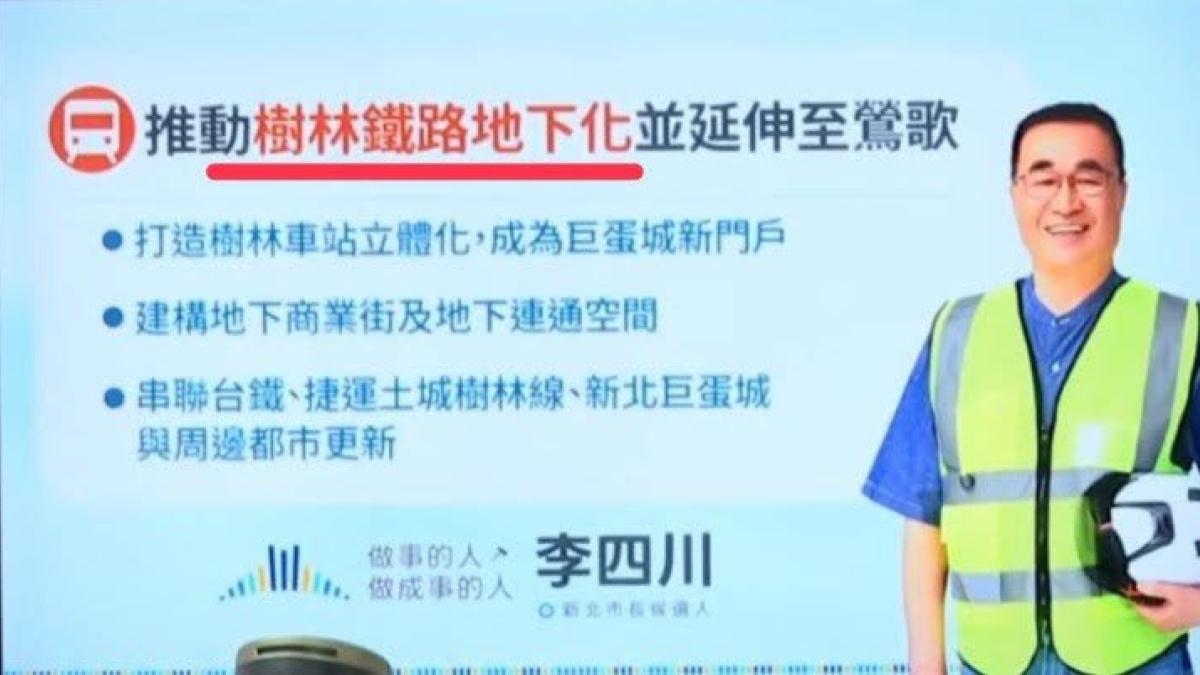
KMT New Taipei mayoral candidate Lee Sichuan unveiled a new policy proposal today aimed at winning votes in Shulin, advocating for the undergrounding of the railway from Shulin to Yingge. However, this plan involves the massive Shulin train depot and extensive demolition of residential buildings, prompting political worker Zhou Xuan to publicly challenge it. "If it couldn’t move forward ten years ago, why would it suddenly be feasible now during a mayoral election?" he questioned. "Did Hou Youyi and Zhu Lilun resolve the difficulties identified a decade ago?"
In a Facebook post, Zhou Xuan criticized Lee Sichuan—touted as an engineering expert—for promoting the underground extension without addressing critical obstacles. "Anything is possible in theory," he stated, "but without explaining the practical challenges, it’s just empty rhetoric and pie-in-the-sky promises." The Shulin railway undergrounding is not a new issue; the New Taipei City government has held public consultations before. The biggest hurdle remains the Shulin train depot, located 1.2 kilometers south of Shulin Station.
Zhou explained that the Shulin depot is the operational heart of Taiwan Railways Administration’s (TRA) northern network and the largest train maintenance base in the region. Covering 14 hectares, it handles critical tasks including dispatching for the Eastern Trunk Line, vehicle maintenance, repairs, and cleaning. If the railway from Shulin to Yingge is to be undergrounded, the immediate question is: what happens to the depot? Relocate it? Where in northern Taiwan could such a large, contiguous land area be found? Underground it? Redesigning and burying a 14-hectare depot would incur astronomical design and construction costs, with an unpredictable timeline.
Zhou pointed out that in March 2017, the New Taipei City government submitted a proposal to central authorities for the Shulin rail project, evaluating three elevated solutions: viaduct, original alignment undergrounding, and realigned undergrounding, with estimated costs ranging from NT$10 billion to NT$20 billion. The viaduct and original alignment options required the demolition of over 100 buildings, causing significant local disruption. The realigned underground option proposed relocating the station, sparking concerns over land speculation and the decline of existing commercial districts, leading to strong public opposition. The entire project was subsequently suspended due to controversy.
"Do you know where Lee Sichuan was in March 2017?" Zhou asked. "He was working at the New Taipei City Government as deputy mayor." He continued, "If it couldn’t move forward ten years ago, why would it now, just because he’s running for mayor? Did Hou Youyi and Zhu Lilun solve the problems identified back then?"
Zhou further criticized Lee’s pattern of behavior. During his tenure as Taipei deputy mayor, he failed to resolve the leaking issues at the Taipei Dome before running for New Taipei mayor. Now he insists on pushing forward the Lushe Bridge project, yet he didn’t resolve the Shilin Island issue when he had the chance. And now, the Shulin-Yingge railway undergrounding? This kind of pie-in-the-sky promise doesn’t align with his self-proclaimed image as a pragmatic engineer wielding an iron hammer.
FACT BOX
- Source: PR Times
- Category: News