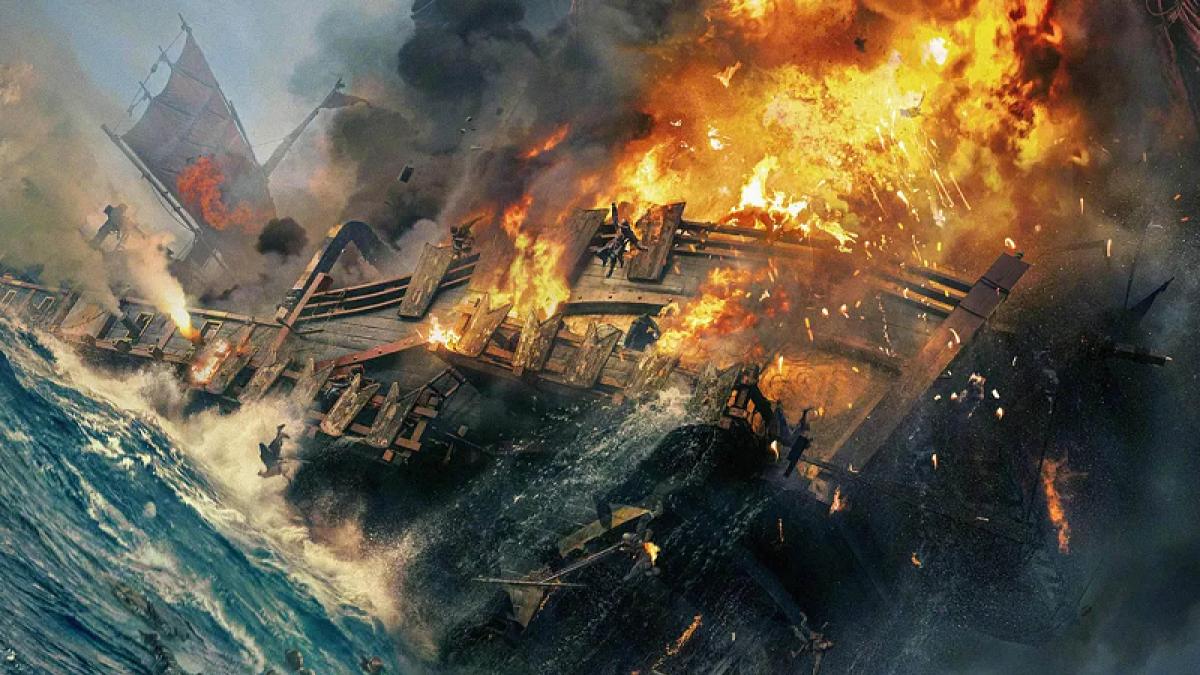
The historical war film 'The Battle of Penghu,' originally scheduled for release on July 25 during China's summer movie season, has recently been reported to have been pulled from theaters, just six days before its planned premiere. According to multiple media outlets, the film's official Weibo account has ceased updates since mid-June and has not opened pre-sales. The production side has only responded externally, 'We have not received a cancellation notice,' without further explanation of the actual situation.
'The Battle of Penghu' was designated as a 'National Key Film' in China and directed by Hong Kong filmmaker Johnny To. The cast includes Wang Xueqi as Shi Lang, a Qing dynasty general, and Yi Yangqianxi as Emperor Kangxi. The plot is based on the historical event of 1683, when Qing general Shi Lang led the Fujian naval forces to defeat the Ming Zheng regime. After this battle, Taiwan was formally incorporated into the Qing dynasty's territory.
Controversy Erupts During Propaganda Phase of Patriotic Film
Prior to its official release, 'The Battle of Penghu' launched a large-scale promotional campaign and was widely seen as a work intended by Beijing authorities to harness historical themes to consolidate national sentiment and divert public dissatisfaction with the economic situation. In recent years, China has successively released nationalist-themed films such as 'Wolf Warrior' and 'The Battle at Lake Changjin,' which some public discourse categorizes as part of the same propaganda strategy.
However, after the trailer for 'The Battle of Penghu' was released, it triggered a wave of negative comments on Chinese social media platforms. Notably, many of the criticisms came from nationalist online users, often referred to as 'Little Pinks,' creating a stark contrast with the film's intended promotional effect.
Controversy Focus: Shi Lang's Historical Identity
The core of the controversy lies in the historical identity of Shi Lang. Some Chinese netizens pointed out that Shi Lang was originally a general under the Ming Zheng regime who later defected to the Qing dynasty and assisted the Qing in attacking Taiwan. His allegiance was to the Qing regime, established by the Manchu ethnic group, while the target of his attack was the Zheng regime, which upheld the legitimacy of the Ming dynasty.
If Shi Lang is portrayed as a 'hero who assisted in completing the great cause of national unification,' some netizens argue that, by the same logic, historical figures such as Wu Sangui and Wang Jingwei—long depicted negatively in Chinese historical narratives—should also receive similarly positive evaluations.
Other netizens extended the discussion to historical events such as the 'Yangzhou Massacre' and the 'Jiading Massacre' during the early Qing dynasty, questioning whether, if a regime of a different ethnicity conquering a Han Chinese regime by force can be called 'completing the great cause of unification,' the same logic could be applied to events like the Nanjing Massacre during Japan's invasion of China. They further questioned whether this would challenge the historical legitimacy of China's anti-Japanese forces at the time. These discussions have continued to spread on Chinese social media platforms and became a focal point of public attention during the film's promotional period.
Policy Context of China's Ethnic Historical Narrative
China's official definition of the concept of 'ethnicity' originates from the theoretical framework of Stalin's 'Marxism and the National Question,' adopted after the founding of the People's Republic of China. Under this framework, ethnic groups within China are classified into 56 nationalities, and through the narrative that they have 'always been part of the Chinese nation,' groups such as the Manchu, Mongol, Hui, Tibetan, Miao, and Yao are all incorporated into the historical narrative of the 'Chinese nation.'
Within this policy context, China's official historical narratives have undergone recent adjustments, including downplaying the title of 'national heroes' for historical figures such as Yue Fei, Shi Kefa, and Wen Tianxiang, who resisted invasions by non-Han regimes. The rationale is that, under the current official historical view, groups such as the Manchu and Mongols are now defined as part of the Chinese nation, rather than 'foreign ethnic groups.'
At the same time, the 'national rejuvenation' and 'great power rise' narratives promoted under Xi Jinping's leadership have driven a renewed emphasis on ancient Chinese culture, particularly Han cultural elements. Since Chinese historical documents and ideological discourses are predominantly from a Han-centric perspective, certain Han-centric historical narratives have resurfaced during the implementation of these policies, including negative portrayals of groups such as the Jurchen, Khitan, Mongols, and Tibetans in specific historical contexts, as well as the continued labeling of historical figures like Wu Sangui as 'Han traitors.'
The Gap Between Official Propaganda and Public Historical Perception
Public opinion observers have pointed out that the controversy sparked by 'The Battle of Penghu' reflects a gap between China's official 'ethnic unity' narrative and public historical cognition. For a long time, Beijing has used the narrative that all ethnic groups have 'always' belonged to the Chinese nation to address the legitimacy of governance in minority regions.
At the same time, when promoting Han cultural revival and nationalist mobilization, it is difficult to completely avoid the negative narratives toward 'non-Han regimes' found in traditional Han-centric historical views.
Similar gaps between official and public sentiment have appeared in other issues in the past. Historically, examples include the suppression of participants in the Diaoyu Island movement by the Kuomintang government during Taiwan's martial law period, and the Chinese government's deployment of stability maintenance forces during anti-Japanese demonstrations in the early 21st century. These cases show that even after the authorities mobilize nationalist sentiment, if such sentiment deviates from official expectations, control measures may still be taken.
As of now, the producers of 'The Battle of Penghu' have not issued an official explanation regarding the cancellation rumors. Whether the film will be rescheduled for release or how it will respond to the controversial discourse on social media remains to be seen in further official announcements.
FACT BOX
- Source: PR Times
- Category: News