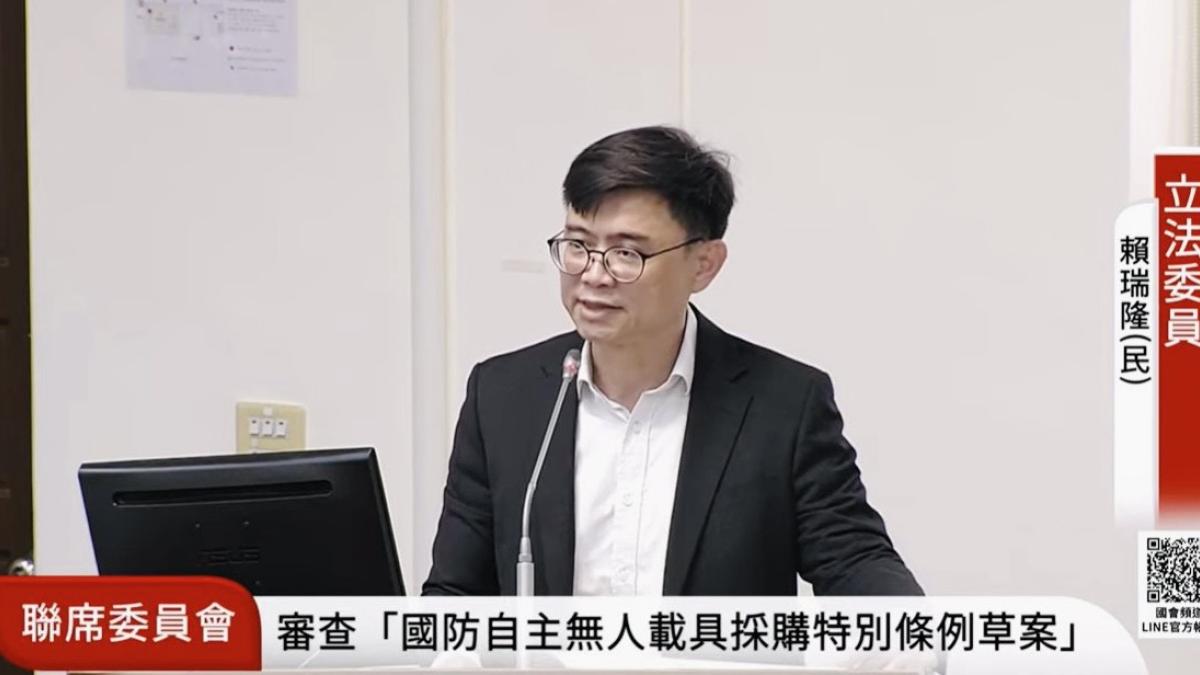
Today (27), the Legislative Yuan's Economic, Foreign Affairs and National Defense, and Finance Committees jointly reviewed 14 draft bills, including the 'Special Act Draft for Indigenous Unmanned Vehicle Procurement for National Defense.' Lai Jui-long, legislator and DPP Kaohsiung mayoral candidate, advocated increasing the special budget for unmanned vehicles by an additional $30 billion NT and relaxing procurement scope to provide the military with more combat options, while simultaneously driving the development of Taiwan’s indigenous supply chain through stable, long-term orders. Meanwhile, he reiterated his recent signing of the 'Traffic Improvement Commitment White Paper' with the Next Generation Human-Centered Transportation Promotion Association, pledging to build a safer and more convenient transportation environment in Kaohsiung based on the principle of 'human-centered transportation.'
Lai stated that unmanned vehicles have become a critical strategic industry for national security and global technological competition, and Taiwan must not only meet immediate procurement needs but also consider future battlefield changes and industrial development. Therefore, he proposed an additional $30 billion NT special budget beyond the Executive Yuan's version, allowing the Ministry of National Defense to procure a wider variety of unmanned vehicles according to actual needs. He also proposed adding 'other unmanned vehicles' to the legislation to avoid procurement being limited to existing models, thereby enhancing technological iteration and flexibility in defense procurement.
He pointed out that the Russia-Ukraine war has proven that drones, unmanned surface vessels, and various unmanned systems have become essential combat assets in modern warfare. For Taiwan to establish a complete industrial chain, it must strengthen indigenous defense capabilities and international competitiveness through stable long-term contracts, mass production, and continuous R&D.
Lai believes that Kaohsiung possesses a comprehensive industrial foundation in shipbuilding, harbors, aerospace, steel, electronics, and system integration, making it a potential key R&D and manufacturing hub for unmanned surface vessels and medium-to-large unmanned systems. Defense demand can drive technological innovation, supply chain upgrades, and international market expansion.
Signing the Traffic Improvement White Paper to Promote a Safe and Convenient Transportation Network
In addition to advancing defense industry development, Lai continues to focus on urban transportation infrastructure. He mentioned that two months ago, he was invited to exchange views with the Next Generation Human-Centered Transportation Promotion Association and signed the 'Traffic Improvement Commitment White Paper.' The association’s youth team and experts proposed multiple reform recommendations for Kaohsiung’s transportation, and he pledged to re-examine road planning and traffic design from a 'human-centered' perspective to create a more user-friendly environment.
Lai noted that in recent years, he has jointly advanced several major transportation projects with the city government, including the Yellow Metro Line connecting Sinsing and Fengshan, Freeway No. 7 and dedicated container truck lanes to improve southern Kaohsiung’s traffic, and the launch of reconstruction for the new terminal at Kaohsiung International Airport. Going forward, he will accelerate major projects such as the elevated expressway for Freeway No. 1 from Kaohsiung to Tainan, the Second Gaoping Expressway, and the Purple Metro Line to improve transportation networks across urban, coastal, and mountainous areas.
Lai emphasized that human-centered transportation is not a one-time event or a mere promise, but requires long-term investment, stable funding, and continuous construction to truly improve the daily safety of citizens’ walking, commuting, and returning home. He stated that he will continue to advance indigenous defense and urban development in parallel, upgrading Kaohsiung’s industrial development, traffic safety, and urban competitiveness simultaneously to build a safer, more convenient, and more livable city.
FACT BOX
- Source: PR Times
- Category: News