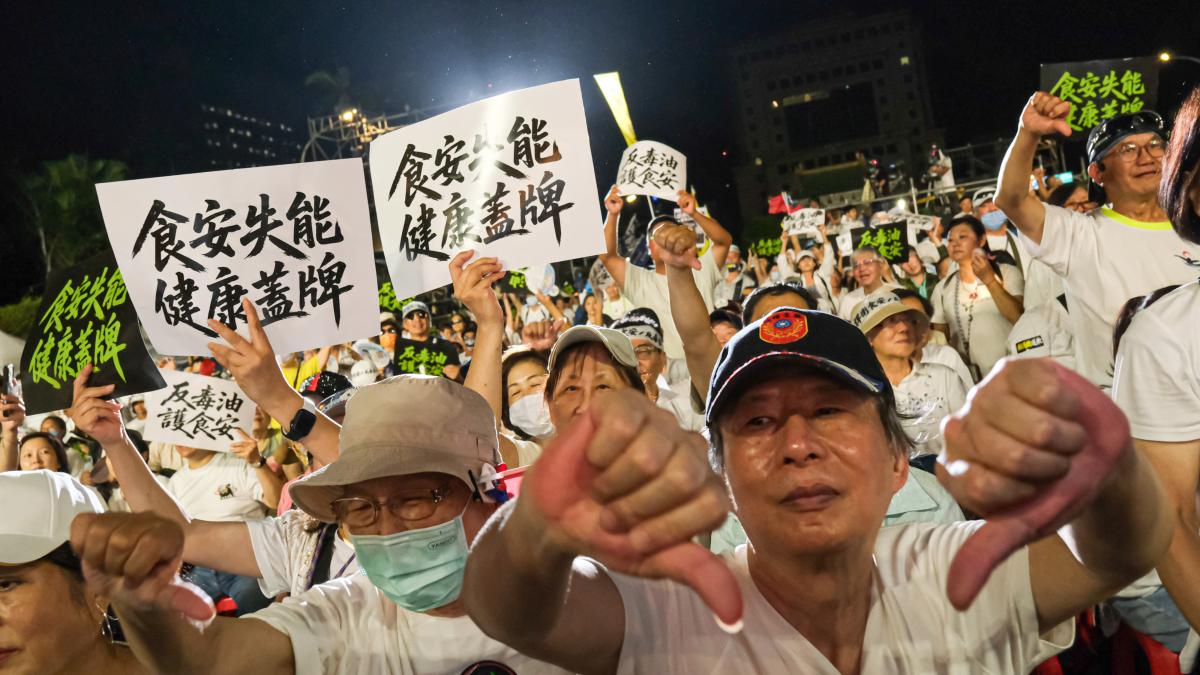
The food safety scandal involving carcinogenic oil from Zhonglian has sparked widespread public outrage. The Kuomintang (KMT) recently concluded its 'I Am Human, I Oppose Poisonous Oil in Taiwan' rally on Ketagalan Boulevard on July 25, and rumors have emerged of another 'Reject Toxic Drunk Driving' rally planned for August 1. In response, writer Piaolang Daoyu posted on Facebook, acknowledging that opposition to toxic drunk driving is indeed a highly charged public issue, but warned that consecutive street protests in successive weeks could exhaust public energy. While public anger over the toxic oil scandal is a valuable resource, it should be used to resolve the current crisis first, before shifting to the next issue at the right moment.
Piaolang Daoyu noted that the July 25 anti-toxic oil rally, which the KMT claimed drew 200,000 angry citizens, proved that people genuinely care about the toxic oil incident and are dissatisfied with the government's response. From a political strategy perspective, this momentum should be capitalized on to push for resolution and maximize influence on public opinion. It's like having a pot of boiling water—instead of cooking a meal, wasting the heat and hastily lighting another stove. Hoping to ignite multiple fires and fill the table with dishes is unrealistic, as public anger cannot be arbitrarily sparked at will.
He admitted that opposition to toxic drunk driving is also a legitimate trigger for public outrage, but attempting to mobilize another 200,000 people the following week is 'like seeking fish in a tree'—utterly futile. While officials speak on stage for just a few minutes, ordinary citizens spend an entire day commuting and sacrificing work hours. No matter how angry they are, their physical and financial resources are limited.
Regarding whether the August 1 anti-toxic drunk driving rally can replicate the 200,000 turnout, Piaolang Daoyu cautioned that a significant drop in attendance would result in halved momentum, turning the event into a laughingstock for 'Green Bird' commentators. If political parties treat public protests as election rallies, they overestimate public willingness to cooperate. Especially when election season is approaching, exhausting all public anger now leaves no leverage for future campaigns.
He emphasized that with only four months left until the year-end county and city mayoral elections, all parties are strategically selecting issues for attack and defense. A long-term plan involving relay-style protests is essential to keep public anger alive and mobilize maximum voter discontent. Although the Green Camp dismissed the July 25 rally with sarcasm, their defiance only fuels the fire for the next wave of public anger. However, if the KMT holds another protest the following week and sees a sharp decline in turnout, the momentum will be cut in half within a week—like offering one's face to be slapped, giving Green Bird pundits endless material for mockery.
Political parties must recognize that while die-hard supporters will always show up, massive turnout is primarily driven by dissatisfaction with current policies, not to cheer for politicians on stage. The public are not party flag-bearers who appear on command. Public anger over the toxic oil issue is usable, but the current issue must be resolved first before transitioning to the next one at the right time.
FACT BOX
- Source: PR Times
- Category: News