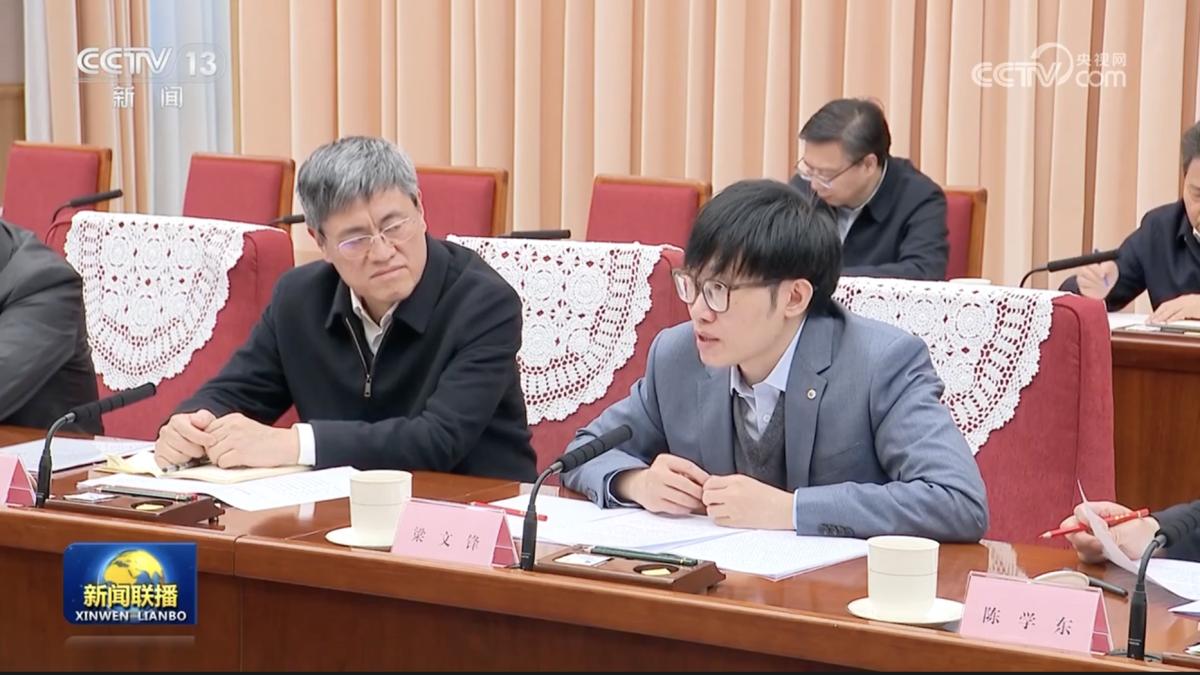
In late July, as Chinese AI company DeepSeek continued to capture global tech attention, founder Liang Wenfeng's recent media comments on China's AI development and technological competition drew intense scrutiny from U.S. policy circles. Numerous American media outlets, think tanks, and even congressional figures began citing his remarks as justification for tightening export controls on AI and semiconductors to China. This has led to public debate over whether Liang's 'golden quotes' inadvertently handed the U.S. a strategic weapon.
Amid the escalating controversy over Liang's statements, China's DRAM leader ChangXin Memory Technologies (CXMT) officially debuted on the Shanghai STAR Market on July 27. Priced at 8.66 yuan, it closed at 49 yuan—a 465.82% surge—locking in a market capitalization of approximately 3.28 trillion yuan, briefly surpassing ICBC to become the most valuable company on the A-share market. The single-day trading volume exceeded 141.1 billion yuan, with a turnover rate as high as 66.4%.
CXMT's predecessor, ChangXin Storage, was established in Hefei in 2016 through collaboration between local government and Zhu Yiming, founder of GigaDevice. Over more than a decade, Hefei's state capital invested approximately 25 to 30 billion yuan cumulatively. Now, amid an AI-driven memory super-cycle, the company's performance has exploded: Q1 2026 revenue reached 50.8 billion yuan, with net profit attributable to shareholders hitting 24.76 billion yuan. First-half 2026 net profit is projected at 50–57 billion yuan, a year-on-year increase of over 22 times.
The leaked audio, titled 'Liang Wenfeng's Four-Hour Investor Meeting Transcript,' circulated widely on Chinese social media on July 22. During a May online investor meeting, Liang candidly discussed the U.S.-China computing power gap, reliance on Nvidia chips, and Huawei's chip performance—despite having explicitly prohibited recording and external dissemination.
Key quotes attributed to Liang include: a 12–18 month technology gap with the U.S. (i.e., one to one-and-a-half years), yet achieving results with only one-twentieth of U.S. computing power; four Huawei cards roughly equivalent to one Nvidia card, but two years behind; the ability to purchase 'non-compliant cards'; and the rapid erosion of the CUDA ecosystem by AI-generated code and new programming languages like TileLang.
These remarks went viral in China, with many 'positive' quotes (e.g., 'We don't really work overtime,' 'The original intention wasn't to make money') shared as inspirational content. However, once sensitive technical details were fully exposed, public sentiment shifted sharply. 'Liang Wenfeng's leaked transcript hands the U.S. a free knife' quickly trended on Weibo.
Chinese influencer Zhao Shengye bluntly stated that the granularity of the meeting notes amounted to handing U.S. regulators a complete investigation checklist, even questioning whether this was a simple leak or a deliberate act—bordering on espionage or trade secret theft.
Reportedly, DeepSeek has informed potential investors in its second funding round that transactions are temporarily suspended, partly due to Liang's dissatisfaction over the leak of discussions from the first round. DeepSeek had just completed a ~$7 billion first-round funding and was preparing for a potential A-share IPO.
CXMT's IPO created a trillion-yuan wealth effect, symbolizing that local governments have regained capital to fund the next phase of the tech race. DeepSeek demonstrates that Chinese AI firms are now challenging global leaders. Together, they signal China's tech policy entering a new phase—not just catching up, but building a complete ecosystem from capital and chips to models and industrial applications.
Whether the U.S. truly 'got a free knife' ultimately depends on whether these public disclosures translate into concrete policy and enforcement actions.
FACT BOX
- Source: PR Times
- Category: News
- Organizations: DeepSeek