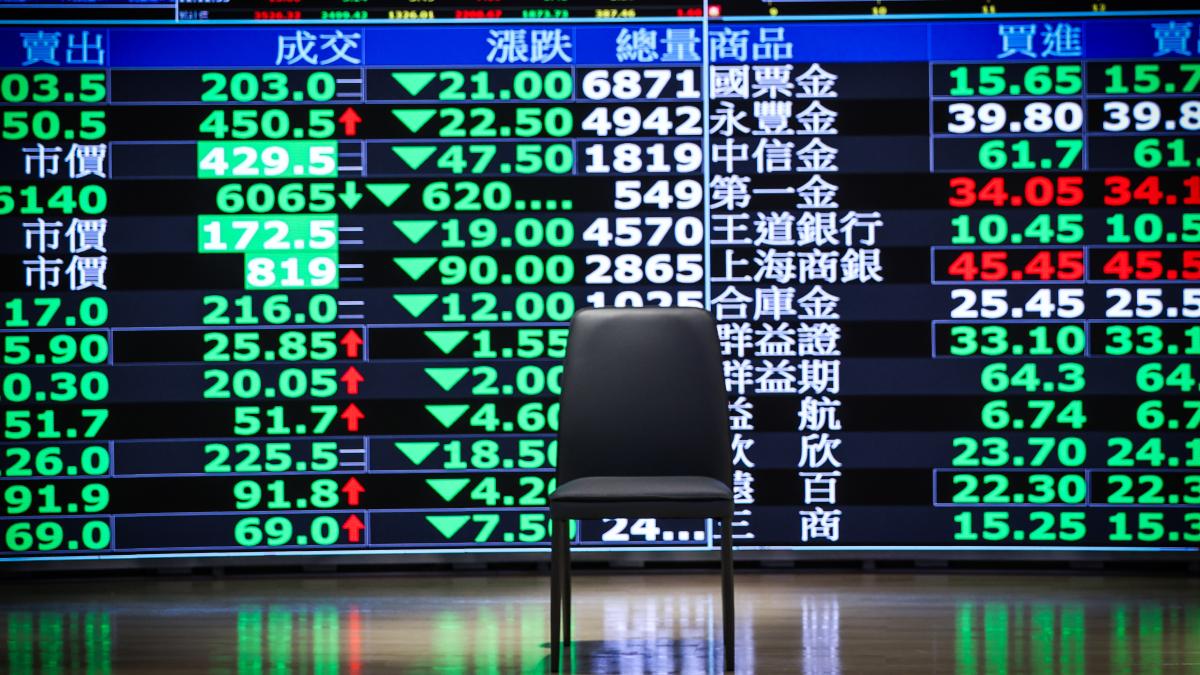
Asia's financial markets were shaken by two major semiconductor developments from mainland China, causing U.S. chip stocks and memory-related equities to plummet and accelerating deleveraging across Asian markets. Japan and South Korea's stock markets fell sharply, and Taiwan's market was hit hard on the 28th. The weighted index opened lower and continued to decline, briefly plunging over 2,000 points to a low of 41,617.4, marking the fifth-largest point drop in Taiwan's stock market history.
Major electronics stocks opened weak, with TSMC dropping 80 yuan to open at 2,270 yuan, a 3.4% decline, severely damaging market confidence. The index opened at 43,221.93 and quickly broke below the 43,000 and 42,000 thresholds, with all sectors turning red.
Why did memory stocks become the hardest hit? The turmoil centers on China's memory giant, ChangXin Memory Technologies (CXMT). On its first trading day, CXMT's share price surged 470%, surpassing Intel in market capitalization and becoming China's most valuable company. This news directly undermined global memory market confidence, sending SK Hynix down 10%, Samsung down 9%, and Kioxia, which relies on traditional processes, tumbling over 18%.
Taiwanese memory-related stocks, including Nanya Technology, Winbond, Phison, and Macronix, all hit the daily trading limit down. Passive component stocks were also dragged down.
CXMT's IPO raised substantial capital, supporting future capacity expansion and R&D. Although traditional memory had been tight due to HBM capacity constraints, market valuations are now high in the second half of 2025. Concerns are rising over whether the memory industry can escape its cyclical nature and whether massive AI investments will yield returns, prompting investors to adopt a wait-and-see stance.
What progress has mainland China made in self-developed semiconductor equipment? Why was ASML affected?
Beyond memory, China has made tangible progress in chip self-sufficiency. Reports indicate China has begun producing self-developed immersion DUV lithography machines, with plans to produce five units in 2025 and ramp up to 20 in 2026. This advancement signals China's determination to localize semiconductor equipment, causing ASML's stock to drop over 5%.
However, Wall Street experts argue the sell-off was overdone. They note that Chinese equipment's real threat depends on long-term yield and efficiency, with commercial scalability still uncertain. BNP Paribas analyst Jakob Bluestone assessed this as a minor negative, as ASML's existing capacity cannot meet global demand. China's domestic production mainly fills local gaps and does not mean abandoning ASML purchases.
Is there a rebound opportunity after position consolidation? Experts advise how investors should respond.
Looking at market positioning, Monday's trading volume in Taiwan dropped to NT$717.687 billion, the lowest since April 7. Foreign investors have withdrawn NT$650 billion from Taiwan stocks this month, driving the USD/TWD exchange rate to its highest since April 2025, indicating significant capital outflow pressure.
However, according to Chinatimes.com, Kangho Investment Consulting noted that margin maintenance rates for the main and OTC markets fell to 143.49% and 133.53% respectively on the 20th—near recent lows—suggesting short-term positions have consolidated, raising hopes for a technical rebound.
Kangho further explained that explosive trading volume in Taiwan futures and TSMC shares near the quarterly moving average suggests that if foreign outflows pause, pressure on large-cap stocks may ease, offering support near the quarterly line.
Still, individual stock risks require caution. The OTC index breaking below the quarterly line shows signs of a short-term top, indicating weak stock structure. Investors should remain cautious with high-P/E stocks, avoiding overbidding. For deeply discounted stocks, patience is advised—wait for position stabilization and clear bottoming signals before considering entry.
FACT BOX
- Source: PR Times
- Category: News
- Products / services: HBM