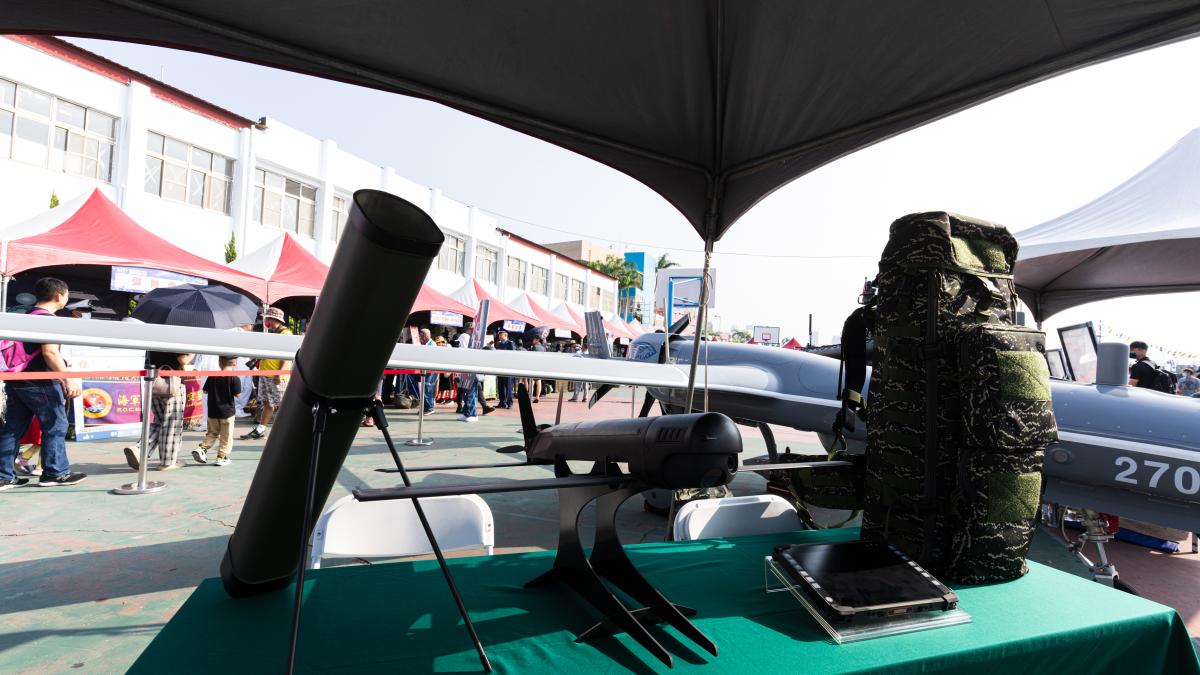
Drone defense systems have recently gained significant attention. However, Taiwan's Audit Department's 2025 Central Government Final Accounts Audit Report revealed that the drone defense system deployed by the Air Force still has shortcomings in detection and defense capabilities. Specifically, the detection and interference range of the drone defense system, developed by the Air Force in collaboration with the National Chung-Shan Institute of Science and Technology (NCSIST), does not cover the 5.1GHz frequency band used by certain drone models.
In response, NCSIST stated that in light of new commercial drones expanding functionality to include the 5.1GHz band, it has already verified relevant interference capabilities and will assist in adding this band's interference function during scheduled maintenance periods.
The Audit Department's investigation found that the Air Force's drone defense system still lacks sufficient detection and defense capabilities. China, being the world's largest drone producer, has seen a steady increase in drone usage and demand. As a result, the previously used 2.4GHz and 5.8GHz remote control and video transmission frequency bands have gradually become saturated, prompting manufacturers to introduce drone models using the 5.1GHz band starting in 2023. However, the drone defense system developed by the Air Force in collaboration with NCSIST does not cover this frequency band, meaning system upgrades are required to achieve detection and interference capabilities for this band.
The Audit Department noted that drone technology is rapidly evolving, with new types including fiber-optic controlled drones with no radio signals, drones equipped with encrypted frequency-hopping and waypoint cruise functions, and drones with artificial intelligence (AI) capable of autonomously adjusting flight paths mid-flight. However, the Air Force currently relies primarily on signal jamming to counter threats at airbases and key military facilities, which may not effectively prevent intrusions by future advanced commercial drones.
Currently, the Air Force has entrusted NCSIST with the development of its drone defense system. Regarding why the 5.1GHz band was not initially included, NCSIST explained that in 2022, under a commission agreement, it developed a remote-controlled drone defense system with detection and interference capabilities for the 1.2, 1.5, 2.4, and 5.8GHz bands. After 2024, new models from DJI, Autel, and others began incorporating the 5.1GHz band. NCSIST stated that it has already verified interference capabilities for this band and will assist in adding the function during maintenance cycles.
In practice, the military faces legal limitations when dealing with drone intrusions near military installations. According to regulations, violations occurring within military-controlled zones or involving military facility security may be subject not only to the Civil Aeronautics Act but also to the Military Installation Security and Maintenance Regulations, with penalties of up to three to ten years in prison. Unauthorized drones may be immediately jammed or shot down on-site. However, in the legal gray zones outside military airports, the division of responsibilities among military police, regular police, and armed forces for immediate response and apprehension remains unclear, requiring legal revisions and improved joint defense mechanisms.
Additionally, an investigation by Taiwan's Control Yuan revealed that illegal drones often operate in a "flash" mode, with average flight times of only about six minutes. Even if airport detection systems identify and locate a target immediately, law enforcement personnel still need time to reach the site and confirm the operator's location. By the time they arrive, the operator has often already finished flying and left, significantly reducing the success rate of on-site apprehensions.
In simple terms, when an unidentified drone appears near a military base, military personnel first alert the guard unit and simultaneously report to the police. However, the military lacks direct judicial authority to arrest drone operators and must hand them over to the police. Yet, if the local police station is far from the base, by the time officers arrive, the drone has already flown away, and the operator cannot be found. This results in the base potentially being photographed while no one is caught—a major challenge currently faced by the military. Without legal updates, drone intrusions into military zones will remain difficult to address.
Insiders also noted that newer models from DJI and others do include the 5.1GHz band, but since Taiwan's National Communications Commission (NCC) has not approved the use of this band domestically, imported models have the remote control functionality for this band removed from their firmware. However, it remains difficult to prevent general or agricultural drone users from modifying the firmware to enable its use.
FACT BOX
- Source: PR Times
- Category: News
- Organizations: DJI / Autel