On July 20, Philippine vessels clashed with Chinese coast guard ships near Second Thomas Shoal (Ren'ai Reef). On the same day, the ASEAN Foreign Ministers' Meeting opened in Manila, Philippines. U.S. Secretary of State Marco Rubio subsequently met with Chinese Foreign Minister Wang Yi to discuss bilateral relations, Taiwan, the South China Sea, and regional security. On July 23 and 24, Chinese coast guard vessels again used water cannons to drive away Philippine government ships near Scarborough Shoal (Huangyan Island). While seeking stability at the diplomatic table, Beijing continues to apply pressure at sea, positioning the China Coast Guard at the forefront of competition along the First Island Chain.
Under this strategy, the People's Liberation Army (PLA) provides military deterrence, while the coast guard conducts patrols, interceptions, and inspections. Maritime militia support these operations, and official legal and propaganda narratives frame the actions as 'lawful jurisdiction.' Beijing thus transforms military pressure into routine law enforcement, gradually altering the maritime order along the First Island Chain without triggering armed conflict.
On July 25, U.S. Secretary of State Rubio visited the Taj Mahal in India with his wife, Janet Rubio. (AP)
South China Sea Model: Turning Pressure into Routine Jurisdiction
From Ren'ai Reef to Scarborough Shoal, Beijing has replaced direct naval occupation of disputed waters with repeated appearances by coast guard vessels. Through patrols, blocking resupply missions, water cannon attacks, and close-proximity maneuvers, China uses imagery and legal language to claim these are not acts of military expansion but exercises of 'jurisdiction.'
The key to this strategy is normalizing the presence of Chinese coast guard vessels. Whenever the Philippines attempts resupply, China blocks it; whenever Manila seeks to maintain outposts, Beijing applies pressure under the guise of law enforcement. Coast guard vessels are less likely than warships to trigger war alerts, yet more coercive than civilian vessels, making them the most difficult actors to handle in gray-zone competition.
During the ASEAN Foreign Ministers' Meeting, disputes in the South China Sea and negotiations over the Code of Conduct in the South China Sea (COC) remained focal points. While China and the Philippines exchanged mutual protests, neither side wanted the situation to spiral out of control. Beijing thus maintained space for de-escalation diplomatically while continuing to apply pressure at sea. This dual approach is now extending to the Taiwan Strait, expanding First Island Chain competition from military deployment to shaping on-site rules and jurisdictional order.
Extension to the Taiwan Strait: Rising Activity by Chinese Government Vessels
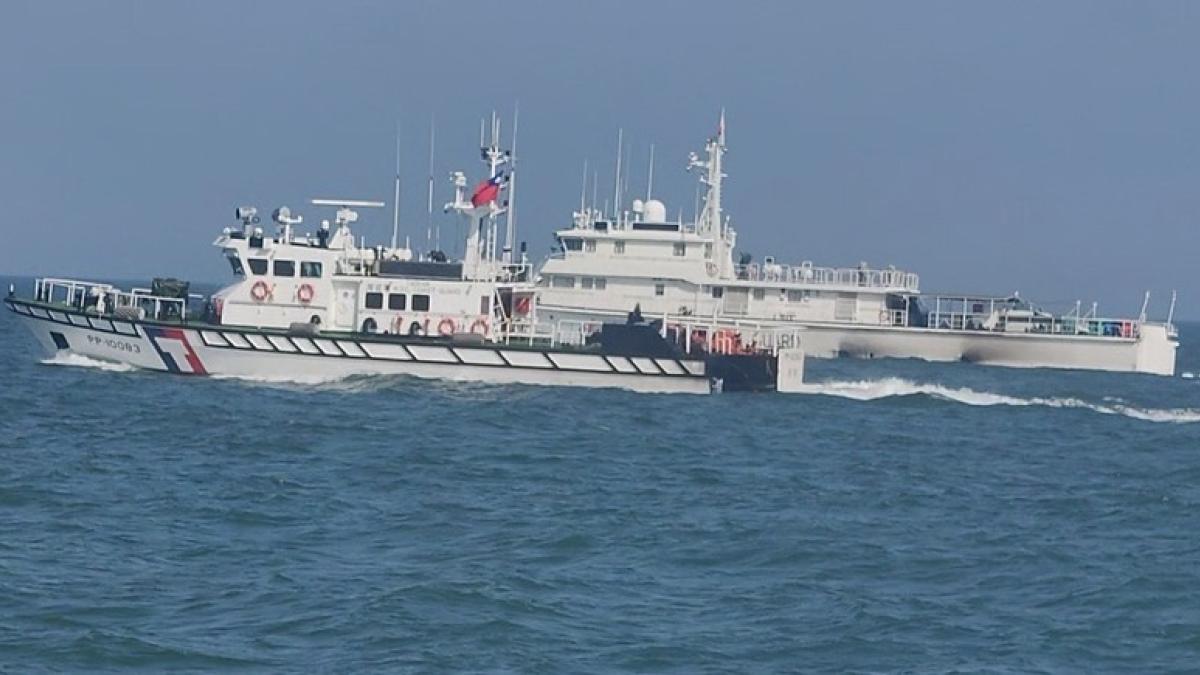
Similar changes are now occurring in the Taiwan Strait. After a Chinese speedboat capsized near Kinmen in February 2024, Beijing rejected Taiwan's claimed restricted waters, and the China Coast Guard began regular patrols around Kinmen. By June 2026, Chinese government vessel activity around Taiwan and its offshore islands had further increased.
According to Agence France-Presse (AFP), Taiwan's Coast Guard Administration detected 263 Chinese government vessels—including coast guard ships, rescue vessels, and research ships—in waters around Taiwan and its offshore islands in June, up from 200 in May and significantly higher than 171 in June 2025. This count excludes military vessels. Coast Guard officials noted a clear increase in Chinese government ships participating in gray-zone operations, both in terms of vessel types and frequency.
This differs from PLA military exercises around Taiwan. While military drills aim for short-term shock value, coast guard operations rely on sustained patrols to gradually challenge Taiwan's traditional law enforcement and jurisdictional space. These activities are no longer limited to offshore islands like Kinmen and Matsu but are extending toward the waters around Taiwan's main island.
Coast Guard Patrols Extend to Taiwan's East Coast
Reuters reported in July that Chinese coast guard activities have extended to the eastern waters of Taiwan. In the past, coast guard vessels appeared off Taiwan's east coast primarily during PLA blockade exercises. Now, they are conducting independent operations under the banner of 'rights protection and law enforcement patrols,' indicating Beijing's attempt to convert temporary blockade pressure into routine patrols.
Taiwan's Coast Guard Administration stated that China is advancing gray-zone operations through a 'multi-point, multi-form, cross-regional' approach and emphasized that China has no jurisdiction in waters around Taiwan. The United States, United Kingdom, France, and Germany have also expressed concern over these patrols. As Chinese coast guard vessels advance from Kinmen to Taiwan's east coast, the eastern flank of the First Island Chain faces not only military threats but also challenges to maritime law enforcement authority and shipping lane jurisdiction.
During Ma Ying-jeou's administration, responses to sovereignty disputes over the Diaoyu Islands and the South China Sea included diplomatic statements, coast guard fishery protection, naval patrols, military support, and stationing personnel on Taiping Island. Before leaving office, Ma personally visited Taiping Island to reaffirm the Republic of China's sovereignty claims. Now, as Chinese coast guard activities extend from Kinmen to Taiwan's east coast, the government must integrate coast guard law enforcement, naval support, and international cooperation to deliver sustained and clear responses.
Securing the First Island Chain: The Key is Sustained Jurisdiction
In response to such pressure, Taiwan cannot rely solely on military measures. On July 9, the government arranged for seven foreign lawmakers and two Taiwanese legislators to board a Coast Guard Administration patrol vessel to inspect waters around Kinmen. This demonstrated Taiwan's law enforcement capabilities and allowed the international community to directly witness the gray-zone pressures on the front lines.
As China seeks to normalize patrols as routine jurisdiction, Taiwan must maintain actual control over relevant waters through sustained patrols, refusal of illegal inspections, and deepened international cooperation.
Past discussions of the First Island Chain focused on military deployments, missile ranges, and wartime blockades. Now, the expansion of China's coast guard has extended the competition into law enforcement, jurisdiction, legal, and diplomatic domains. Beijing does not need to launch direct war; by continuously conducting coast guard patrols, inspections, and pressure campaigns, it may gradually alter the jurisdictional status quo of neighboring countries.
The same gray-zone strategy is advancing step by step along the First Island Chain—from Ren'ai Reef and Scarborough Shoal to Kinmen and Taiwan's east coast. For Taiwan, the real challenge is not the coast guard vessels themselves, but China's attempt to shape a new maritime order through sustained law enforcement.
If the government limits itself to post-incident protests and fails to maintain actual jurisdiction through stable patrols, law enforcement, and international cooperation, China's coast guard activities may gradually be accepted by the international community as a new normal.
Competition over the First Island Chain is no longer merely a military race but a contest over jurisdiction and on-site order. Sovereignty cannot remain confined to legal documents or diplomatic statements; it must be realized through continuous presence and effective management. When one side's patrols become routine and the other fails to maintain equivalent jurisdictional actions, the reality of the First Island Chain will inevitably shift.
*The author is a Ph.D. from the University of British Columbia, Canada, an appointed associate professor by the Ministry of Education, and a psychiatrist.
FACT BOX
- Source: PR Times
- Category: News