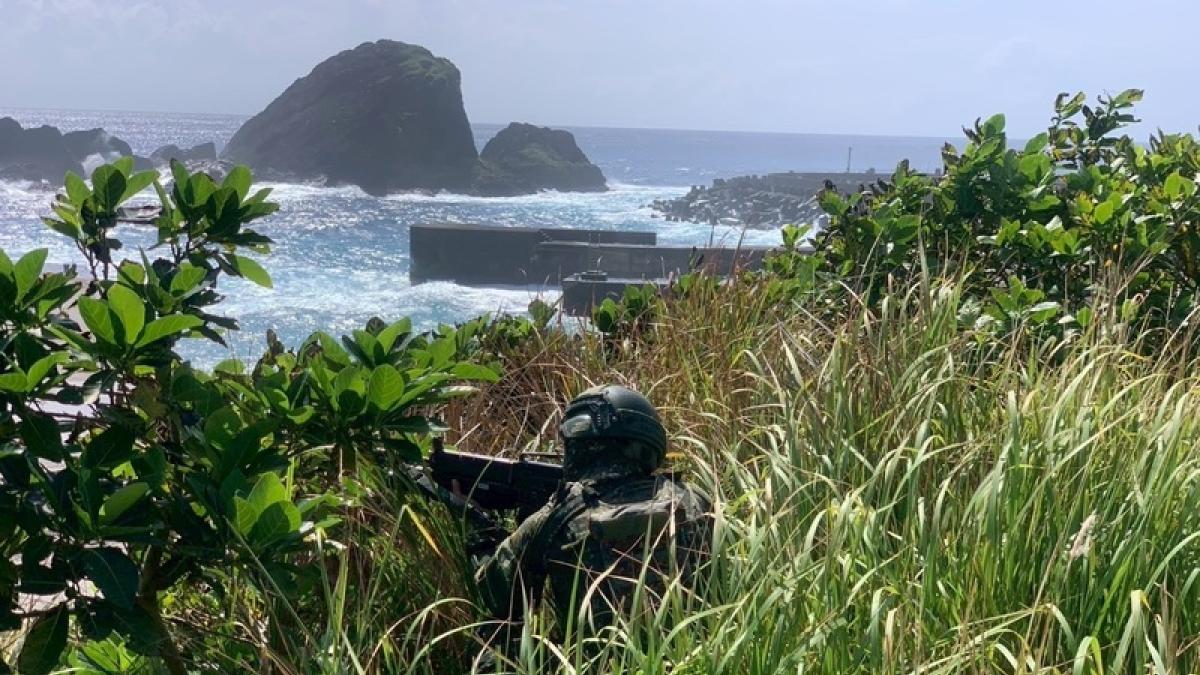
The Ministry of National Defense's 'Joint Defense Exercise' concluded on July 17, 2026, primarily simulating enemy launch scenarios to verify tri-service integration, decentralized kill chains, and distributed command structures. It served as a precursor to 'Han Kuang 42.' During the exercise, numerous units conducted 'cross-zone reinforcement' operations. Military officials explained that the purpose was to test the tactical mobility and logistical feasibility of troop movements—comparable to test-driving a route to confirm its usability.
Notably, for the first time in decades, troops were deployed to Green Island and Orchid Island under the Second作战 Area (Hualien and Taitung). Orchid Island, in particular, saw its first military landing in nearly 30 years—a rare and significant development. Behind this move was the strategic initiative of a senior general.
Eastern Taiwan has long been regarded as a force preservation zone. However, the deployment of troops further eastward suggests a fundamental shift in defense strategy. What does this mean? Is Taiwan redefining its national defense posture?
Military analysts suggest that positioning forces on remote islands like Lanyu (Orchid Island) is not merely symbolic. These locations serve as forward observation posts, early warning nodes, and potential launch points for asymmetric counterattacks. Orchid Island lies close to the Philippines and sits along the southern extension of the first island chain, giving it high strategic value in maritime defense.
The exercise involved various platforms, including drones, electronic warfare systems, and mobile missile launchers, simulating real-world combat conditions. Emphasis was placed on distributed command nodes to ensure operational continuity even if central command centers are compromised.
This marks a departure from traditional centralized defense models centered on western Taiwan. Instead, the military is adopting a more agile, dispersed, and resilient posture. The inclusion of Green and Orchid Islands in major drills indicates a long-term plan to institutionalize offshore island defense operations.
Experts believe this exercise reflects a broader strategic recalibration in response to evolving regional threats. As tensions in the Taiwan Strait persist, the military is preparing for scenarios involving rapid escalation, amphibious assaults, and gray-zone tactics. By testing logistics, command resilience, and cross-domain coordination on remote islands, Taiwan is enhancing its deterrence and defensive credibility.
Future exercises are expected to expand to other outlying islands, potentially including Kinmen, Matsu, and even Taiping Island in the South China Sea. The precedent set by this drill may become a regular feature of Taiwan’s annual defense planning.
The general who championed this initiative reportedly emphasized the importance of 'forward presence' and 'tactical surprise' in modern warfare. His vision appears to be reshaping how Taiwan’s military thinks about territorial defense—not just holding the main island, but actively securing its periphery.
While no direct combat occurred, the psychological and strategic impact is significant. It sends a clear message: Taiwan is prepared to defend every inch of its territory, even on its most remote outposts.
FACT BOX
- Source: PR Times
- Category: News