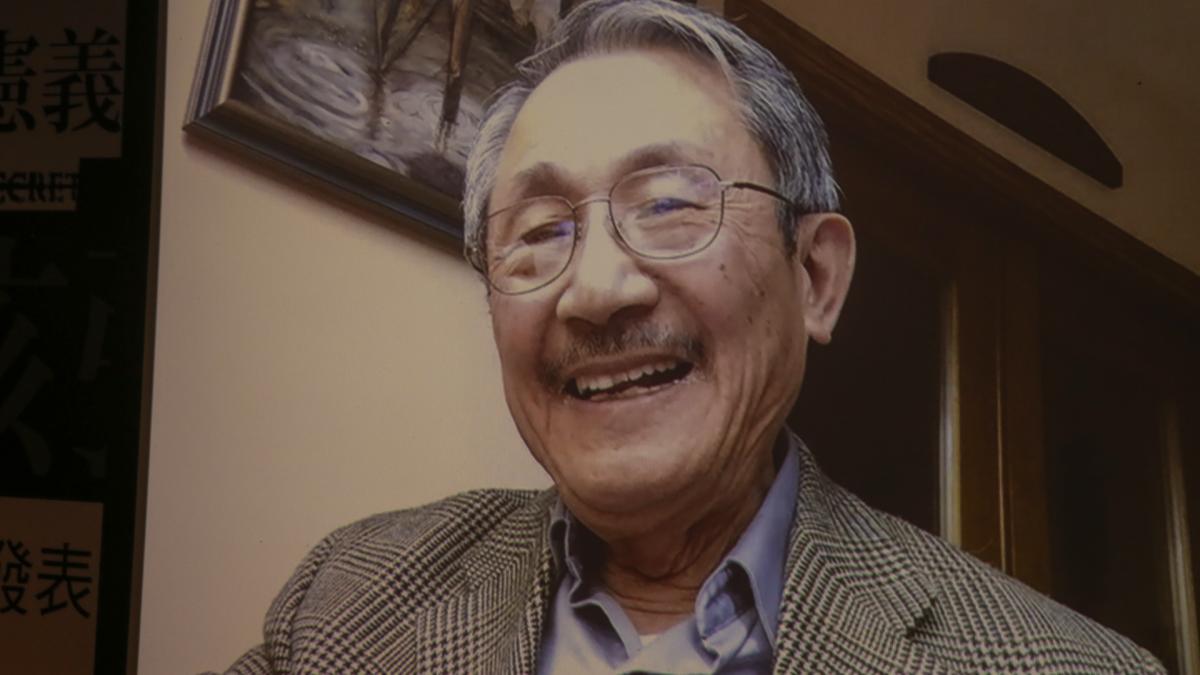
On January 13, 1988 (Republic Year 77), President Chiang Ching-kuo passed away while in office. Just four days earlier, on January 9, Chang Hsien-yi, a senior official at the Institute of Nuclear Energy Research (INER), vanished after taking leave. His wife and two of their three children had departed days earlier for a tourist trip to Japan through normal channels. Their eldest daughter, who had remained in Taiwan for schooling, also disappeared with Chang. Their home was left empty, and the family’s whereabouts became unknown.
While the nation mourned Chiang’s passing, only the security units of the Chungshan Institute of Science and Technology (CSIST) and senior INER officials were gripped by intense tension and suspicion.
On January 17, David Dean, director of the American Institute in Taiwan (AIT), who had been in the U.S. for a routine briefing, returned urgently to Taipei. News reports correctly stated that Dean had rushed back from America to express condolences over President Chiang’s death. However, what remained unknown to the public was that he also carried a weighty memorandum from the U.S. Department of State, which he personally delivered to Vice President Lee Teng-hui, who had just assumed the presidency.
The memorandum reaffirmed Taiwan’s past commitments not to develop nuclear weapons and stated that the U.S. had reliable intelligence indicating that INER was conducting research in violation of that pledge. It listed several facilities and research programs that must be immediately halted or dismantled, including the immediate shutdown and decommissioning of the heavy water reactor, and a comprehensive inspection of existing hot cells, with further decisions on these critical facilities to follow.
Additionally, the U.S. formally demanded that INER be effectively transferred from military to civilian oversight. This made clear that the U.S. had long seen through the pretense of the “Atomic Energy Council’s Nuclear Energy Research Institute” as merely a facade. The memo was direct and blunt, urging Lee Teng-hui to task then Chief of General Staff Hao Pei-tsun with enforcing these measures. The document made no mention of the Atomic Energy Council, and its tone was firm and unambiguous, directly targeting the Ministry of National Defense without circumlocution.
During his tenure as an Executive Yuan policy advisor, Lee Teng-hui had visited CSIST once. The only facility he toured at INER was the very hot cell that was now facing decommissioning. In hindsight, this was deeply ironic. Given the circumstances, Lee likely had no choice but to hand the document over to General Hao for implementation. He had limited knowledge of the internal details, the situation was sudden, and gaining full control was difficult.
For General Hao, this moment was critical. Having served as Chief of General Staff for eight years, he wielded immense power. But his main patron had just died, and a new president had just taken office. The President of the Republic of China, as commander-in-chief, was the only person who could dismiss the Chief of General Staff. At this turbulent time, Hao’s future rested entirely in Lee’s hands.
If the INER affair erupted into an uncontrollable scandal, Hao, who was both Chief of General Staff and head of CSIST, would be the first to face consequences, with unpredictable outcomes. Thus, Hao immediately delegated full authority to his deputy, Yeh Chang-tung, and withdrew to the background. The Ministry of National Defense accepted nearly all of the U.S. demands in principle. However, the subsequent developments did not go as Hao had hoped. His plan to handle the matter quietly and discreetly ultimately failed.
The U.S. Did Not State Its Intentions
The memorandum delivered by AIT’s David Dean to President Lee did not explicitly state that Chang Hsien-yi was already in U.S. custody, but it was mutually understood. Hao, in particular, knew that the U.S. could not have been unaware of his activities at INER and thus instinctively believed they now held solid evidence.
But was the truth really so?
The U.S. government had never ceased sending inspection teams to INER over the years. If Chang Hsien-yi had already been a high-level American spy embedded at INER, serving as deputy director, why did the U.S. wait until now to take decisive action? During Liu Kuang-chi’s tenure as director, INER had submitted numerous international procurement requests for the nuclear weapons program over two years. The U.S. State Department repeatedly reviewed end-use certifications and accepted INER’s explanations. Even the newly constructed hot cell in the outer compound of CSIST was a visible, undeniable physical piece of evidence. In the past, even the slightest clue prompted large-scale U.S. inspections. Why, then, did they not immediately intervene when faced with such a concrete new facility? Had Chang not tipped them off?
If the U.S. had already uncovered everything at INER, there was no need to use Chang’s defection as proof. In past inspections, the U.S. had always made a show of force, finding issues even when none existed. Now, with a clear target like the new hot cell, why not act immediately?
Even more puzzling: if Chang was a long-term, high-level insider, why abandon him so easily? The U.S. could have conducted another thorough investigation instead of exposing a carefully cultivated asset. Why go to such lengths and risk revealing a spy planted for years?
In October 1987 (Republic Year 76), Chang was assigned to coordinate with the U.S. on transporting spent nuclear fuel and planned a trip to America. At the time, Director Chou Jen-chang was dissatisfied with Chang, believing the trip was not urgent and should not be taken lightly. The two were at an impasse, but the U.S. formally contacted Chou, allowing Chang’s visit to proceed. This occurred just three months before his disappearance, indicating the visit was highly significant. What, then, was discussed?
It would make sense if the U.S., suspecting INER’s misconduct, summoned Chang to gather information. But Chang’s subsequent defection weakens this theory. If the U.S. only wanted verification, they could have sent an inspection team to Taiwan after a delay.
In the past, many INER personnel traveled between Taiwan and the U.S. without triggering follow-up inspections. Chang could have returned and continued as deputy director, serving as an ongoing informant. Moreover, the new hot cell was already built—“the monk may flee, but the temple remains”—a clear, undeniable fact. Why rush to sacrifice such a high-level asset?
Suppose Chang’s defection was unrelated to INER work—e.g., the U.S. judged his cover was about to be blown and ordered his evacuation. Yet afterward, Taiwan’s intelligence agencies showed no signs that Chang’s identity had been compromised, making “exposure” highly unlikely.
Nevertheless, Chang ultimately defected with his entire family, confirming he had been recruited by the CIA. The most plausible inference is that the U.S. deliberately arranged his visit to America three months prior. More likely, the U.S. reaffirmed their earlier recruitment and, under new circumstances, demanded he relocate with his family. Past promises of resettlement and employment for his family were likely fulfilled at this point, making refusal difficult. Once the U.S. made the request, Chang could hardly refuse. Added to this, his resentment toward Director Chou may have given the move a psychological element of revenge, ensuring Chou’s downfall.
Thus, upon returning, Chang fully cooperated with the plan. He formally applied for his wife and two younger children to travel to Japan for tourism, leaving only the eldest daughter in Taiwan for operational flexibility. Whether the U.S. disclosed the true reason beforehand is uncertain—likely not. The mere suspicion of exposure was enough to keep him anxious and sleepless. To the U.S., he was merely a pawn, not required to know the full game or the reason for this move.
Yet questions remain: Did the U.S. truly already know INER’s secrets? Did Chang provide critical intelligence? Or did the U.S. use Chang’s departure to achieve other objectives?
*Author Tung Chao-chin holds a master’s degree in materials science from the University of Rochester, New York. He served as Director at Taiwan’s Atomic Energy Council and Deputy Director of the Science-Based Industrial Park Administration. Recruited by former CITIC Financial Holding Chairman Koo Liang-sung, he joined the CITIC Group, serving as Chairman of Development Industrial Bank, General Manager of Development Financial Holding, Chairman of China Trust Bank, and Vice Chairman of CITIC Financial Holding. This article is excerpted from his new book, Taiwan’s Nuclear Bomb: The Illusion of Nuclear Weapons and the Struggle of Humanity (CommonWealth Publishing).
FACT BOX
- Source: PR Times
- Category: News