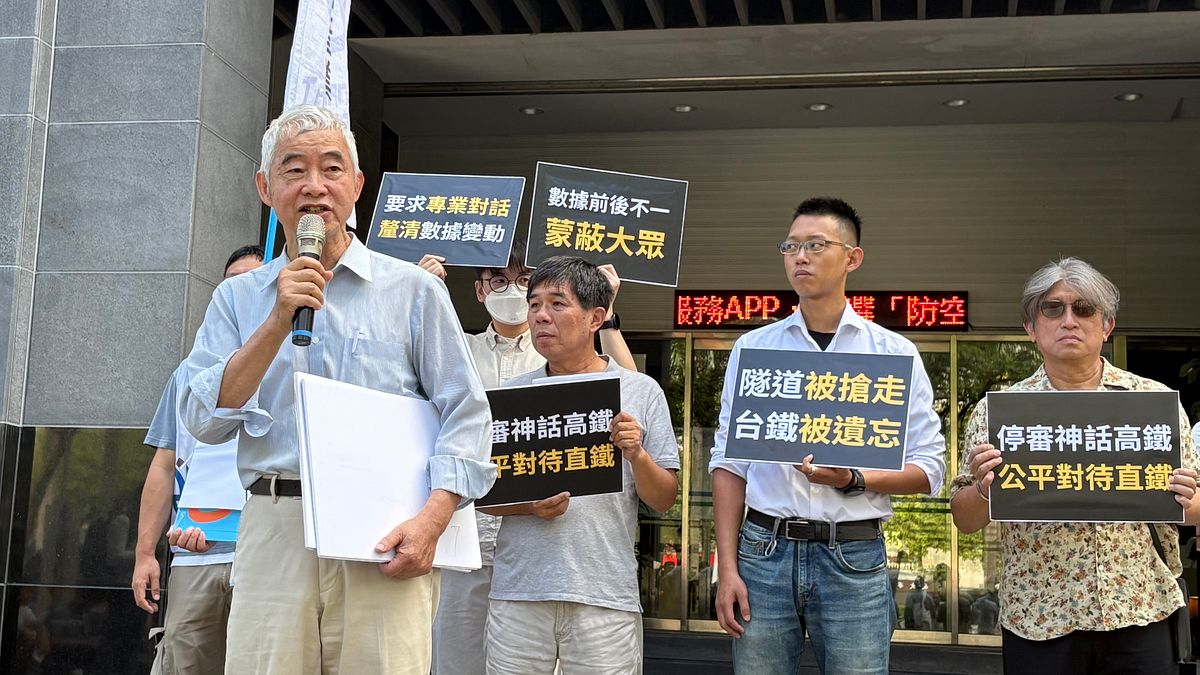
The Executive Yuan has formally approved the Nangang-Hualien High-Speed Rail (HSR) project, with a total budget reaching NT$352.175 billion, once again setting a new record for investment scale in Taiwan's major public infrastructure projects. Former Executive Yuan Minister without Portfolio Chang Ching-sen announced his resignation from the Democratic Progressive Party (DPP), which he had joined for 32 years, bluntly calling this a 'foolish investment and a grave historical mistake,' sparking widespread public attention. However, beyond the departure of political figures, a more pressing question arises: based on what system does Taiwan make decisions on public investments exceeding NT$350 billion?
Every major public infrastructure project represents a choice in national development direction. The real questions to answer are not merely whether the engineering can be completed, but whether it serves the public interest, offers optimal cost-effectiveness, and aligns with the nation's long-term development priorities. Major construction projects are not just engineering decisions—they are political choices about resource allocation. A truly mature nation is not defined by how much it builds, but by knowing which projects are most worthy of priority investment.
The most compelling argument for the Nangang-Hualien HSR is reducing travel time between Taipei and Yilan to just over 20 minutes. However, shorter travel time does not necessarily equate to maximized overall transportation efficiency. Evaluating major transportation projects should not focus solely on train travel time, but must include door-to-door travel time, transfer costs, transport capacity, service frequency, and overall network efficiency to truly assess public benefit. Otherwise, 'just over 20 minutes' risks becoming a politically appealing slogan rather than a genuine maximization of public interest.
What truly deserves discussion is the opportunity cost of public investment. The greatest constraint on any nation has never been a lack of infrastructure needs, but the limitation of resources. Every major expenditure means another public need may be delayed. When rail safety reforms, capacity upgrades on the North-Link Line, long-term care systems, and AI and emerging technology infrastructure all require substantial resources, have we sufficiently demonstrated that the Nangang-Hualien HSR is indeed the most urgent and worthwhile public investment at this moment? Public governance must answer not 'can we do it,' but 'why now, and why first?'
Another critical issue is the relationship between transportation infrastructure and land development. According to Yilan County Government's plan, the HSR station area will be integrated with a special urban development zone covering approximately 420 hectares, involving farmland conversion, land expropriation, and new town development. However, the HSR project and station-area land development are being reviewed separately, making it difficult to holistically assess the intertwined effects of transportation, land use, settlement changes, ecological impacts, and urban development within a unified decision-making framework. While this may formally comply with legal procedures, separating transportation and land development assessments risks underestimating long-term environmental, social, and fiscal costs.
The government has recently emphasized 'balanced regional development,' but true regional balance is not about giving more places an HSR station, but about enabling localities to develop autonomously. Genuine regional balance is not about turning every place into Taipei, but about empowering each locality to become its own unique self. If transportation development merely accelerates Yilan's integration into the capital's metropolitan area, drives up housing prices with external capital, makes homeownership harder for youth, and gradually turns the region into an extension of urban areas, then does this development model truly align with the original intent of regional balance? This deserves continuous scrutiny.
Public works also test fiscal governance capabilities. The Nangang-Hualien HSR budget has nearly doubled from an initial estimate of around NT$180 billion to over NT$350 billion in just a few years. Future challenges include land acquisition, land expropriation, geological conditions, price fluctuations, and construction risks. The government has a responsibility to present more transparent financial planning and risk management mechanisms. International experience repeatedly shows that cost overruns are not exceptions but the norm in major public projects. Therefore, more important than the construction itself are systems for public disclosure, ongoing review, and external oversight.
In recent years, major public investment decisions in various countries have gradually shifted from a 'construction mindset' to a 'governance mindset.' Amid accelerating demographic shifts, fiscal pressures, geopolitical risks, and net-zero transitions, nations increasingly prioritize whether public investments truly enhance national resilience, fiscal sustainability, and long-term competitiveness—not just short-term economic effects. Every public budget represents another policy choice that cannot be realized. Thus, every major investment must undergo more comprehensive cost-benefit analysis, fuller information disclosure, and more mature public debate.
Each time we visit Yilan, what we see may not be prosperity, but another vision of local governance. Yilan has consistently drawn national attention for its land conservation, environmental governance, and fiscal discipline, leading many to believe that local competitiveness need not rely on large-scale development, but can be built through governance quality, living environment, and local characteristics. Today, we are not opposing the Nangang-Hualien HSR, nor are we opposing Yilan's development. What we truly care about is whether, in an era of rapid demographic change, limited fiscal resources, and intensifying international competition, we are still responding to 21st-century challenges with 20th-century large-scale public works thinking.
What the Nangang-Hualien HSR truly tests is not just engineering technology, but whether Taiwan has established a mature system for public investment governance. The value of a major project depends not only on how quickly it is built, but on whether it answers three fundamental questions: Why must it be built now? Why should it be prioritized? Are there better public alternatives? A truly mature nation is not one without large-scale projects, but one where every large-scale project withstands repeated scrutiny of public interest, fiscal responsibility, and intergenerational equity.
Chen Ding-nan once said: 'Do not leave the earth bare; do not let green lands become wounded.' What we truly need to protect today is not just a piece of land in Yilan, but the principles of democratic decision-making, fiscal responsibility, and intergenerational accountability behind every major public investment. A mature nation is not only capable of building HSRs, but also capable of establishing an open, transparent, comparable, and accountable system for major public investment decisions. Only when major public investments are grounded in thorough justification, open dialogue, and institutional governance can every dollar of national resources become an asset for the next generation—not a burden they must bear.
*Author is the founder of the Taiwan Sustainable Governance Forum and Associate Professor at Chinese Culture University.
FACT BOX
- Source: PR Times
- Category: News