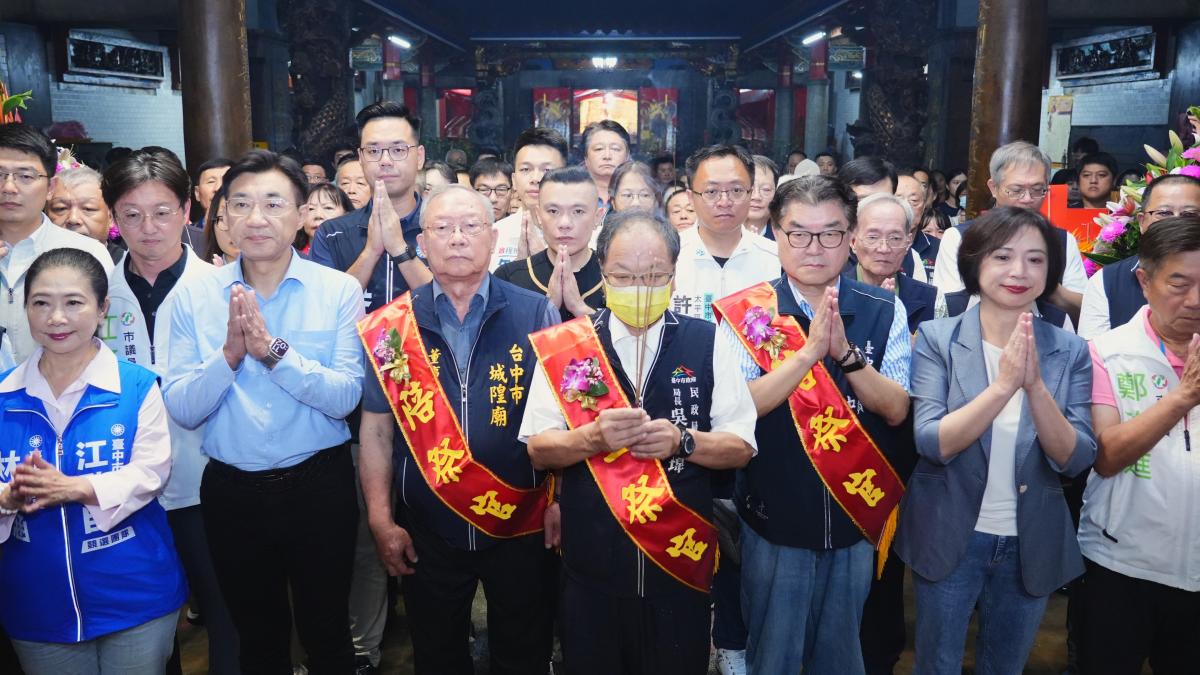
On July 28, corresponding to the 15th day of the sixth lunar month, Taichung City celebrated the birthday of its Chenghuang Deity. At the historic Taichung City Chenghuang Temple, which boasts nearly 137 years of history, the 'Birthday Ceremony of the Honorable Chenghuang Deity' commenced solemnly at midnight on July 27. The temple grounds were brightly lit and filled with incense, as bells and drums echoed in accordance with ancient rites. Devotees clasped their hands in prayer, creating a reverent and solemn atmosphere.
Wu Shih-wei, Director of the Civil Affairs Bureau, attended the ceremony on behalf of Mayor Lu Hsiu-yen, offering ceremonial tributes and birthday blessings. He expressed gratitude to the temple for its long-standing dedication to public welfare, charity, and community cohesion, and prayed for the Chenghuang Deity's protection—ensuring favorable weather, freedom from disasters, public safety and health, and prosperity across all industries in Taichung.
Wu stated that for over a century, the Taichung City Chenghuang Temple has demonstrated divine prestige, serving not only as a vital center of faith in the city but also as a key force in strengthening local community bonds and promoting moral values. Each year, the Chenghuang Deity's birthday attracts devotees from across the region. He thanked Chairman Lin Cheng-kung and the temple management team for their dedicated stewardship, continuous engagement in charitable activities, care for the vulnerable, and social services—transforming devotees' goodwill into tangible actions. This, he noted, ensures that faith not only brings inner peace but also becomes a powerful force for societal good.
Legislative Yuan Vice President Chiang Chi-chen remarked that the Chenghuang Deity, akin to a local magistrate, bears the crucial responsibility of safeguarding the community and discerning right from wrong. He expressed gratitude for the deity's enduring protection of Taichung's peace and smooth municipal operations, which, alongside efforts by the city government, council, and citizens, have enabled residents to live and work in security and comfort. He prayed for the Chenghuang Deity's continued blessings upon Greater Taichung and for the well-being, happiness, and prosperity of its people.
Legislator Ho Hsin-chun highlighted that the Taichung City Chenghuang Temple is a pivotal center of religious and cultural significance. She expressed gratitude to the Chenghuang Deity and other deities for safeguarding peace and harmony in Taichung, allowing citizens to live with confidence and pursue their livelihoods. She commended Chairman Lin and all benefactors for their contributions to the successful event, and prayed for national peace, local prosperity, and the health, family happiness, and career success of all citizens.
The Civil Affairs Bureau noted that the Taichung City Chenghuang Temple has long been committed to charitable causes, repeatedly receiving recognition from the city government as an 'Outstanding Organization for Donating to Public Welfare, Charity, and Social Education Initiatives.' In recent years, the temple donated NT$1 million to assist in installing air conditioning in classrooms at multiple elementary and junior high schools within the city, improving learning environments. After each annual Ghost Festival, the temple donates rice and daily necessities to foundations such as Chuang Shih, Jen-An, Hua-Shan, and Hung En, as well as community care centers. It also partners with the Red Cross Food Bank to support underprivileged families. Additionally, the temple funded the publication of the historical and cultural picture book 'Chenghuang Draws a Smile,' integrating religious culture, local history, and community education to deepen the roots of kindness in the community.
The bureau added that the history of the Taichung City Chenghuang Temple dates back to the 15th year of the Qing Guangxu era (1889), when it was originally established by Taichung County Magistrate Huang Cheng-yi as the 'Prefectural Chenghuang Temple of Taiwan Prefecture.' The Chenghuang Deity was enshrined with the title 'Weiling Gong' and held official sacrificial status. During the Japanese colonial period, the temple was relocated several times due to the original site being converted into a sugar factory. In 1921, local gentry including Lin Tzu-chin, Wu Tzu-yu, Lin Yen-tun, Lin Tsu-fan, Lai Ching-yen, and Lin Cheng-po jointly advocated for reconstruction, moving the temple to its current location on Hezuo Street in the South District. By 1928, the construction of the Three Gates Hall and side corridors was completed, establishing the temple's present form.
FACT BOX
- Source: PR Times
- Category: Event