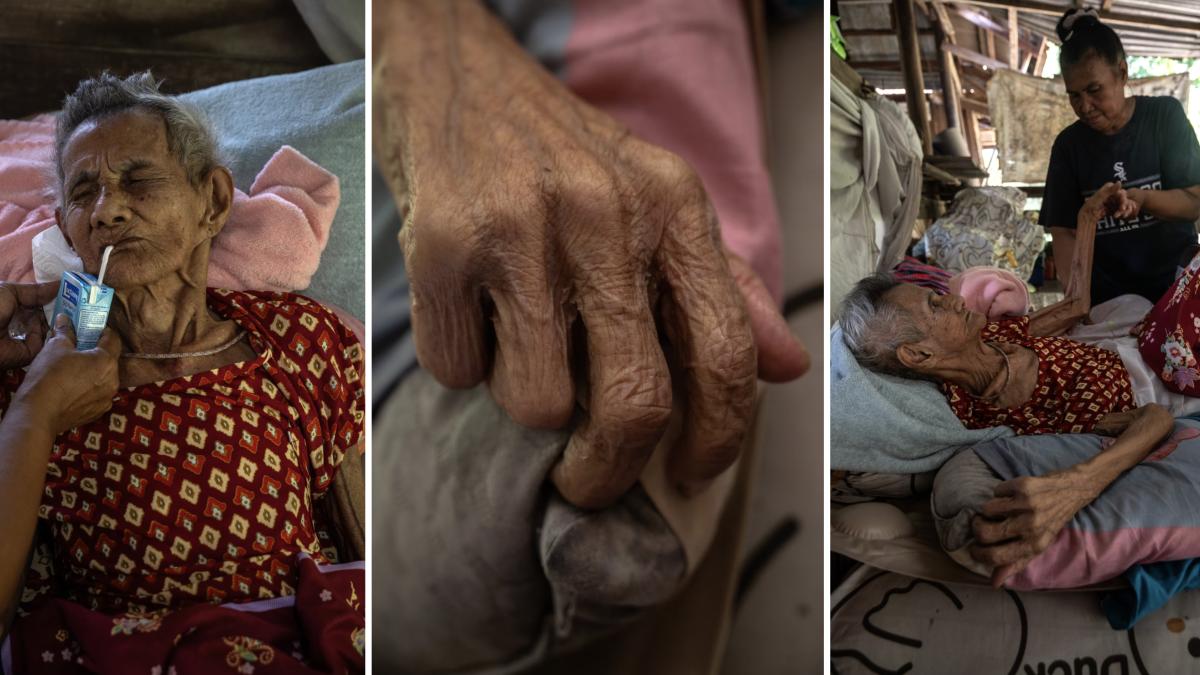
Every morning, Boonma Klahan must first bathe, dress, and feed her 85-year-old mother, who suffers from dementia and lies all day on a mattress on the floor of their home. After settling her mother, she prepares breakfast for her 87-year-old father, then rides her motorcycle to work. Nong Bua Kham is a poor agricultural village west of Bangkok, where Klahan works as a health caregiver, tending to 22 other elderly residents. Three of them are bedridden like her mother, while most others can no longer leave their homes.
The family lives on a tight budget, relying on Klahan’s monthly $90 salary, her parents’ combined $50 in government pension, and financial support sent by her adult children. Her brother, who lives nearby, usually brings groceries each morning.
“Life is getting harder and harder,” says 57-year-old Klahan. Lifting elderly people without hospital beds or specialized medical equipment has begun to take a toll on her back and knees.
In Nong Bua Kham, Thailand, Boonma Klahan must balance caring for her mother with supporting other elderly villagers.
Countries like Thailand are caught in a 'growing old before growing rich' dilemma. Their societies are aging rapidly, yet lack the pension systems and personal savings that most developed nations use to secure elderly livelihoods.
Today, one in six Thais is aged 65 or older, a result of a fertility decline that began in the 1970s. Within about a decade, Thailand’s fertility rate dropped from nearly six children per woman to just over two.
In the village where Boonma cares for her parents, the population is overwhelmingly composed of people aged 60 and above.
Thailand’s fertility rate is now just 0.9, far below the U.S. rate of 1.6 and less than half the level needed to maintain a stable population. Meanwhile, life expectancy in Thailand has risen from 51 years in 1960 to 77 today—just two years below that of the U.S.
Key demographic indicators in many developing countries, especially in Asia, are beginning to mirror those of highly developed nations. Labor-age populations are nearing their peak or, as in Thailand, have already begun to shrink. These countries face a grim future: a sharply declining youth population must support a rapidly expanding elderly cohort.
Yet countries like Thailand, Vietnam, China, and even India entered aging with far less wealth than Western economies. In India, fertility dropped to 1.9 children per woman in 2024.
In cities like Bangkok, aging takes on a different character. Experts told The Wall Street Journal that social networks there are less robust than in rural communities.
The U.S. entered what the UN defines as an 'aging society'—where 7% of the population is 65 or older—in the early 1940s. It then took over 70 years to transition to an 'aged society,' where the share doubles to 14%.
In contrast, Thailand became an 'aging society' in 2004 and reached 'aged society' status just 18 years later. Current projections suggest both the U.S. and Thailand will enter a 'super-aged society' around 2030, when those 65 and older make up at least 20% of the population.
However, when the U.S. entered its aged society phase in 2014, its per capita GDP was $55,264. Thailand, entering the same phase in 2022, had a per capita GDP of just $6,910.
Filial Piety
As recently as the 1990s, demographers worried about overpopulation and resource scarcity, and Thailand’s sharp fertility decline was seen as a success.
Unlike China’s coercive one-child policy, Thailand’s 'fertility revolution' resulted from the voluntary spread of contraception, including among married women.
But times have changed. Now, like other Asian nations, the Thai government is trying to encourage women to have more children. In Vietnam, manufacturing prosperity faces labor shortages, prompting the Communist Party leadership to abolish the two-child limit last year. Thailand’s economy remains heavily dependent on labor-intensive industries like tourism and agriculture.
Village chief Yod Khlaisiri has organized the elderly of Nong Bua Kham into a traditional percussion ensemble.
“Our labor force is shrinking, and output will decline,” said Nikorn Soemklang, Thailand’s Minister of Social Development and Human Security.
Meanwhile, the first generation of Thais who had fewer children are now aging.
Klahan’s mother had seven siblings, but Klahan herself had only two children. When her mother broke her hip five years ago, Klahan had to quit her job with the local government and return home to care for her.
A 2024 survey by Thailand’s National Statistical Office found that 45% of Thais aged 60 and older have no savings at all, and another 35% have less than $3,000. Nearly half of elderly Thais live with their children. Among those living alone, 80% receive some financial support from their children. Among the elderly needing physical care, two-thirds rely on their children.
Yod Khlaisiri, 55, the village chief, says about 80% of adults in Nong Bua Kham are over 60. Like Klahan’s children, most young people have moved to Bangkok or other cities for work.
To ease loneliness and provide some income, Khlaisiri formed a traditional drumming troupe that performs at weddings and other events. But during a recent rehearsal, two regular members, including the instructor, were hospitalized due to strokes. The village also has a Thai dance troupe of 12 women, five of whom are over 60—traditionally, such troupes are composed of young women or girls.
Tipping Point
Nopphol Witvorapong, an economist at Chulalongkorn University in Bangkok who studies Thai family structures, says rural communities still have strong social networks, with neighbors helping each other and local caregivers like Klahan sharing the burden.
However, in Thailand’s rapidly developing cities, these bonds are gradually eroding.
Malinee Sangkalak, 71, worked for decades as a cook in Bangkok restaurants. In her late 60s, she could no longer endure the physical strain of standing for long hours and had to stop working. Now, she lives with her son, who works in a factory, and one grandchild.
On a recent Monday, she joined a line of about 200 people waiting to receive free meals from a local charity. Many in the line were homeless, and about two-thirds were elderly.
“I never had extra money to save. All my money went to my family,” Sangkalak said.
Successive Thai governments have discussed raising the universal pension, but have abandoned the idea due to high costs. The current pension ranges from $18 to $35 per month. Additional subsidies are available based on financial need, up to $90 per month.
Beyond that, elderly people without savings or family support have few options.
Homeless shelters typically do not accept sick elderly people. According to Thailand’s Ministry of Social Development and Human Security, in a country of 71 million people, only 25 government-run elderly care facilities offer low-cost or free care. Meanwhile, the World Bank predicts that by the early 2040s, the number of Thais aged 80 and older needing care will surge sixfold to about 2.5 million.
The Thai government now hopes to promote a new model: paying families to 'foster' elderly people, similar to child foster care.
Aran Inthakul, 71, is one of the first beneficiaries. A former auto mechanic, he suffered a serious fall in front of the makeshift shelter he built on the outskirts of Bangkok a few years ago, and since then
FACT BOX
- Source: PR Times
- Category: Survey