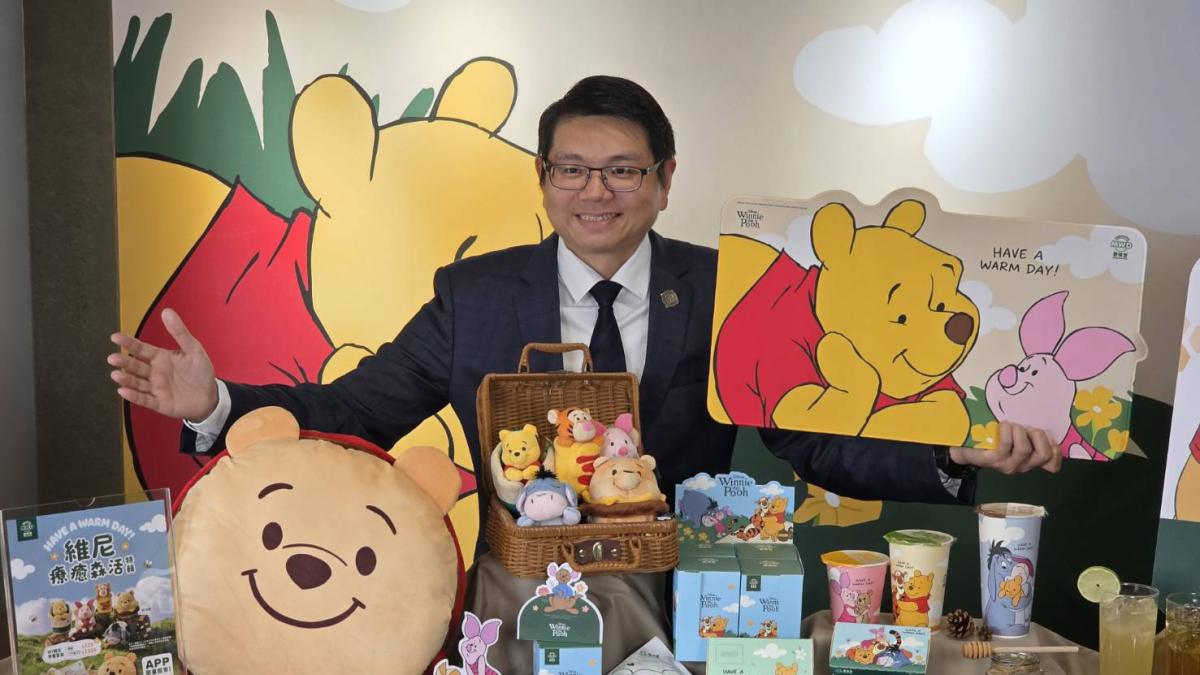
The breakfast market is also riding the wave of IP and blind box opportunities. Yang Qin International (2755) subsidiary McDonald's has collaborated with Disney's classic IP Winnie the Pooh for the first time, launching limited-time meals, breakfast-style blind boxes, and theme stores. Yang Qin Chairman Chao Jinglun said today (28) that the previous Snoopy collaboration had driven up the same-period performance by nearly 20%. This time, the Winnie the Pooh activity will continue from summer vacation to the start of school, and the company expects double-digit growth in sales from August to October. Currently, McDonald's has 1033 stores, aiming to reach 1100 by the end of the year, and is striving to surpass 2 million app members. However, Chao Jinglun emphasized that IP collaboration is just an entry point to attract consumers and increase brand interaction. The core of McDonald's is still its breakfast and lunch business, 'you can't make side dishes the main course.' Behind the collaboration activities, Yang Qin is simultaneously promoting app traffic, AI site selection, and multi-store franchising, hoping to further convert member traffic into store sales and expansion momentum. The Snoopy collaboration had driven up performance by nearly 20%. Winnie the Pooh attacks the blind box market again. The story of Winnie the Pooh has been around for 100 years, and Chao Jinglun said that the story conveys the spirit of companionship and mutual support, which is similar to McDonald's brand positioning of 'warming up every day,' and is also the main reason for this collaboration. About 95% of McDonald's stores are located in residential areas, so the chosen IP must cater to cross-generational, family customers, and home scenarios. The activity will start on August 1st at all stores nationwide, in addition to the limited-time tender chicken pancake special, tender chicken French toast special, honey green tea, and honey lemon, all cups, boxes, and hamburger bags at all stores nationwide will also be changed to Winnie the Pooh collaboration packaging. Another difference in this collaboration is that McDonald's is introducing the blind box concept into the breakfast market for the first time, launching five types of plush toys combined with brand meal imagery, including crepes, strawberry dough, fried eggs, potato egg tarts, and a special edition full-score burger shape, each box priced at 329 yuan, with the special edition limited to 500 pieces. In addition, McDonald's also launched a large Winnie the Pooh hamburger pillow and a large mouse pad, with two theme stores located at the Taipei Dunsun Yuanqi store and the Kaohsiung Xiziwan store. The collaboration peripherals will be available for limited pre-order through the McDonald's app starting at 10 am on August 3rd. Yang Qin spokesperson Cai Guohuan said that McDonald's previous IP collaborations were mainly focused on practical small items, and this time they are further targeting young groups, trendy players, and consumers who like to collect blind boxes and plush toys, hoping to increase brand contact with different customer groups. Chao Jinglun pointed out that the previous Snoopy collaboration had driven up the same-period performance by nearly 20%, giving the company more confidence to expand the form of IP cooperation. This time, the Winnie the Pooh activity spans August, September, and October, covering both summer vacation family customers and post-school consumption needs. The company estimates that the period's sales will show double-digit growth compared to the same period last year. Collaboration cannot replace the breakfast business Chao Jinglun: IP is just the icing on the cake Although IP collaboration can bring topics and short-term customers, Chao Jinglun still emphasized that brands should not collaborate just for the sake of collaboration, and even more, they should not treat collaboration products as their main business. 'IP is an added bonus, it is not the main reason consumers keep coming to McDonald's for meals.' Chao Jinglun said that McDonald's core business is still breakfast and lunch, so in recent years, the collaboration strategy is to combine IP with meals, stores, and consumption scenarios, rather than just printing patterns on products and selling licensed peripherals. Taking the earlier canned pig LuLu collaboration this year as an example, the activity was mainly for charity sales, with the proceeds invested in public welfare; this time, Winnie the Pooh further links meals, blind boxes, packaging, theme stores, and app pre-orders, trying to establish a more complete consumption experience. Chao Jinglun said that the company is still observing the life cycle of IP collaboration and consumer reactions. In the future, if the model is recognized by the market, the form of cooperation may be extended from the current small living items to backpacks, clothing, or wearable items, but the premise is still not to affect the positioning of the main business. McDonald's has 1033 stores and aims to reach 1100 by the end of the year In terms of store layout, Chao Jinglun said that as of the end of last month, McDonald's had 1033 stores in Taiwan. Based on the current expansion progress, the number of stores by the end of the year is expected to be between 1050 and 1100, with a target of challenging 1100. Behind the 1033 McDonald's stores are about 700 franchisees, of which franchisees under the age of 30 account for about one-tenth, equivalent to more than 70 people. Chao Jinglun observed that the new generation of franchisees are more familiar with mobile phones, tablets, and digital tools, which is in line with Yang Qin's recent introduction of apps, AI, and smart operating systems. He pointed out that although breakfast is a traditional industry, franchisees can now manage stores, grasp operating information through mobile phones, and communicate with headquarters using tablets. The digital tools they use are not much different from those of large chain fast-food operators. In the second half of the year, in addition to expanding through the existing franchise system, Yang Qin will also participate in the Kaohsiung Franchise Expo and the Nanfang Franchise Expo held in October, continuing to recruit new-generation catering entrepreneurs. More than ten million POS data per year AI locks in more than 500 store locations In addition to finding new franchisees through franchise expos, Yang Qin is also using AI to analyze the sales and commercial district data of existing stores to help franchisees choose the next store location. Chao Jinglun said that more than 1000 McDonald's stores use the POS system provided by the headquarters. The company accumulates more than ten million sales data per year and combines business registration, rent, population structure, and commercial district changes to evaluate the future three to five years of consumption needs in different regions. Currently, Yang Qin has identified more than 500 potential store locations within a one-kilometer range of existing McDonald's stores, which can be provided to new franchisees for evaluation, or existing franchisees can open a second, third, or fourth store. 'In the past, there was McDonald's where there was consumer demand; now, McDonald's can see the demand and open there in advance waiting for the demand to come.' Chao Jinglun said that in the past, the catering industry usually entered the market after the commercial district matured and the crowd formed, but by the time the commercial district was completely mature, the suitable first-floor storefront might have been snatched by other operators. Therefore, McDonald's recent expansion focus has gradually shifted to new buildings, emerging residential areas, and newly developed areas on the outskirts of cities, including Beitun in Taichung, Qingpu in Taoyuan, and other areas with continuous population influx, hoping to lay out in advance before rents and market competition rise significantly. The proportion of multi-store franchises is expected to increase to 40% in the long term, moving towards 2000 stores Compared to relying entirely on new franchisees, Yang Qin also hopes to encourage mature existing franchisees to expand their multi-store layout. Currently, the proportion of multi-store franchises at McDonald's is about 20%, and the company hopes to increase this to 35% to 40% in the future. Chao Jinglun pointed out that multi-store franchises can not only schedule personnel, shifts, and materials across stores but also jointly accept 100, 200, or even 300 large group orders, reducing the situation where a single store misses business opportunities due to insufficient manpower or production capacity. If the same franchisee operates multiple stores in nearby commercial districts, it can also reduce conflicts between stores and quickly replicate the verified store manager, shift, and operating system. Chao Jinglun said that McDonald's long-term goal is to develop from 1000 stores to 2000. If the proportion of multi-store franchisees can be increased to 40%, combined with the continuous addition of new franchisees, the number of stores has the opportunity to first grow to 1500 to 1600, and then gradually move towards 2000. The proportion of takeout has dropped to 17% to 18%, and the number of app members is expected to reach 2 million In terms of digital member management, the revenue proportion of McDonald's generated through takeout platforms such as Uber Eats was once over 20%, but has now dropped to 17% to 18%. The company hopes to further reduce this to around 15% in the future. Chao Jinglun said that reducing the platform's share is not abandoning the takeout customer group but considering the takeout platform's commission, monthly settlement system, and related fees, which may squeeze the franchisee's income and cash flow. Dine-in, takeout, and takeout belong to different consumption scenarios. McDonald's will still design suitable products for different customer groups but hopes to bring more orders back to its own app. This time, the Winnie the Pooh collaboration products adopt app limited pre-orders, which also undertake the task of increasing member stickiness and repurchase rate. Chao Jinglun said that McDonald's app member number will challenge 2 million this year, and through member consumption data, store POS system, and AI analysis, establish a digital operation cycle from traffic diversion, ordering to store expansion. 'Franchisees make money, and we will move on to the next step.' Chao Jinglun emphasized that IP can create topics, but long-term growth ultimately still needs to return to franchisee profits, single-store operations, and self-owned member management. Yang Qin International Chairman Chao Jinglun said that based on the current online community's discussion heat about McDonald's cooperation with Winnie the Pooh, it is expected to drive overall revenue to present double-digit growth. (Wei Xinyang photo)
FACT BOX
- Source: PR Times
- Category: Partnership