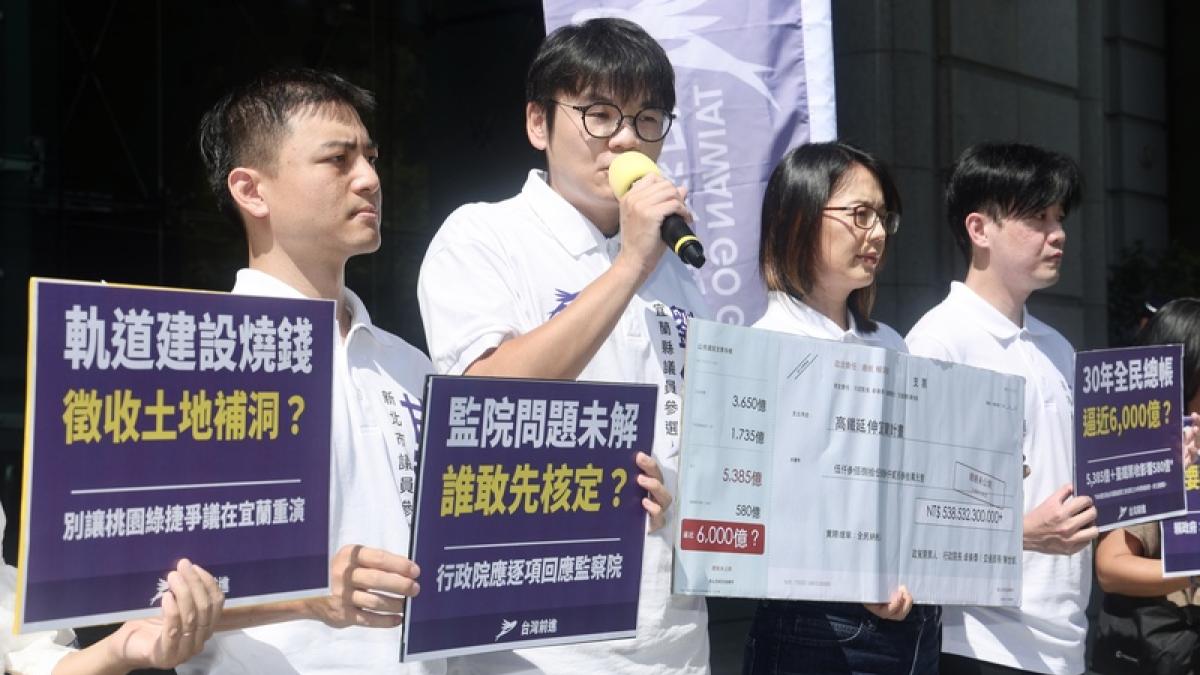
The Executive Yuan of Taiwan officially approved the extension of the high-speed rail to Yilan on July 23, 2026, with a planned route length of approximately 60.6 kilometers and a total budget of 352.18 billion NT dollars. The government claims that this will reduce travel time from Taipei to Yilan to approximately 28 minutes, alleviate traffic congestion on National Highway No. 5, and promote the development of the eastern region, gradually completing a high-efficiency island-wide railway network. However, a responsible government should answer the most basic question before investing thousands of billions of dollars: Does Taiwan need more high-speed rail, or should it maximize the efficiency of the already-built Taiwan Railways and highways?
The success of the high-speed rail has significantly shortened travel time between major cities in western Taiwan. However, this success has also brought a bloody lesson: In Taiwan, which has a north-south length of only about 400 kilometers, adding a parallel high-speed transportation system often does not create new travel demand but rather redistributes passengers from existing airlines, Taiwan Railways, and bus services. The initial operation of the high-speed rail incurred losses for many years, relying on government guarantees to lower bank interest rates, extend amortization periods, lay off employees, reduce wages, and increase capital to barely survive. However, the price of this hardship is that the transportation tools for the poor, Taiwan Railways, and buses are becoming increasingly difficult to operate. The consecutive occurrence of the 2018 Puyuma and 2021 Taroko major transportation accidents, and the financial squeeze on Taiwan Railways by high-speed rail, is there no correlation? This is the accompanying measures that policies must consider before implementation! If high-speed rail was not built at that time, but instead the speed of Taiwan Railways was improved and the interference problem of fast and slow trains was improved, or even the long-distance bus was railized (subsequently supplemented), would Taiwan's transportation be more convenient? At least the author can be sure that there will be no particularly remote high-speed rail stations (Taichung Wuri and Tainan Shalun). High-speed rail takes away high-priced, most consumptive long-distance passengers; Taiwan Railways continues to bear the burden of low-priced, multi-stop, high-maintenance costs for commuting, rural, and small station services. After the loss of national highway bus passengers, the number of trips decreases, the fewer the number of trips, the less willing passengers are to take them, and finally, the public is forced to purchase small cars. The government, on the one hand, spends a huge amount of money to build new systems, and on the other hand, lets the existing systems bleed, and finally fills the deficit of Taiwan Railways with public funds. This cannot be called integration but can only be called internal consumption of national resources. The success of high-speed rail does not mean that there are no other plans that can more reasonably solve Taiwan's transportation problems! The merits and demerits of high-speed rail have such past experiences to refer to, still cannot learn the lessons, and still want to continue extending to Beiyilan and Pingtung? Or even, under the pressure of not losing face, under the needs of certain legislative elections, finally high-speed rail encircles the island?
The official forecast of Yilan high-speed rail shows that in 2051, if high-speed rail is not built, the distribution of transportation modes for Beiyilan trips is approximately:
Before building high-speed rail After building high-speed rail Passenger volume (ten thousand trips) Percentage Passenger volume (ten thousand trips) Percentage Small cars 21.2 81.60% 19.9 70.30% Road buses 1.8 7.20% 1.2 4.20% Taiwan Railways 2.9 11.20% 1.2 4.10% High-speed rail 6 21.30%
The official itself admits that the transfer effect of high-speed rail on National Highway No. 5 small cars is only about 3% to 6% on weekdays and holidays. This set of data is worth the Executive Yuan to look at carefully: Taiwan Railways may reduce about 17,000 trips per day, road buses reduce about 6,000 trips, but small cars only reduce about 13,000 trips. That is to say, the passengers absorbed by Yilan high-speed rail from Taiwan Railways and buses may be more than those transferred from small cars. How can this be called 'solving the congestion of National Highway No. 5'? After the opening of the high-speed rail, the Xueshan Tunnel will still have nearly 200,000 small car trips; the government first spends more than 35 billion yuan, and then weakens Taiwan Railways and buses again. This is not treating the right illness but treating the wrong patient with the most expensive medicine. The benefit-cost ratio of Yilan high-speed rail announced by the official is 1.10, which means that for every 1 yuan invested, it theoretically generates 1.10 yuan of benefits, which seems to barely qualify. However, about 61% of the total benefits come from 'industrial economic spillover effects,' amounting to over 23 billion yuan. If this highly model-assumed benefit is excluded and only the more direct benefits such as travel time, driving costs, accidents, pollution, carbon emissions, and land use are calculated, the benefit-cost ratio is far below 1. The so-called spillover benefits must prove that high-speed rail has indeed created new national value, rather than moving consumption from Taipei, Hualien, or other regions to Yilan. If it is only a change in the place of consumption, it cannot be entirely regarded as new national added value. A benefit-cost ratio of only 1.10 also means that if the engineering cost increases by one-tenth, or the passenger volume and spillover benefits are slightly lower than expected, the entire project may lose economic feasibility. This is not a stable investment but a high-risk construction that barely passes with optimistic assumptions. What Yilan really lacks is a complete car-free tourism system. Currently, the national highway bus to Beiyilan is not entirely without a foundation. Taipei, Banqiao, City Hall, Nangang, Yuanshan, Science and Technology Building, and Dapinglin all have different routes to Jiuxi, Yilan, and Luodong; some sections of National Highway No. 5 also have measures such as priority for large buses, shoulder running, and no control by ramps. The real breakpoint occurs after the passenger arrives in Yilan. Yilan's tourist attractions are scattered in Head City, Jiuxi, Yuanshan, Sanxing, Luodong, Dongshan, Suao, and the mountainous areas. After passengers take the bus to the transfer station, they may still need to go to homestays, farms, beaches, water parks, Plum Blossom Lake, Art Center, QingShui Geothermal, or Taiping Mountain. If the last leg of the journey has few trips, unclear information, uncertain return trips, and needs to carry luggage, the elderly, and children, a family will naturally choose to drive the entire way. Therefore, the focus of Beiyilan public transportation policy should not only be 'transporting passengers to Yilan' but must also be responsible for delivering passengers to their real destinations. The last mile is not difficult; it's just that the government has not integrated it. The last mile in Yilan should not only rely on fixed-route buses but should be completed by different modes of transportation together: Urban and short-distance travel using YouBike and electric-assisted bicycles. Two or three people's scattered trips using taxis and Uber-like ride-hailing services. Families, multi-day trips, and remote attractions using short-term rentals or shared cars. Homestay clusters using joint shuttle buses. Popular attractions using fixed circular buses. Long-distance attractions such as Taiping Mountain and QingShui Geothermal using reserved minibuses. Luggage directly delivered from the transfer station to homestays or hotels. YouBike is particularly suitable for handling holiday peaks. Bicycles do not require drivers and do not need to employ a large number of people for a few holidays a year. The government can bring in bicycles from other regions before the holidays, and set up temporary bike racks at transfer stations, hotels, night markets, water parks, and around attractions. Of course, bicycles cannot serve everyone. Rainy days, hot weather, the elderly, children, luggage, and long-distance trips all need Uber, taxis, rentals, shared cars, and minibuses to make up for it. Precisely because passenger needs are different, the government should integrate multiple tools rather than expect a fixed bus route to handle everything. The government can promote the 'homestay joint shuttle system'. Nearby five to ten homestays jointly use a nine-seater or medium-sized bus operated by a legal professional team. When booking a room, passengers fill in the arrival station and time at the same time, and the system merges nearby passengers for dispatch. The government subsidizes based on the actual number of pick-ups or kilometers traveled, does not subsidize empty cars without passengers, and does not require each homestay to buy a car. Helping homestay operators complete the shuttle system only needs a fraction of the cost of building high-speed rail. Increase vehicles in the peak season and reduce dispatch in the off-season; raise prices during peak hours and offer discounts during off-peak hours. This is exactly the operating method of a normal enterprise facing seasonal demand. The government should also establish a unified 'Yilan car-free tourism platform'. When purchasing Beiyilan bus or Taiwan Railways tickets, passengers can simultaneously book: Transfer station shuttle Homestay pickup Luggage delivery YouBike or electric-assisted bicycles Shared cars Attraction minibuses Return trunk line seats If the previous bus is delayed, the subsequent shuttle will be automatically postponed. The public purchases a complete journey, not facing five unrelated systems of Taiwan Railways, buses, homestays, taxis, and buses separately. Technically, it is entirely possible; what is really lacking is whether the government is willing to take responsibility for integration. National highway buses should follow the operation mode of railways and establish fast and slow lanes and fixed beats. The first layer is the Beiyilan high-speed trunk line, departing from Banqiao, Taipei, City Hall, Nangang, Dapinglin, etc. During peak hours, one trip every 10 minutes, and during regular days, one trip every 15 to 30 minutes, adopting a common schedule, without requiring passengers to distinguish different bus companies. The second layer is to set up lightweight transfer nodes near the interchanges of Head City, Yilan, Luodong, and Suao. After the trunk bus goes down the interchange, it stops quickly and immediately returns to the national highway, not
FACT BOX
- Source: PR Times
- Category: 政策