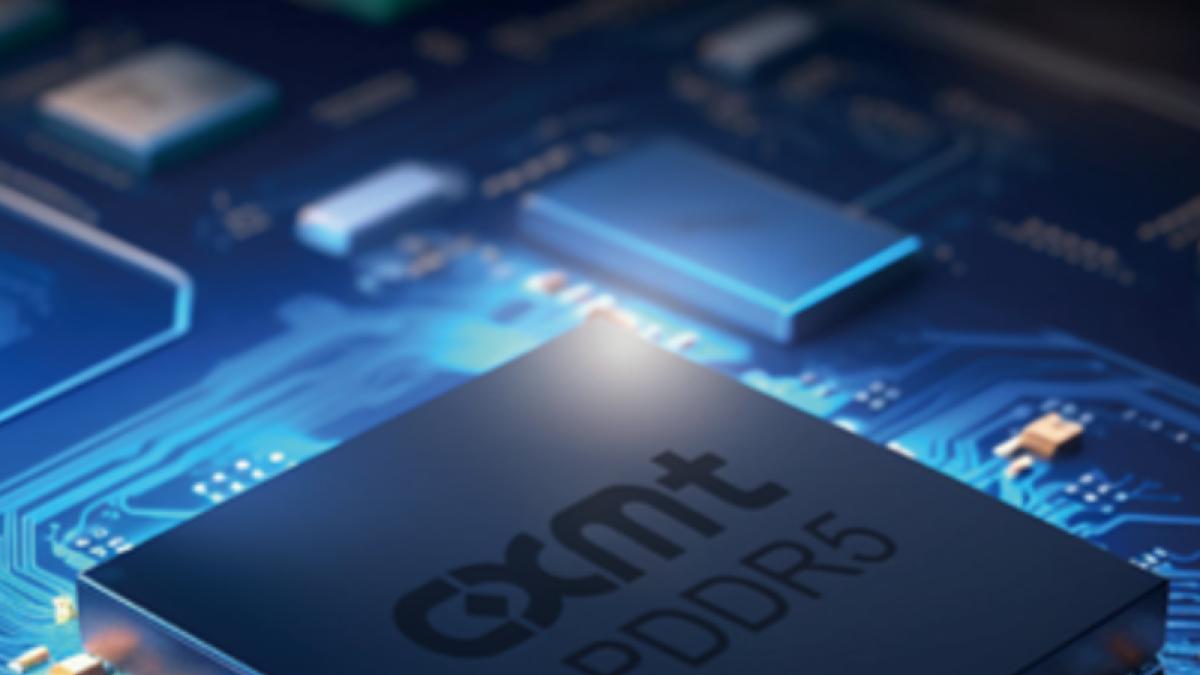
China's largest DRAM memory chip manufacturer, ChangXin Memory Technologies (CXMT), officially debuted on the Shanghai Stock Exchange's STAR Market on the 28th. On its first trading day, the stock price surged 466%, becoming one of the most high-profile IPOs in China's A-share market in recent years. The company's market capitalization soared to approximately 3.3 trillion RMB (about $487 billion), making it the highest-valued listed company in China's A-share market.
The IPO raised at least $8.6 billion, marking the largest IPO in China in recent years and the second-largest in Chinese history, only behind Agricultural Bank of China's $22.1 billion dual listing in Shanghai and Hong Kong in 2010. This underscores the capital market's high expectations for domestic chip companies amid China's push for semiconductor self-reliance and AI industry development.
Fueled by the AI wave, CXMT's revenue skyrocketed over 700%. Founded in 2016 and headquartered in Hefei, Anhui Province, CXMT has become one of the world's major DRAM (Dynamic Random Access Memory) suppliers. DRAM is widely used in AI servers, data centers, smartphones, PCs, and automotive electronics, serving as a critical component in modern information devices.
The rapid advancement of generative AI in recent years has driven explosive growth in global AI computing demand, triggering a new growth cycle in the memory market. Large-scale AI model training and inference require higher-capacity and faster memory, leading to a sharp rise in DRAM demand.
CXMT has emerged as a key beneficiary of the AI boom. According to company data, its revenue for the first quarter of 2026 reached 50.8 billion RMB (about $7.5 billion), a year-on-year increase of over 700%, reflecting strong demand driven by expanding AI infrastructure investment.
The rapid expansion of the AI industry has also caused ongoing global memory supply tightness, increasing costs for end products like computers and smartphones, further pushing up memory prices.
Under U.S. export controls, China is accelerating the development of an independent memory supply chain. CXMT's rapid rise is also driven by China's strategic push for semiconductor self-sufficiency.
Amid tightening U.S.-led export controls on advanced semiconductors, Chinese firms face strict limitations in acquiring cutting-edge chip manufacturing equipment and cannot access high-bandwidth memory (HBM) products essential for high-performance AI.
Kyle Chan, a China technology policy researcher at the Brookings Institution, stated that CXMT plays a crucial role in China's AI strategy, especially under ongoing U.S. export restrictions, making its importance even more pronounced.
Chan noted that CXMT is one of China's most promising platforms capable of independently developing advanced HBM technology to support domestic large-scale AI models.
HBM, a specialized DRAM architecture, delivers significantly higher data transfer speeds than traditional DRAM. It has become a core component in AI GPUs, high-performance computing (HPC), and large AI servers, and is an essential memory for AI accelerators from NVIDIA and AMD.
Despite market optimism, analysts widely believe CXMT still faces significant technological and supply chain challenges. Kyle Chan pointed out that the biggest bottleneck for CXMT's capacity expansion remains difficulties in acquiring chip manufacturing equipment. Unable to access the world's most advanced semiconductor tools, the company must rely more on domestic Chinese equipment suppliers, potentially impacting the timeline for advanced process nodes and HBM mass production.
The market generally believes HBM production requires not only advanced DRAM process technology but also high-precision packaging, stacking techniques, and a complete supply chain, making equipment restrictions one of CXMT's biggest competitive hurdles.
MS Hwang, Counterpoint Research's Director of Memory Semiconductor Research, stated that the primary factor affecting CXMT's development remains international trade restrictions on advanced chip manufacturing equipment.
While CXMT's global market share continues to rise, it still lags far behind Samsung, SK Hynix, and Micron. According to Counterpoint Research, CXMT became the world's fourth-largest DRAM supplier in 2025, with a global shipment market share of about 8%.
The global DRAM market is currently dominated by three major players:
- Samsung Electronics: 36% - SK Hynix: 29% - Micron Technology: ~24% - ChangXin Memory: ~8%
In the first quarter of 2026, CXMT's global shipment share further increased to about 9%. Counterpoint forecasts that by 2028, CXMT's global market share could reach approximately 11%. However, to establish a long-term competitive advantage, it needs to reach around 15% market share to pose a real threat to Samsung, SK Hynix, and Micron.
Rising U.S. national security concerns have once again placed CXMT at the center of U.S.-China tech rivalry. Beyond technical challenges, CXMT continues to be affected by U.S.-China tech competition.
Recently, some U.S. lawmakers have urged the Trump administration to ban American companies from purchasing memory products made by CXMT on grounds of national and economic security, suggesting that such restrictions could expand further.
Additionally, the U.S. Department of Defense has already listed CXMT among Chinese companies linked to the Chinese military. Beijing has consistently denied these allegations and opposes labeling Chinese companies with military affiliations.
Market observers believe that as the global AI chip race intensifies, CXMT's future development will depend not only on technological breakthroughs and production capacity expansion but also on ongoing factors like U.S.-China tech rivalry, export controls, and global semiconductor supply chain restructuring.
Notably, CXMT's A-share IPO follows closely after South Korea's SK Hynix completed a $26.5 billion IPO earlier this month. The two Asian memory giants raising massive funds through capital markets reflect how the global AI boom is driving a new cycle of competition and investment in the memory industry.
FACT BOX
- Source: PR Times
- Category: Funding
- Organizations: ChangXin Memory Technologies / Samsung Electronics / SK Hynix
- Products / services: DRAM / HBM(High Bandwidth Memory)