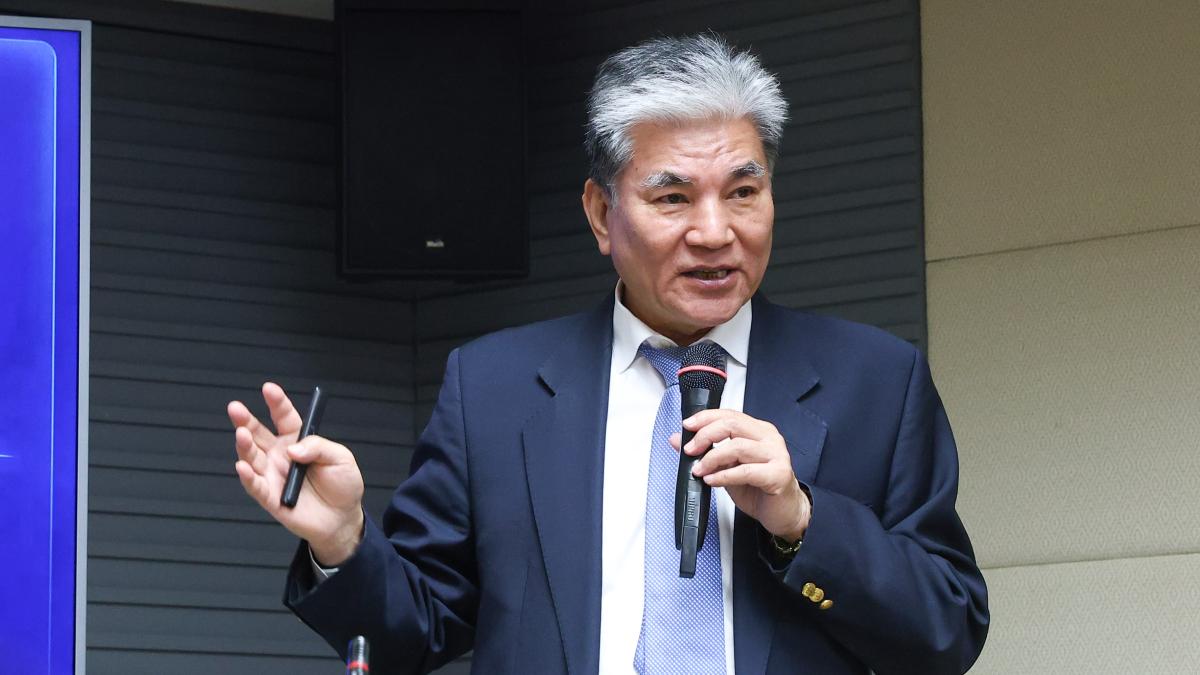
The Executive Yuan recently approved the High-Speed Rail (HSR) extension to Yilan, planning to extend the line from Nangang to Yilan, covering approximately 60.6 kilometers with a total budget of about NT$352.175 billion (approximately $11 billion), aiming for completion 11 years after approval.
In response, former Executive Yuan advisor Chang Ching-sen announced on the 24th that he would leave the Democratic Progressive Party, criticizing the Yilan HSR extension as a politically motivated 'favor' for local elections, calling it a 'useless appendix HSR' funded by nearly $400 billion.
However, former Interior Minister Lee Hong-yuan questioned whether the government had fully assessed the impact of the HSR on Yilan and Taiwan's overall development before committing nearly $400 billion. He emphasized that discussions should go beyond engineering and ecological environmental impact assessments (EIA) and include a 'policy-level EIA'.
Can the HSR really not go to Yilan?
In an exclusive interview with Huang Kuang-chin, host of CNEWS, Lee Hong-yuan stated that Chang Ching-sen isn't opposing the HSR itself, but rather questioning the project's cost-benefit analysis and overall national land planning. Lee clarified that he does not oppose HSR extensions to Yilan or Pingtung, but stressed that the key issue is the purpose: 'The HSR isn't incapable of going to Yilan or Pingtung—it's about why we're going there. That's the real question.'
The Executive Yuan's approved plan extends the line eastward from Nangang Station, establishing the Yilan HSR Station south of the Yilan County Government Center. Upon completion, travel time between Taipei and Yilan would be reduced to approximately 28 minutes. The government believes the project will enhance transportation efficiency between northern and eastern Taiwan, alleviate congestion on National Highway No. 5, increase rail transport capacity in eastern Taiwan, and serve as a starting point for strengthening transportation resilience in eastern Taiwan.
Is a $400 billion investment justified?
Lee Hong-yuan pointed out that the Yilan HSR Station remains distant from the city center, Luodong, and major tourist attractions, requiring passengers to transfer to other transportation or rent cars to reach places like Taipingshan and Sanxing. He bluntly stated that if transfers and connections are inconvenient, tourists might prefer driving through the Snow Mountain Tunnel: 'I can sit in traffic for half an hour in the tunnel, but once I arrive, I can move freely.'
He also doubted whether Yilan's tourism demand could support frequent train services, suggesting that future operations might only run one or two trains per hour, offering limited relief to National Highway No. 5 traffic. If the HSR fails to significantly reduce tunnel congestion or save as much time as expected, the government must explain whether the nearly $400 billion investment and environmental costs are proportionate.
What were the reasons behind past HSR site selections?
Regarding the Yilan HSR Station's location, Lee Hong-yuan noted that some western HSR stations were built far from existing urban centers, and surrounding land development did not meet initial expectations. Therefore, the Yilan station's site selection should undergo public scrutiny. He questioned why the current location was ultimately chosen, who owns the surrounding land, and how land prices changed before and after the project was confirmed—all of which should be transparently disclosed to the public.
Lee also mentioned that some land along the HSR corridor remains undeveloped after more than 20 years. Early landowners may have profited, while later investors face high land costs that hinder housing sales. He warned that without comprehensive national and local development planning, the Yilan HSR project could repeat similar mistakes.
Lee recalled, 'When the HSR route was originally determined, I was serving in the provincial government. Why was that particular route chosen? In my cynical view—it was land speculation.' He added that the land through which the HSR passed remained idle for over 20 years and ultimately 'couldn't be hyped up.'
Is an ecological EIA sufficient for the Yilan HSR?
Lee Hong-yuan argued that beyond engineering and ecological environmental assessments, the government should conduct a policy-level review of the project. He explained that a 'policy EIA' evaluates the broader impacts of investing nearly $400 billion and adopting a specific route on Yilan's environment, industries, population, and Taiwan's overall national land development.
He stated bluntly: 'A policy EIA would never pass. I would never spend $400 billion on this.' Lee believes that as project costs continue to rise, the government must clearly explain the cost per kilometer, projected ridership, and future operational benefits, and must not push forward without sufficient public discussion.
Can the project be withdrawn after approval? Lee Hong-yuan calls for reevaluation in 2028
When Huang Kuang-chin asked whether the project could still be withdrawn after Executive Yuan approval, Lee Hong-yuan acknowledged that once approved, the project would enter detailed design phases, making it difficult to stop—but not impossible. He said, 'It's not impossible. Let's cancel it in 2028.'
Lee further stated that if there is a change in ruling party in 2028 and he has the opportunity to serve in government, he would invite Chang Ching-sen and experts from various fields to re-examine the project. He would also go to Yilan to hold thorough discussions with all sectors. He emphasized that if, after comprehensive professional evaluation and local consultation, the majority still supports moving forward, 'then let's do it professionally.' But the government must first clearly explain the costs, benefits, site selection, and environmental impacts.
FACT BOX
- Source: PR Times
- Category: News