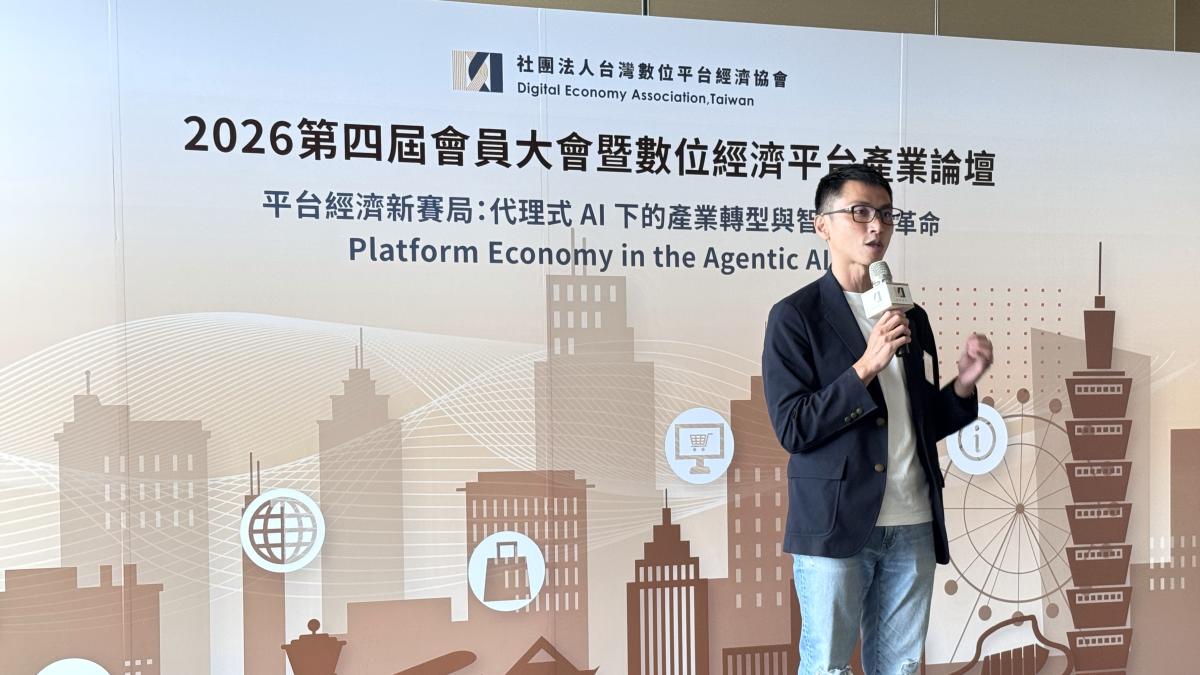
The Digital Economy Association Taiwan (DEAT) convened its 5th General Assembly and Industry Forum, completing the election of its fifth-term board of directors and supervisors. WeMo CEO Eric Liu was re-elected as Chairman. The new board brings together representatives from diverse fields including shared mobility, food delivery platforms, social media, logistics services, the sharing economy, corporate consulting, and legal sectors, showcasing the cross-sector collaboration power of Taiwan’s digital platform industry.
The event also hosted an annual industry forum titled "Platform Economy in the Agentic AI Era: Industrial Transformation and the Smart Monetization Revolution," featuring a panel discussion with Dcard Founder and CEO Lin Yu-Chin, PanSci Co-Founder and Chief Knowledge Officer Cheng Kuo-Wei, and INSIDE Founder and internet entrepreneur Hsiao Shang-Nung. They explored how Agentic AI is redefining platform value, business models, and Taiwan’s next wave of industrial opportunities.
Eric Liu Re-elected Chairman to Continue Deepening Policy Advocacy and Public-Private Collaboration
Since its founding in 2017, DEAT has consistently connected domestic and international digital platform enterprises. Its membership spans diverse industries such as shared mobility, food delivery, content platforms, online education, rentals, logistics, and telecommunications. The association has long promoted the development of the digital platform industry, regulatory advocacy, and industry-government-academia exchanges. Through research projects, forums, and public initiatives, DEAT has supported the creation of a more favorable environment for digital economic development.
Over the past two years, DEAT has deepened its policy advocacy and public-private collaboration, hosting eight fireside chats and facilitating dialogue with over 30 industry, government, and academic representatives. It has participated in more than 20 policy advocacy sessions and government meetings, actively advancing discussions on platform economy-related regulations and systems. The association has also engaged with central ministries and local governments to establish policy communication mechanisms. On the research front, DEAT has advanced two academic research projects. Its flagship annual report, the "Digital Policy Survey of Taiwan’s Six Major Cities," was developed in collaboration with National Chengchi University, establishing Taiwan’s first localized digital policy evaluation framework. The findings have been shared with mayors and local governments of the six major cities (Taipei, New Taipei, Taoyuan, Taichung, Tainan, and Kaohsiung), serving as a critical reference for urban digital governance and AI policy development.
Eric Liu, re-elected as DEAT’s fifth-term Chairman, stated, "I am honored to receive the continued trust and support from our members. Over the next two years, the association will continue to deepen policy advocacy and public-private collaboration, helping members overcome institutional barriers and build a more innovation-friendly environment. We will also integrate frontline industry insights from our members, strengthen dialogue with central and local governments, and ensure industry needs are incorporated earlier into the policy-making process, creating a more robust digital platform development ecosystem."
Focusing on the Sharing Economy and 10th Anniversary Strategy: Building a More Influential Industry Platform
Regarding future priorities, Liu emphasized that the sharing economy remains one of DEAT’s most representative core areas. Moving forward, the association plans to publish research findings on shared data and substitution rates, establishing a solid data-driven foundation for public discourse. This will help society better understand the value of the sharing economy in transportation, urban governance, resource utilization, and sustainable development.
Liu also noted that DEAT is approaching a significant milestone—its 10th anniversary. In the first year of his new term, he will personally visit member companies to deeply understand their needs and expectations, and jointly shape the association’s vision for the next decade. "In the next ten years, DEAT will not only be a platform for industry exchange but also aspire to become a key bridge in advancing Taiwan’s digital policies. Through deeper engagement with our members, we aim to build industry consensus and foster collaboration among members on key issues, resources, and future development, collectively building a more competitive platform economy ecosystem."
The General Assembly also finalized the election of the fifth-term board of directors and supervisors. The new board spans diverse fields including shared mobility, the sharing economy, logistics services, food delivery platforms, social media, content platforms, corporate consulting, and legal expertise, fully reflecting the cross-sector representation of Taiwan’s digital platform industry.
Going forward, DEAT will continue to integrate frontline industry insights from its members, deepen policy dialogue with central and local governments, promote cross-industry collaboration, digital policy research, and regulatory advocacy. The association aims to build a more comprehensive digital policy dialogue platform, supporting Taiwan in creating a digital platform economy environment that balances innovation, governance, and sustainable development.
FACT BOX
- Source: PR Times
- Category: Event
- Organizations: WeMo / Dcard / INSIDE