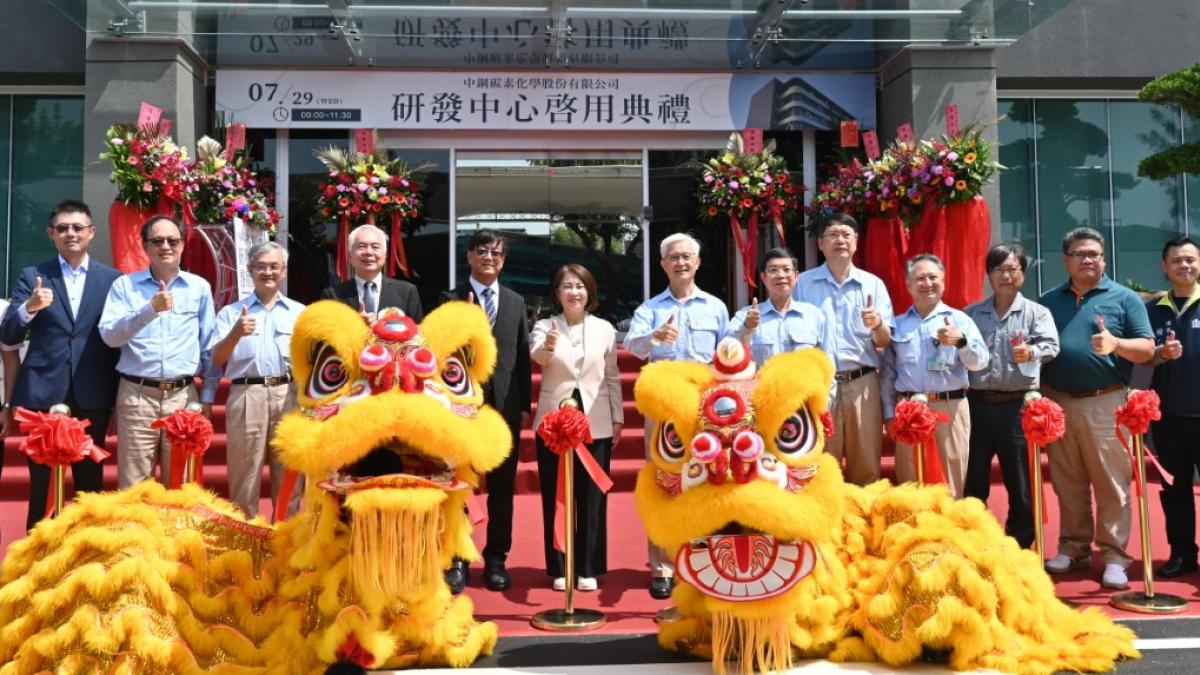
In response to the global energy transition and the rapid development of artificial intelligence (AI) driving demand for high-end carbon materials, Zhong Tai Carbon Chemical Company (Zhong Tai), a member of the China Steel Group, has officially launched its R&D center at the Pingnan Plant in Pingnan Industrial Park, Fangliao Township, Pingtung County, on the 29th, after investing NT$187 million. This marks a new milestone as the Pingnan Plant transitions from a production base to a 'dual-engine' model of 'R&D and production,' accelerating its strategic deployment into the high-end carbon materials markets for new energy and semiconductors.
The inauguration ceremony was attended by Pingtung County Magistrate Chou Chun-mi, Director-General Weng Ku-sung of the Ministry of Economic Affairs' Industrial Development Bureau, Director Wu Miao-wen of the Kaoping Branch of the Ministry's Industrial Parks Administration, Wu Yu-hsiang, Chairman of the Precision Carbon Association, as well as representatives from the China Steel Group and industry, government, academia, and research sectors, witnessing Zhong Tai's significant progress in the development of high-end carbon materials.
Zhong Tai Chairman Huang Chien-chih stated that since the Pingnan Plant began operations in 2019 (Year 108), it has continuously expanded its production capacity and currently possesses 4,000 tons of carbonization and 6,000 tons of graphitization capacity. The core product, 'mesophase graphite carbon microspheres,' is widely used in lithium-ion battery anode materials, meeting the demands of electric vehicles and energy storage systems for high energy density, high power density, and long life. With the rapid growth of AI servers, electric vehicles, energy storage equipment, and the semiconductor industry, Zhong Tai continues to invest in the development of new products such as advanced carbon materials and isotropic graphite. The R&D center will serve as a core driver for product innovation and operational upgrades.
Magistrate Chou emphasized that the launch of Zhong Tai's R&D center is an important milestone for Pingtung's industrial upgrading. The three R&D pillars closely align with global industrial trends and are consistent with Pingtung's efforts to build a technology industry cluster. Following TSMC's supply chain entering the Pingtung Science Park, the county government will continue to promote industrial park development and attract more high-tech enterprises to invest in Pingtung.
The Ministry of Economic Affairs' Industrial Development Bureau noted that crucibles, a key material in semiconductor manufacturing processes, have long relied on imports. In recent years, Zhong Tai has successfully developed high-purity carbon materials, graphite blocks, and crucible products, helping stabilize the domestic supply chain during periods of international graphite export restrictions, which is of great significance for enhancing Taiwan's self-reliance in critical materials.
Zhong Tai stated that the Pingnan Plant currently focuses on three core product areas: lithium-ion battery anode materials, advanced carbon materials, and isotropic graphite. Anode materials target applications such as drones, electric vertical takeoff and landing aircraft (eVTOL), electric racing cars, and high-end fast-charging smartphones. Advanced carbon materials target markets for supercapacitors, lithium-ion capacitors, and AI server backup batteries (BBU). Isotropic graphite focuses on crucible demand for silicon and silicon carbide crystal growth in the semiconductor industry, aiming to reduce reliance on imported key materials and enhance the resilience of the domestic supply chain.
Additionally, Zhong Tai will gradually introduce AI smart manufacturing and smart warehouse systems to improve product yield and logistics efficiency, while continuously expanding its R&D and production capacity. The board recently approved an expansion plan for 500 tons of advanced carbon materials and 720 tons of isotropic graphite at the Pingnan Plant, with a total investment of approximately NT$1.452 billion, to be implemented in two phases. The first phase is expected to be completed and operational by the first quarter of next year, further strengthening its market competitiveness.
FACT BOX
- Source: PR Times
- Category: Event